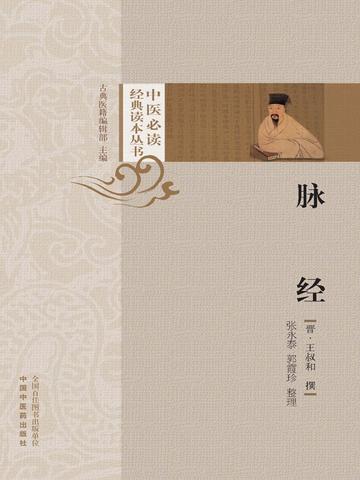
"Mai Jing" was written by Wang Shuhe of the Jin Dynasty and was written between 210 and 259 AD. It is the earliest existing monograph on the pulse theory of traditional Chinese medicine in China. Wang Shuhe, named Xi, "had a calm nature, and was especially good at writing. He was well versed in classic prescriptions, was meticulous in diagnosis, and had an insight into the way of self-cultivation (Song Dynasty Lin Yi and others submitted Zha Ziyu)." Using various pulse studies documents he searched for when he was an imperial physician, he first took the "Nei Jing", "Difficult Classic" and Zhang Zhongjing and Hua Tuo et al.'S discussion on pulse science was based on extensive quotations and group theories. Then based on his own clinical experience, he followed the method of "the root causes of all diseases are according to their categories", organized them according to categories, and carefully sorted them out. Finally, he completed the great work "Pulse Classic". The book consists of ten volumes and ninety-eight chapters. Volume 1 discusses the three parts and nine conditions, the Cunkou pulse and the twenty-four pulses; Volume 2 and Volume 3 combine the pulses with the internal organs and meridians, citing the deficiency and excess of yin and yang, and the similarities and differences of physical syndromes, as the basis for treatment; Volume 4 diagnoses the four seasons, distinguishes life and death from various diseases, and discusses pulse methods; Volume 5 discusses Zhong. Jing and Bian Que's Pulse Method; Volume 6 lists various meridians diseases and syndromes; Volumes 7 to 9 discuss the treatment of pulse syndromes, among which Volume 7 focuses on typhoid and febrile diseases, Volume 8 covers miscellaneous diseases, Volume 9 covers obstetrics and gynecology, and pediatric diseases and syndromes; Volume 10 discusses the eight extraordinary meridians and the pulses of the upper and lower limbs on the right side. The original "Thirty-One Manual Examination Pictures" has been lost. This publication is based on the engraving of Ye's Guangqin Bookstore in Gengwu, Yuan Dynasty (1330), and is collated.
Reader comments
"Mai Jing" is rich in content and covers many aspects of TCM pulse theory. It is a treasure among TCM classics. Based on the Three Parts and Nine Conditions, Cunkou Pulse, etc., This book discusses in detail the relationship between the pulse and the internal organs and meridians, and also lists the pulse syndrome treatments for various diseases. It reminded me of the Huangdi Neijing, both of which had a profound impact on the development of traditional Chinese medicine. When reading, we must pay attention to avoid being misled by wrong corrections and punctuation, so that we can better appreciate the profoundness of traditional Chinese medicine.
"Mai Jing" is rich in content and covers many aspects of TCM pulse theory. It is a treasure among TCM classics. Based on the Three Parts and Nine Conditions, Cunkou Pulse, etc., This book discusses in detail the relationship between the pulse and the internal organs and meridians, and also lists the pulse syndrome treatments for various diseases. It reminded me of the Huangdi Neijing, both of which had a profound impact on the development of traditional Chinese medicine. When reading, we must pay attention to avoid being misled by wrong corrections and punctuation, so that we can better appreciate the profoundness of traditional Chinese medicine.