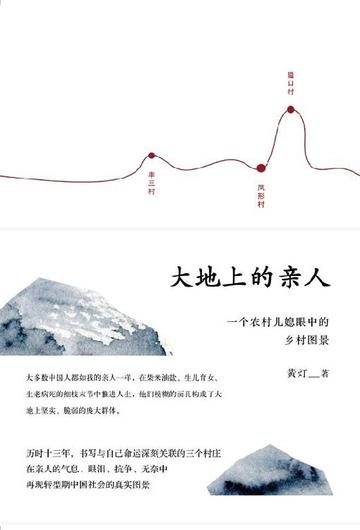
On the eve of the Spring Festival in 2016, an article titled "The Rural Scene in the Eyes of a Rural Daughter-in-law" described the changes in fate of three generations of her husband's family living in rural Hubei from the perspective of a rural daughter-in-law, triggering a national discussion on rural issues. Taking this opportunity, the author Huang Deng restructured his uninterrupted rural writing in the past thirteen years and wrote this book, which records in detail the ups and downs of the three village families where his in-laws' family, his own family, and his grandmother's family are located. Huang Deng's true, detailed and in-depth records and analysis of his relatives provide valuable samples for Chinese people to think about rural issues and Chinese social issues.
The three villages Huang Deng shows in the book - Fengsan Village, Fengxing Village, and Aikou Village, span the two provinces of Hunan and Hubei. Although they seem to have no connection with each other and are far apart, the challenges and crises faced by the relatives living here are almost the same because they share a common "peasant identity." In the process of social transformation over the past thirty years, modernity has wrapped up the mask of the city and completely penetrated into the villages and the people living here. Huang Leng uses the experiences of relatives to try to show the complex picture of farmers' relatives struggling with their destiny, questioning the origin and whereabouts of Chinese villages, and also revealing the inner incomprehension and confusion. In Huang Deng's works, the countryside is no longer a carrier of nostalgia, but a "problem field" in which intellectuals devote their knowledge and care - highlighting the truth, facing problems head-on, and looking for possibilities.
Reader comments
This book is very real. The author depicts the life in the countryside with delicate brushwork, which gave me a deeper understanding of the countryside. I like Huang Lan in the book. She cares about her relatives in the countryside in her own way and works hard to find the future of the countryside. "In an empty academic experience, if I am willing to indulge in conceptual deduction and academic illusion, it will be difficult for my life to have much intersection with the groups behind me." This sentence made me feel her struggle and confusion, and also made me think about my relationship with the countryside. All in all, this is a book worth reading!
This book is well written, with rigorous but not verbose prose. It provides an in-depth analysis of the helplessness and suffering of being a farmer. As long as they are farmers, they cannot get rid of suffering, which is a summary of Jingcun, because their fate can only be left to fate. This is the real helplessness in reality.
I felt particularly depressed and helpless when I saw some of the descriptions. This family is too helpless to save itself.
Although I was also born in a rural area, my understanding of it is far less profound than that of Teacher Huang Deng. I am very sorry.
The real situation in the vast rural areas is an archive of people's livelihood.
It's really good. I read it in one sitting. It's wonderful! ! !
It's super good-looking, and you can understand the relationship between personal destiny and the development of the times.

This book is very real. The author depicts the life in the countryside with delicate brushwork, which gave me a deeper understanding of the countryside. I like Huang Lan in the book. She cares about her relatives in the countryside in her own way and works hard to find the future of the countryside. "In an empty academic experience, if I am willing to indulge in conceptual deduction and academic illusion, it will be difficult for my life to have much intersection with the groups behind me." This sentence made me feel her struggle and confusion, and also made me think about my relationship with the countryside. All in all, this is a book worth reading!
This book is well written, with rigorous but not verbose prose. It provides an in-depth analysis of the helplessness and suffering of being a farmer. As long as they are farmers, they cannot get rid of suffering, which is a summary of Jingcun, because their fate can only be left to fate. This is the real helplessness in reality.
I felt particularly depressed and helpless when I saw some of the descriptions. This family is too helpless to save itself.
Although I was also born in a rural area, my understanding of it is far less profound than that of Teacher Huang Deng. I am very sorry.
The real situation in the vast rural areas is an archive of people's livelihood.
It's really good. I read it in one sitting. It's wonderful! ! !
It's super good-looking, and you can understand the relationship between personal destiny and the development of the times.