The full-speed advancement of modernism has caused the appearance of Japanese cities to change with each passing day. High-rise buildings covered with glass appear to be transparent and light, but the people living in them feel the increasingly thick divisions under this homogeneous architectural style, as if they are lifeless neutral existences. This wave also provides a stage for architects to show their individuality. Each piece of "artwork" is exquisite in shape, constantly moving towards the limits of form and technology, but far away from the essence of caring for people.
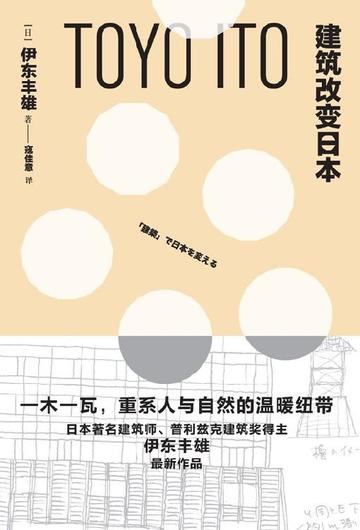
People's hope for a happy life on the other side of the building has constantly prompted the reflection of Japanese architect Toyo Ito. How does a library take care of people's different needs for light? How can a new office building respect people's feelings about seasonal temperatures? How can an island regain the glory of the interdependence between man and nature?
The author feels the changes in his thoughts in the past ten years. Through sorting out and contemplating the latest architectural projects such as "Everyone's Forest Gifu Media Center" and Ehime Prefecture's "Omishima Plan", he points out the limits of modernist architecture and shows the architectural possibilities of the interdependence between people and people and between people and nature in this era.
People shape buildings, and buildings shape people's lives. Return to simplicity and rethink the future of people and architecture.
Reader comments
Japan is in an earthquake zone and needs to worry about earthquake attacks at all times. In the process of fighting against earthquakes for many years, Japan's basic necessities, food, housing, and transportation have inevitably taken into account the hazards of incoming earthquakes. Their buildings are usually tree structures, pursuing simplicity and stability. Such buildings can usually remain intact under earthquake attacks. And those residents in earthquake zones have long been accustomed to natural disasters such as earthquakes. Earthquakes that occur frequently will no longer have the fatal blow and harm to their lives that they did before. The power of nature to destroy everything also prompts humans to constantly solve problems.
Japan, starting from the Meiji Restoration, became the first country in Asia to develop modernization. However, its rapid development has created inequality between rich and poor. As a result, Japanese architectural styles are layered, including ancient, medieval, and modern, with a hundred flowers blooming. The author of the book uses his professional knowledge to describe the impact of modern architecture on the Japanese people. From the combing of the three buildings, the architectural possibilities of the interdependence between modern people and nature are shown. Then think about the future of architecture and people.
Houses, buildings, pavilions and waterside pavilions, the architecture of a city also shows the style of a city. House architecture is not only people's expectation for a happy life but also their yearning for a happy family. As people's ideological and cultural levels continue to change, architectural preferences are also constantly changing. While people shape buildings, buildings also engrave people's inner thoughts. After Japan's huge tsunami, the reconstruction of buildings is also constantly affecting the Japanese people.
Mr. Toyo Ito's thoughts are very profound. He cares about the relationship between man and nature, which I agree with. This reminds me of Ba Academy in "Little Doudou by the Window", which is also a school that pays great attention to the relationship between nature and people. I think architecture should be like Ba Academy, making people feel happy and warm.



Japan is in an earthquake zone and needs to worry about earthquake attacks at all times. In the process of fighting against earthquakes for many years, Japan's basic necessities, food, housing, and transportation have inevitably taken into account the hazards of incoming earthquakes. Their buildings are usually tree structures, pursuing simplicity and stability. Such buildings can usually remain intact under earthquake attacks. And those residents in earthquake zones have long been accustomed to natural disasters such as earthquakes. Earthquakes that occur frequently will no longer have the fatal blow and harm to their lives that they did before. The power of nature to destroy everything also prompts humans to constantly solve problems.
Japan, starting from the Meiji Restoration, became the first country in Asia to develop modernization. However, its rapid development has created inequality between rich and poor. As a result, Japanese architectural styles are layered, including ancient, medieval, and modern, with a hundred flowers blooming. The author of the book uses his professional knowledge to describe the impact of modern architecture on the Japanese people. From the combing of the three buildings, the architectural possibilities of the interdependence between modern people and nature are shown. Then think about the future of architecture and people.
Houses, buildings, pavilions and waterside pavilions, the architecture of a city also shows the style of a city. House architecture is not only people's expectation for a happy life but also their yearning for a happy family. As people's ideological and cultural levels continue to change, architectural preferences are also constantly changing. While people shape buildings, buildings also engrave people's inner thoughts. After Japan's huge tsunami, the reconstruction of buildings is also constantly affecting the Japanese people.
Mr. Toyo Ito's thoughts are very profound. He cares about the relationship between man and nature, which I agree with. This reminds me of Ba Academy in "Little Doudou by the Window", which is also a school that pays great attention to the relationship between nature and people. I think architecture should be like Ba Academy, making people feel happy and warm.