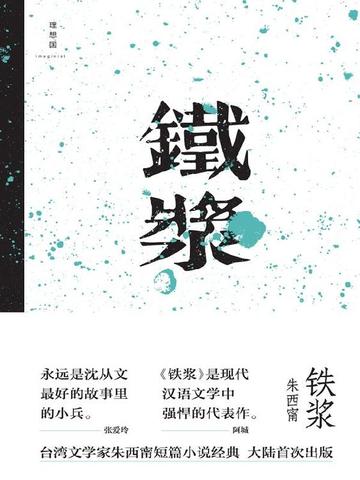
"The fossils of rouge, the fossils of tears, an ancient world, a little bit of eternity; they still illuminate a hazy modernity and future generations."
"Iron Slurry" is a short story collection by Taiwanese writer Mr. Zhu Xining. It includes nine classic short stories and is published in mainland China for the first time. Written in the 1960s in Taiwan, the work continues the tradition of vernacular novels of the May Fourth Movement and restores legendary figures and ancient events in northern rural market towns in the early years of the Republic of China. At the moment of conflict between traditional Chinese society and modern civilization, the countryside has become a stage for exploring the good and evil of human nature: Meng Zhaoyou, who committed suicide by drinking iron slurry while fighting for the salt business, Fu Ernu, the butcher who stirred people's hearts by eating in restaurants, and those who taught themselves medical books and killed themselves one after another. The family's Neng Ye... A group of hot-blooded little people resurrected the bloody nature of the Warring States Period and the national character that we don't know much about. They performed vendetta and redemption, chivalry and warmth, ignorance and civilization, all of which are tragedies that shock the soul. Mr. Acheng wrote a postscript: "Iron Slurry" is a powerful masterpiece in modern Chinese literature.
Reader comments
I especially like the scene in "Iron Slurry" where Meng Zhaoyou kills himself by drinking iron slurry. It's really frightening. The author's words are very powerful, as if they can take me back to that ancient era and feel the joys, sorrows and joys of those people. I think this is a book worth reading and I highly recommend it!
The aftertaste of May Fourth vernacular literature
I especially like the scene in "Iron Slurry" where Meng Zhaoyou kills himself by drinking iron slurry. It's really frightening. The author's words are very powerful, as if they can take me back to that ancient era and feel the joys, sorrows and joys of those people. I think this is a book worth reading and I highly recommend it!
The aftertaste of May Fourth vernacular literature
Strong logic and ups and downs of the story
Very beautiful, worth recommending