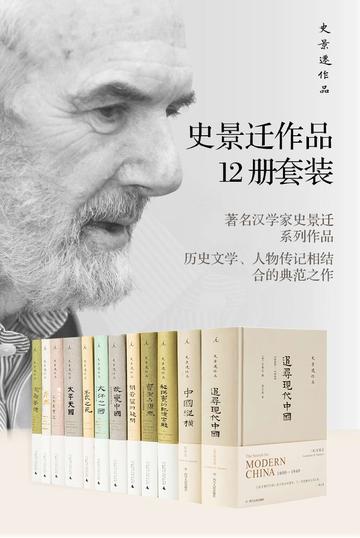
This collection brings together the following 12 works by Jonathan Spence:
The Search for Modern China takes the late sixteenth century as its starting point and traces changes in Chinese society, politics, economics, thought, and culture.
China in the World gathers some of Jonathan Spence’s most representative essays, reflecting his efforts to think about China as precisely, fairly, and perceptively as possible.
The Memory Palace of Matteo Ricci skillfully constructs a complete picture of two great civilizations meeting. We are also able to enter the memory palace Matteo Ricci built and watch him navigate an unfamiliar world, sometimes with conviction and sometimes with uncertainty.
Ts’ao Yin and the K’ang-hsi Emperor focuses on Cao Yin’s life as an imperial textile official in Jiangnan. It describes and examines the relationship between Qing rulers and the wealthy Jiangnan region and its leading figures, revealing the ethnic tensions and social conflicts beneath the surface of the Kangxi emperor’s prosperous reign.
The Question of Hu focuses on Hu Ruowang’s extraordinary adventures more than two hundred years ago and seeks to explain his questions through history and culture.
To Change China is about Western advisers in China. Over more than three centuries, from the 1620s to the 1950s, these people offered their exceptional skills for Chinese use. They first introduced theories of celestial motion and, in the end, showed the Chinese the astonishing sophistication of aerial warfare and atomic science.
The Chan’s Great Continent broadens our understanding of how intricate and often gripping encounters, clashes, and interactions between different cultures can be, sometimes stranger than anything in fiction.
The Death of Woman Wang is a literary account of life among the people of rural Shandong, in Tancheng and Zichuan, during the early Qing. One of its central figures, Woman Wang, crushed by the burdens of life, runs away with a lover, only to meet a tragic end at her husband’s hands.
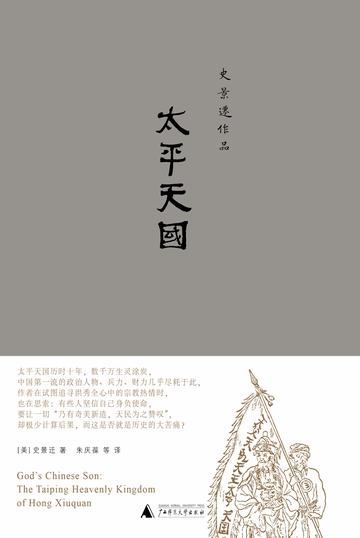
God’s Chinese Son provides a clear, orderly historical account that helps us understand Hong Xiuquan’s inner world and trace the logic behind his actions.
Treason by the Book recounts in fine detail how the remarkable book The Record of Great Righteousness and Bewilderment came to be written, circulated, and banned, along with the many intriguing and astonishing side stories that unfolded around it.
Kangxi tells the story through the emperor’s own voice, recounting his joys, fears, suspicions, regrets, and helplessness, as well as his memories and dreams, in order to probe his personality, thoughts, and state of mind.
Return to Dragon Mountain weaves family anecdotes into the upheavals and intermingled joys and sorrows of a great era. The splendor and desolation of Zhang Dai’s life gradually emerge amid the shifting interplay of dreams and memories.

Shi Jingqian's work is really great! With his delicate brushwork and rich historical materials, he made me feel as if I had traveled through the long river of history. In particular, the book "The Death of Wang" gave me a deeper understanding of the lives of rural people in the early Qing Dynasty. Thinking that I have also experienced the pressure of life, I can better understand Wang's helplessness and pain. These books are not only historical records, but also profound insights into human nature, which have benefited me a lot.
History should be the history of the people, not just the genealogy of kings, marquis and generals
Historians' remarks are helpful to read
Very nice, very good