Stats
9.5Score
9Chapters
Tags
Synopsis
Reader comments
In booklists 8
Nobel Prize for Literature, Mao Dun Literature Prize, Lu Xun Literature Prize and Other Literary Works
I want to read a book similar to "One Sentence is Worth Ten Thousand Sentences: Collector's Edition".
122.1MViews701Books2dUpdated
Masterpiece! ! ! a Chinese and Foreign Classic Book! ! !
94.6MViews930Books20hUpdated
Literary Masterpiece, (ㆁωㆁ)
84.9MViews748Books1dUpdated
Why Not Read Classics?
Recommend some good books that are meaningful, influential and well-written.
54.6MViews881Books9hUpdated
Books to Improve Your Sense of Chinese Language
I want to read books similar to "The Collection of Lu Xun (21 volumes in total)". I'm looking for books with stories that are more interesting and interesting.
8.3MViews455Books1dUpdated
A Must-Read for Chinese Language and Literature Majors
Are there any books that can actually help improve your writing and expression skills?
4.8MViews565Books19hUpdated
Literature Books, I Want Literature Books! ! !
Family members, I want to read literature books, books that can improve my writing skills or increase my knowledge. Beg on your knees!
3.1MViews739Books4hUpdated
Are There Any... Foreign Masterpieces... Chinese Masterpieces?
2MViews783Books5dUpdated
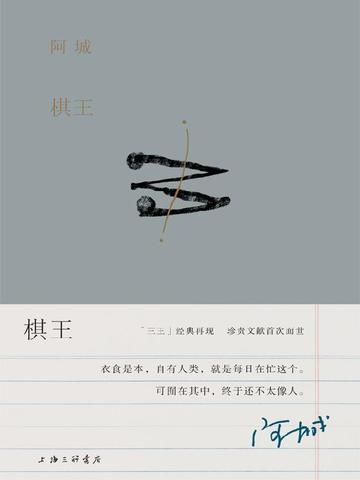
I liked this book very much when I read the title, and I really liked it after reading it. It can be said to be a condensed silhouette of Chinese chess culture. After reading it, you seem to appreciate the magic and grandeur of Chinese chess culture. The protagonist Wang is superb in chess. He has the cultural spirit of China that has been passed down for thousands of years. Watching him play chess is not only watching chess, but also seeing the history of our Chinese nation. A young man who is good at playing chess has a life experience in which he understands the art of chess. His love for chess allows him to follow it throughout his life. He is happiest when playing against others. There is a saying in the article, "People still need something to be alive." Yes, only if there is something worth doing in your life and you go all out, life will be meaningful and people will be happier.
The Chess King is one of the classics of the author's Three Kings novels. It has a very precious significance and contains its precious documents and very beautiful illustrations. Today's magazine. It also shows the warmth and demeanor of the craftsman Mr. Acheng. Judging from these secular novels, the protagonist in Qi Wang Zhongli is very heroic and realist, and the language in it is also relatively so, which critics are not familiar with. This is also one of the major features of this novel.
It's so well written, so good, it's as good as eating a bowl of fragrant beef noodles with three layers of meat when you're very hungry. I am a person who has a hard time reading books. After reading "The King of Chess", I read "Letter from a Strange Woman". Coincidentally, the next article in the letter was "The Story of Chess", which was also about the King of Chess, but while I was reading it, Wang Yisheng kept popping up in my mind. "The King of Chess" also reflects the times through personal writing, but the blank spaces in "The King of Chess" are precise and memorable. In comparison, "The Story of Chess" is a little acclimated, as boring as a salad without dressing. "The King of Chess" was so well written that I went back to watch "The King of Trees" for the first time. After finishing it, I closed it and went to watch the video. "King of Trees" is also very well written. Xiao Guda kept wandering in my mind and never let go of my video, so I opened "King of Children" again. After reading Three Kings, I realized how arrogant I am and how many treasures I have missed. It's so beautiful and so well written.
Understanding life on the black and white chessboard - Thoughts on reading "The King of Chess" Before reading "The King of Chess" by Acheng, I never thought that a novel with the theme of chess could touch my heart so deeply and give me a new understanding of life. The story of "The King of Chess" takes place in a special era. The protagonist Wang Yisheng is an educated youth obsessed with chess. He lived in poverty, his mother died young, and his father was an alcoholic. However, these difficulties did not diminish his love for chess. He went around looking for opponents to play chess, looking for his own world on the chessboard. In order to play chess, he would not eat or drink, and he would not even care about worldly views. This pure love is touching. In his world, chess is not only a hobby, but also a spiritual sustenance and a weapon for him to fight against the hardships of life. There are many details in the book that impressed me deeply. For example, Wang Yisheng's gobbling while eating and his cherishment of food show the hardship of his life; there is also the scene of him playing blind chess under the street lamp with an old man picking up scraps of paper. The old man's mystery and Wang Yisheng's persistence and seriousness make people feel the profoundness of chess skills and the charm of chess. These detailed descriptions vividly portrayed the characters and gave me a deeper understanding of the living conditions and spiritual world of people at that time. The reason why Wang Yisheng's chess skills are superb is not only because of his talent and diligence, but also because of his deep understanding of chess. He learned the principle of "playing chess rather than making a living" from an old man who picked up scraps of paper. He understood that the true meaning of playing chess is not about winning or losing, but about pursuing a kind of spiritual satisfaction and improvement of realm. In the games with many masters, he always maintained a peaceful mind, respecting his opponents and himself. This kind of reverence for chess earned him respect in the chess world, and also allowed him to find his own direction in life. From Wang Yisheng, I saw the power of dreams. No matter how difficult life is, as long as you have a dream in your heart, you will have the motivation to move forward. Wang's lifelong love for chess allowed him to persevere in difficult situations and eventually became a chess king. His story tells us that dreams, big or small, can come true as long as we work hard for them. At the same time, I was deeply inspired by his quality of sticking to the bottom line in the face of temptation. In real life, we will also face various temptations. Only by adhering to our own principles and bottom lines can we maintain a clear mind and not be swayed by desires. This novel also made me think about the relationship between individuals and the times. In that special era, although Wang Yisheng was in trouble, he was not overwhelmed by the torrent of the times. Instead, he found his own value and meaning through chess. This made me realize that no matter how the times change, we should maintain independent thinking and pursuit, not follow the crowd, and strive to create our own wonderful life under limited conditions. After reading "The King of Chess", I seemed to have experienced a spiritual baptism. It made me feel the beauty and tenacity of human nature, and also gave me a deeper understanding of life. In the future life, like Wang Yisheng, I will maintain my love for my dreams, stick to my bottom line, and strive to create my own wonderful chess game on the chessboard of life.
There are three short stories in the book, namely the Chess King, the Tree King, and the Child King. The three uncrowned kings are all idiots. The words in this book are very delicate, and the descriptions of some details make readers feel like they are there. Although they have never seen the scenes of that year, they can feel the appearance of the times in his words. In the short story "The King of Chess", the chess nerd only wants to be full and plays chess just to relieve his worries. He has no way out. He is still seeking spiritual pleasure and self-salvation. Wang Meng said that this is a tribute to people's wisdom, attention, energy and potential in special times. Playing chess is an attitude towards life and an application of philosophical thought. In the short film King of Trees, the description of the burning mountain is shocking. "The fire instantly blocked the top of the mountain. The flames on both sides met and soared hundreds of feet high, making people look up. The top of the flames licked the red bottom of the sky. I understood that I had never really seen fire, nor had I seen destruction, let alone rebirth. The mountain was completely boiling. Tens of thousands of big trees left the earth in the flames and rose into the sky. They seemed to be flying away, But they slowly fell down, collided with each other in the air, broke up, then rose up, floated down again, rose again, and rose again. The heat was coming from all directions, and my hair suddenly stood up, but I didn't dare to hold them, for fear that they would be brittle and break, and scatter into the air. The immediate emotional impact of "Kids King" is not as great as the previous two, but it has great stamina. When it is inconsistent with mainstream values, is it a compromise or a maverick? They couldn't understand the empty articles copied by the children and could not make progress. A barefoot teacher who did not follow common sense devoted himself to teaching the children how to read so that they could write clearly and explain their own affairs. Is this wrong?
"Chess King" He often starts re-arranging pieces before we even see that we are losing. "Tree King" The tree coughed and couldn't breathe. "Kid King" If your family has overnight food, you should not be the king of children. These are three sentences that made me stop and take notes. They are easy to understand and can be read in one sitting, but each article takes nearly two hours. Sometimes uncomfortable, sometimes snickering, it is really enjoyable to read and makes people intoxicated and unable to extricate themselves. [Like][Like]
Acheng's "Three Kings" series has no passionate shouting or deliberate sensationalism. It only uses calm and restrained pen and ink to describe the perseverance and dignity of ordinary people in special eras. It is the short story classic with the most character and background in contemporary literature. "The King of Chess" writes about life and spirit. Wang Yisheng's obsession with chess has never been a pastime, but the confidence to survive in troubled times. A mouthful of rough rice and a broken game of chess hide the simplest philosophy of life: No matter how poor the material is, the spirit can form a world of its own, maintaining inner order and freedom within the square inch of the chessboard. "The King of Trees" writes about nature and awe. A fight over cutting down trees illustrates the relationship between man and nature. The giant tree fell not only in the mountains and forests, but also in awe of the heaven and earth; Xiao Gida's silent guardianship is a silent resistance to barbaric transformation. It is full of desolation when read, and it also hides questions about the authenticity of life. "The King of Children" depicts truth and original intention. Not teaching according to the textbook, not writing empty-handed compositions, is the respect for knowledge and the protection of innocence in the lean years. There is no dramatic plot, but the most ordinary daily life is used to express the most authentic meaning of education: teaching children to speak the truth and keep their sincerity. Three works, three ordinary protagonists, three restrained and hot lives. Acheng uses line drawing-like words to peel away the hustle and bustle of the times and get straight to the depths of human nature: No matter what kind of predicament you are in, sticking to your heart, reverence for life, and adhering to the truth is the most amazing power. This is the spiritual foundation of the Chinese people, and it is also a literary treasure worth reading again and again.
The most touching article is "The King of Children". When "I" teach, practicality is the main consideration, and I have mentioned thinking about how to teach better many times. I am a responsible teacher who truly thinks about children. The scene where Wang Fu chopped down more than 200 bamboos for Ying Dictionary's family particularly touched me. In addition, it also writes about a lot of people. From it, you can feel the simplicity and kindness of the characters. The beauty is very good... The language is concise but very charming. The most impressive thing is that the ending is quite sudden but makes people feel that it is very appropriate to stop here. The rest of the blank space is left to our own imagination. After reading it like this, we can still ponder it for a long time. Oh, it is very amazing. "The white sun rises in the morning. My father walks on the mountain and walks into the white sun. I think my father has strength."
One story a day, read in just three days. The king of chess is the king of trees and the king of children. I like the article about the king of chess the most. Because there is an excerpt of this story in the middle school Chinese textbook, and I saw it here, I felt like seeing an old friend. Also, the entire story of The Chess King is more romantic. The romance I am talking about here is a technique, not the romantic kind. In the end, Wang Yisheng fought against nine people in a chess game, and people from the whole county came to watch the battle. It really felt like a martial arts competition in martial arts novels, and it was majestic. After reading these three articles, I feel a touch of sadness. I couldn't help crying after Wang Yisheng played chess. Before the death of the Tree King, I couldn't help crying when he mentioned the comrade who had his leg kicked off. I still wanted to cry when the Child King left school in the fog. I don't understand why. Wang Yisheng, I feel pity for him. He is a very charming figure, a chess fanatic, obsessed and powerful at the same time. In fact, I feel that Chinese people like this kind of crazy image. The purity of his obsession and the experience of regret at the same time make his image as a person even more pitiable. Well. Only sighs. I can see Xiao Geda, the King of Trees, very quickly. I read that there are some comments that always mention protecting the environment, but what I read is more regretful. This reminds me of a line in The Legend of Zhen Huan, probably because the misfortunes in this world never stop. When I saw Xiao Lida changing the trajectory of his life because of an orange when he was young, these words flowed out like water. Well. When that towering tree was cut down, I always imagined that some supernatural phenomena would appear to shock these ignorant and nature-reverent people. But there are no gods or ghosts in this world, and people at that time did not have a God's perspective, so how could they know what was right and wrong about going against the current? I thought about watching "People in the Alley" before. When I saw the protagonists seizing or missing the opportunities of the times, I felt that I would be able to stand at the forefront of the times. But that was not my time. When I think about how confused I am in life now, I realize how arrogant I am. The king of children. This article on "Kids King" has a deeper connection with me, as I am also a normal school student. When I treat students, I actually have some indifference towards my work. This is not to say that I see students being unsmiling, but that I am not willing to invest my emotions in making friends with students except in class. There are some good teachers like Kids King nowadays. I have several classmates who always love their students sincerely and call them Bao Zai Zai. I felt so disgusting, but I admired it from the bottom of my heart. I also felt that I was a hollow person, because my memories of those months of internship were of getting up early and revising the courseware repeatedly. I don't have much communication with my students outside of class. When students come to chat with me, I always don't know what to say. I'm not yet proficient in talking about truths like an old teacher, and I can't find a topic when chatting with friends. Well. Sometimes I feel that I am very indifferent. I rarely take the initiative to contact my friends when they are not around, and I gradually become alienated from many people. Although I am aware of the problem, I have never been able to change it. Maybe it's just for myself. Life is a journey of one person. Since I can't make friends with many people, I have to learn to get along with myself.
Thoughts after reading: Whether it is "The King of Chess", "The King of Trees" or "The King of Children", their protagonists have a simple persistence that does not contain worldly selfish thoughts, and is so persistent that it is almost crazy. It is their own unique way of living in the world, and it is their way of dealing with the relationship between material and spiritual, man and nature, reality and ideal. "The King of Chess" tells the story of the life of the chess nerd king. He has a good character and good chess skills. He refuses unfair profit-making methods and is principled. It can be seen from his nickname that he has an almost silly pursuit of playing chess. In the age of not having enough to eat, he was so thin that he seemed to have no butt, but he had a full spiritual world. He had a soul that was not simple but extremely simple. The part where his mother sharpened a wordless chess set for him was also extremely touching. She didn't understand chess, but she supported it. This was motherly love that didn't require any reason. Although his mother passed away, this love has always been with him. From the words "Mom" he shouted after winning the last and most exciting game of chess in the story, it can be seen that he is deeply attached to chess, and he also misses his mother deeply. The king of trees, Xiao Lida, fell down as the big tree fell to the ground. That was the life of a tree, the life of Xiao Lida, and the life of all the creatures in that mountain. He used his life to protect that mountain and that tree, and after the mountain and that tree died, he followed them. Under the catalysis of wind and rain, their flesh and blood merged and finally formed a symbiosis. Life is so precious, nature is so majestic, we must be in awe. Wang Fu's delicate observations in "King of Children" show the lack of educational resources, difficult conditions and students' exploration and desire for knowledge in that era. We see persistence, innocence and beauty in their teacher-student relationship. The chess king's state of unity during the decisive battle, the tree king's heartache when the tree was cut down and the fire broke out, and the child king's joy at seeing the students still diligently pursuing knowledge under such difficult conditions are all touching. No matter what the situation is, you should persevere.
Shen Congwen, Wang Zengqi, and Acheng's nature and simplicity are engraved in the bones of Chinese people [Adoration][Admiration][Admiration]
The novel is really well written, using a lot of detailed descriptions, and without fancy words, it can describe the characters vividly. Especially the section describing Wang Yisheng's eating experience is written in great detail. The last time I read this book was in high school, I just thought the story was interesting. In the blink of an eye, I am already a junior in college. Now that I am studying, I actually feel a sense of sadness.
Thoughts after reading "The King of Chess" The whole book is unfolded from the perspective of "I", a person who does not like to play Go and is not very interested in Go, and observes his friend Wang Yisheng and his bond with Go. This book is more about describing the atmosphere, demeanor, and movements of Wang Yisheng when he played Go with others, to show the style and superbness of his chess skills. The description of life also shows his simple but wise and principled outlook on life like running water. Life flows through him, yet nourishes each other. Because he is not a "chess madman" who "skips meals" just to play chess, but builds his own spiritual world on top of a fortress that guarantees his basic food and clothing. This is a "complete person". This is the "Chess King" in everyone's eyes. Although he is a bit "crazy" and a bit unique, if he could be understood by most people, he would not be the "Chess King".
In The King of Chess, Wang Yisheng's world is very simple. Having enough food is a blessing, and he can play chess all day long. In addition, the part about Wang Yisheng's mother is also very touching. Your mother is illiterate, but she knows that you love to play chess. Wang Yisheng also competes with others to play chess. For him, chess is his whole world. He is completely immersed in his world and formulates strategies like an emperor. I see the persistence and determination of little people in the tide of the times. The sympathy between the opponents is also very good. In King of Trees, I think it is a collision between faith and faith. Li Li believes that big trees block the growth of other trees, so useful trees should be planted. He even thinks that Xiaoguda is superstitious. Xiao Goda has already regarded the tree as his family, an inseparable existence. After the big tree was cut down, the faith of this "tree king" collapsed and he could not afford a serious illness. The sentence about burning mountains also aroused my thinking: "I realized now that I have never really seen fire, nor destruction, nor rebirth." Does what most people think must be right? But at that time we could only follow the brigade and obey the orders. In Kids King, I saw the rigidity of the education system. "Are these lessons really useful to them?" Wang Fu's essay about his father is really real and touching. His father, Wang Qitong, couldn't speak and was bullied in the team. Wang Fu wanted to learn more useful knowledge and help his father speak in the future. Everyone said that just teach them casually, since these students from the third grade of junior high school will not go to college anyway. This is not the case. Teaching and educating people must not be casual. In this article, you can see that the children are not ignorant. They have become wise and have their own desire to learn. But if we only teach things that are useless in the future, will it really be useful to them?
After reading three articles, they were short but very touching and left a lot to be desired. My parents are both educated youths. From the articles, I learned about the experience of my parents' generation going to the countryside. I especially like "The King of Children" and I feel overwhelmed after reading it. Those children in the mountains who do not have the opportunity to receive a good education may not be able to leave the mountains in their entire lives. Wang Fu is such a good boy.
Such a good book, allowing people to read it for free, really accumulates great virtue!
Three Kings is indeed one of the few books in modern China that can be called a good book. The King of Chess has a more philosophical atmosphere. Wang Yisheng has the feeling of a hermit. He only cares about eating, and then only chess is left. He does not care about the world, whether it is revolution or not. He only watches chess, and only chess. I feel that Acheng wants to tell us that it is extremely important to stick to one's heart even under the circumstances. The acting in the movie version is very good, but the depth is shallow, and there are a lot of meaningless shots; The King of Trees is a reflection on man and nature, and the picture is the most beautiful. , Also criticized the various one-sided felling at that time, regardless of whether it was useful or not, just blindly changing it, and finally ending with the death of the King of Trees. As the earliest article, it can be seen that the author wanted to say a lot; the last article, King of Children, felt more ordinary, and the author had nothing to say. It was more about worries about the education system at that time, and knowledge changing destiny. Nothing else, it was relatively simple, and it ended abruptly and was uninspiring.
The first time I read it was when my high school Chinese teacher printed it out. I immediately spent half a semester studying in self-study and read it in one go. At that time, I just realized that the author is talented and the language can be so polished. Today, when I read Bi Shu Wang, I sighed deeply. It has been a long time since the words have been so directly reflected in my heart. The trauma of the times can be portrayed from such a unique angle. The author's writing skills are evident.
The writing is really good, and the text reveals the sincerity of that era. The King of Trees and the King of Chess are all dedicated people for their own love. As for the King of Children, he is a serious and responsible person. Unfortunately, the reality is cruel and he has to compromise. That era was extreme, and people like them were scarce. . . All three articles are very interesting and exciting! ! !
It is a very delicate book, written around the connection between people and the outside world. After reading it, you will feel sadness, helplessness, warmth, and regret. It is worth savoring every word. Acheng's writing style is very comfortable, like a gust of wind from the forest, lingering and stretching just right. The lyrical time comes naturally. When narrating the story, it is calm and restrained, but not cold and rational. It is like a grandfather sitting at the door of his house, shaking a cattail leaf fan, telling his grandchildren stories about literary youth that have faded into the dust of the times.
The writing is so good, all kinds of small details and beauty are revealed in the ordinary. The hero in The King of Chess cherishes the hero, and the final one is a blockbuster. There is pity and stubbornness in King of Trees. The regrets in Children's King, the songs that were not taught, Laidi's thoughts, and the inheritance of dictionaries.
"The openness and freedom of writing and reading depend on our inner abilities."
I always think that art is a process, and novels are especially a process art, just like the art of drinking tea. The whole process of drinking tea, if it is just to quench thirst, the ancient Chinese called it "donkey drinking".
You can appreciate a lot of things by reading it. The King of Chess is breathtaking, the King of Trees is an indescribable sadness, and the King of Children is a sigh.
I haven't read many books, so I can't make too detailed a judgment. For me, the most impressive part of this book is at the end. There is not much description at the end, only some actions, etc., But it is full of human feelings under people's reverie. This touched me, and I thought it was a good book.
This book is divided into three chapters. The characters in front of each chapter seem plain and ordinary, and the text does not seem to be that modern and literary, but it is sonorous and powerful, making us feel as if we are on the scene. This way of expression is really rare! Not to mention anything else, just this alone, I highly recommend everyone to watch it. Especially the last part - the ending of "The King of Children", or to be precise, the ending sentence, which has a profound meaning!
A young prototype of a chess king, a simple temperament of a chess king, a tough character of a chess king, and a real chess king himself are all strung together in the article, which left my soul behind.
The novel's persuasion also lies in people's inner understanding. "The King of Chess" should be the author's inner realization and impulse. There are traces of the times. No matter what era, people have never stopped pursuing survival, nature and spirituality.
Although the Chess King is the most famous among these three articles, the order I like is the Child King, the Tree King, and the Chess King.
Simple and refreshing, with a long aftertaste