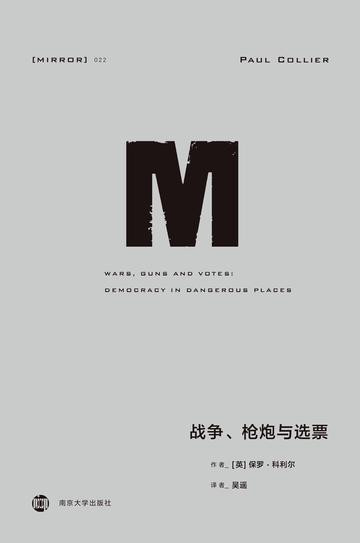
Why is political violence so common in extremely poor societies? How can it be contained? In areas with one billion of the poorest people in the world, such as Ethiopia, Uganda, Kenya and other African countries, their tribal traditions prevent the people from forming a national identity, and elections cannot prevent inter-tribal wars. Structural deficiencies in the countries in these regions have also prevented normal economic development, and the people can only rely on international assistance for basic necessities of life. Yet the fierce defense of sovereignty by the governments of small, poor countries, combined with the weakness and indifference of their leaders, radically limits what international action can actually achieve.
In War, Guns and Ballots, Paul Collier focuses on power, exploring why political violence is so common among the bottom billion and what can be done to curb it. In countries at the bottom of the world's economic ladder, violence has always been the main route to power. Political violence is a bane in itself and an obstacle to the establishment of accountable and legitimate government. He broke away from "election superstition" and suggested that through "co-governance" between the international community and extremely poor societies, the international community can control the inherent political violence in the country with the bottom billion people with only minor intervention. Only then can this destructive force, so far so powerful, be harnessed to turn disaster into blessing, turning the destructive force of democratic institutions into its defending force.
Paul Collier combines solid field research and rigorous statistical research and analysis, crosses political, economic, social and cultural boundaries, and uses a macro perspective to derive policy recommendations and prescribe medicine to the world's poorest one billion people. This book has very important cognitive value and guiding significance for Chinese people to understand the poverty situation and riot plight of the world's most backward areas, as well as the various current international suggestions and measures for intervention.
Reader comments
Unobjective naivety? …
At least for me, it's better to just feel pity, a kind of pity for idealism.
Whether it is Bai Zuo or wishful thinking, it is just a mode of trying to solve problems. For contemporary people, nations, countries, sovereignty, and even the boundaries randomly drawn by European powers are already like the "sacred land and sovereignty" after the Thirty Years' War in Europe, so that any discussion in this regard seems like hypocrisy.
This is reality. The reality is that there is no unity in the world. We have a deep hatred for each other, and everything has the most sensitive nerves.
Would such a discussion be pointless? I don't know how long it will take before I get the answer.
The logic is clear, the analysis is rigorous, the credibility is high, and the readability is strong.




Unobjective naivety? … At least for me, it's better to just feel pity, a kind of pity for idealism. Whether it is Bai Zuo or wishful thinking, it is just a mode of trying to solve problems. For contemporary people, nations, countries, sovereignty, and even the boundaries randomly drawn by European powers are already like the "sacred land and sovereignty" after the Thirty Years' War in Europe, so that any discussion in this regard seems like hypocrisy. This is reality. The reality is that there is no unity in the world. We have a deep hatred for each other, and everything has the most sensitive nerves. Would such a discussion be pointless? I don't know how long it will take before I get the answer.
The logic is clear, the analysis is rigorous, the credibility is high, and the readability is strong.