In 466 AD, Emperor Ming of Song, Liu Yu, and his nephew Liu Zixun, who had declared himself emperor in Xunyang, ruled side by side. The civil war nearly engulfed the entire Liu Song realm, then escalated into a war with Northern Wei.
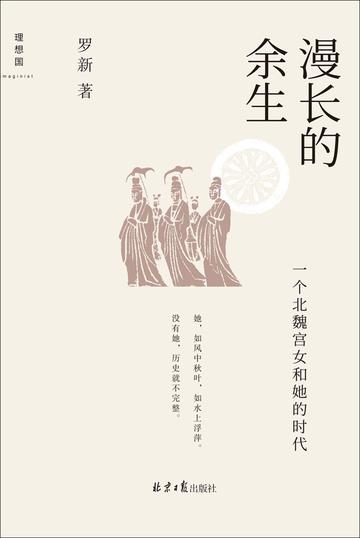
Wang Zhong'er was born into a family of mid-ranking officials in the Southern Dynasties. Swept into the conflict against her will, she lost her home and family. Two years later, at the age of thirty, she was captured and taken to Pingcheng Palace as an ordinary palace maid.
By a twist of fate, her life became entangled with the system of “the mother dies when her son is made heir.” She was unexpectedly drawn into the whirlpool of political power struggles and, first as a palace maid and later as a Buddhist nun, became a crucial figure in raising two generations of emperors. She would go on to live in the Northern Wei palace for fifty-six years.
Professor Luo Xin draws on historical sources such as Wang Zhong'er's epitaph to recount her long and tumultuous life. Through her eyes, he shows the age she lived in, restoring emperors, consorts, powerful maternal relatives, court officials, eunuchs, and palace maids as real people, and revealing the joy, suspicion, arrogance, and despair they felt in the face of power. Alongside Wang Zhong'er's story unfolds nearly eighty years of Northern Wei history, from Emperor Xianwen and Emperor Xiaowen to Emperor Xuanwu and Emperor Xiaoming, as well as the lives of countless people swept up in the era's raging tides.
We care about ordinary people from distant eras because they are part of real history. Without them, history is incomplete and unreal.
It comes from the Pingcheng era of the Northern Wei Dynasty. In fact, this period of history is not described from the perspective of a palace maid, but with her, this period of history becomes more warm and sad at the same time. The rest of my long life is just a grain of sand in the long river of history. I really like a sentence in the book: "History is different from stories: stories have a protagonist, a beginning, and an end, but history does not. Stories are rivers, with a source and an end. History is an ocean, with no beginning and no end."
The storyline of this book is so exciting! The author uses Wang Zhonger's life as a clue to show the nearly eighty-year history of the Northern Wei Dynasty, making me feel like I have traveled back to that era. Moreover, the writing style is very unique, the writing is concise and powerful, and it reads smoothly. I think this book is worth reading and I recommend it to you!
This book begins with Wang Zhonger's epitaph and Wang Zhonger's life as a clue, revealing to us the fact that in the feudal era, the Northern Wei Dynasty was nominally "the son dies, the mother dies", but in reality it was a redistribution of power. In this competition for power, how can you After singing, we take the stage. Every power holder has power for a short time like a meteor and then quickly dies, turning into wisps of gray smoke and blending into the thick smoke of history. Wang Zhonger used her long life to tell us that ordinary things are actually precious.
From the perspective of palace maids, the author elaborates on the political landscape and social changes of the Northern Wei Dynasty in the early Southern and Northern Dynasties. The information is detailed and the perspective is unique. It can not only enrich the understanding of this historical period, but also make people sympathize with ordinary people in the political whirlpool.
As a historical book, it is sophisticated but not boring, and has a unique entry point. It uses the life of a palace maid to connect the history of the Northern Wei Dynasty, and it is very sad to read it.
The flesh-and-blood life stories of the weak and marginalized characters are more intimate than cold history books.
Good! Read history carefully
In the grand historical narrative, in the billowing smoke and dust of the years, the life of an ordinary woman seems as light as floating dust.
I particularly like this kind of narration method that cuts through the cocoons, and the writing style that makes subtle sense.