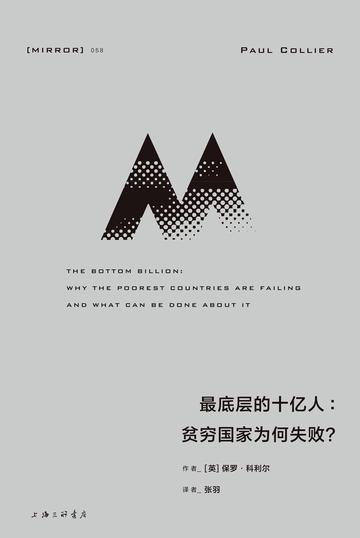
It is common knowledge that Africa is very poor. In order to explain the problem of poverty, the author of this book, Paul Collier, proposed the concept of the "bottom billion people". Most of them live in countries in sub-Saharan Africa, with long-term socioeconomic stagnation and no hope of improvement. In this book, Collier combines solid data and concise reasoning to analyze four types of traps that restrict the sustainable development of these poor countries: conflict, natural resources, being deeply landlocked and surrounded by evil neighbors, and bad governance. Whether these traps can be dealt with correctly will determine the future fate of the bottom billion people.
It has been more than ten years since this book was published. According to World Bank data, nine of the ten countries at the bottom of the world in terms of per capita GDP in 2021 are from Africa; if you turn the clock back to 2007, when this book was published, seven of the ten poorest countries in the world are from Africa. At the same time, problems caused by conflict, governance and natural resources remain unresolved, and population growth means that the number of people living at the bottom of the pile now exceeds one billion - Africa is not only poor, but getting poorer. Everything shows that reading Collier's book is not only still of profound practical significance in today's world, but also more urgent than in the past.
Reader comments
This book gave me a deeper understanding of poverty in Africa. The author's writing style is concise and clear, using data and truth to speak, which is very convincing. I hate the bad governance that gets the country into trouble and makes people's lives harder. This book is very practical and worth reading.



This book gave me a deeper understanding of poverty in Africa. The author's writing style is concise and clear, using data and truth to speak, which is very convincing. I hate the bad governance that gets the country into trouble and makes people's lives harder. This book is very practical and worth reading.