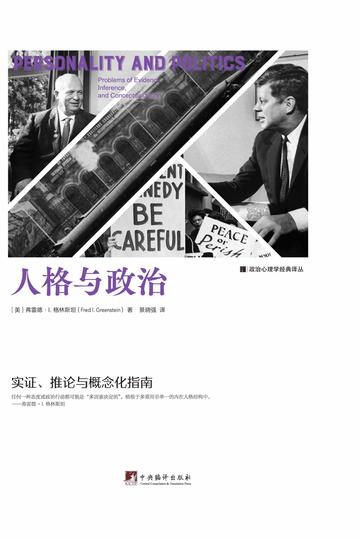
Focusing on the theme of how personality affects politics, the author discusses the great academic value, feasibility, and reality of research on personality and politics, constructs three research paths including case analysis, type analysis, and aggregate analysis, and proposes three research perspectives on the origins, dynamics, and roots of personality, and looks forward to the broad development prospects of this field. The entire book provides an important theoretical reference for optimizing research on the relationship between personality and politics.
Reader comments
Classic works do not lie in the meticulous care of minutiae, but in the eternal interpretation of the relationship between human nature and politics. Theory is gray, but the tree of life is evergreen; theory explains the past, and reality brings us hope. Over the past 100 years, the political world has been turned upside down. Ten years ago, it was difficult for us to imagine the political world 20 years from now. Classic works are answers to the most important questions of the current era and society. Times have changed and the development of the times has created new problems and also had new impacts on people's thinking.
It is very interesting to explore the relationship between personality and politics. Through a large number of empirical studies and case analyses, the book reveals the relationship between personality characteristics and individual political attitudes, political participation and political behavior. It explores the impact of personality traits on aspects such as voter behavior, political participation, leadership, and political decision-making, and theoretically conceptualizes and explains these relationships. Provide researchers and scholars with empirical research and theoretical frameworks on personality and politics.
Personality and politics are not independent of each other. On the contrary, they are closely related. In this book, the author discusses multiple connections between personality and politics, in which personality traits also have a certain impact on the development and performance of political leadership abilities and behaviors. Some personality traits, such as decisiveness, leadership, emotional stability, etc., May be associated with successful leadership roles in politics. Facing the relationship between the two can make us more clear about their development status.
Political psychology is a newly emerged discipline. It takes political issues as its research object and draws on the latest achievements in the development of psychology in terms of theory and method, thus providing innovative explanations for traditional research topics. Therefore, political psychology mainly focuses on the relationship between personality and politics. This book first introduces the mainstream research fields of political psychology, and on the basis of refuting objections one by one, summarizes and reflects on the existing three research paths of case analysis, type analysis and aggregate analysis, and finally gives thoughts on the future development of the discipline.





Classic works do not lie in the meticulous care of minutiae, but in the eternal interpretation of the relationship between human nature and politics. Theory is gray, but the tree of life is evergreen; theory explains the past, and reality brings us hope. Over the past 100 years, the political world has been turned upside down. Ten years ago, it was difficult for us to imagine the political world 20 years from now. Classic works are answers to the most important questions of the current era and society. Times have changed and the development of the times has created new problems and also had new impacts on people's thinking.
It is very interesting to explore the relationship between personality and politics. Through a large number of empirical studies and case analyses, the book reveals the relationship between personality characteristics and individual political attitudes, political participation and political behavior. It explores the impact of personality traits on aspects such as voter behavior, political participation, leadership, and political decision-making, and theoretically conceptualizes and explains these relationships. Provide researchers and scholars with empirical research and theoretical frameworks on personality and politics.
Personality and politics are not independent of each other. On the contrary, they are closely related. In this book, the author discusses multiple connections between personality and politics, in which personality traits also have a certain impact on the development and performance of political leadership abilities and behaviors. Some personality traits, such as decisiveness, leadership, emotional stability, etc., May be associated with successful leadership roles in politics. Facing the relationship between the two can make us more clear about their development status.
Political psychology is a newly emerged discipline. It takes political issues as its research object and draws on the latest achievements in the development of psychology in terms of theory and method, thus providing innovative explanations for traditional research topics. Therefore, political psychology mainly focuses on the relationship between personality and politics. This book first introduces the mainstream research fields of political psychology, and on the basis of refuting objections one by one, summarizes and reflects on the existing three research paths of case analysis, type analysis and aggregate analysis, and finally gives thoughts on the future development of the discipline.