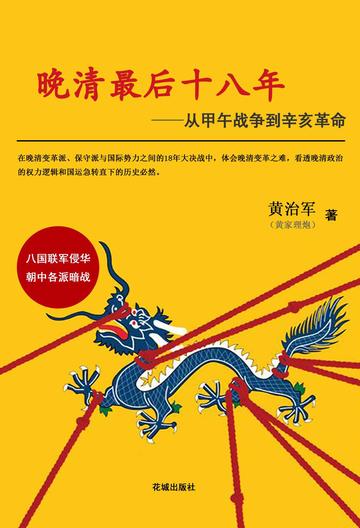
The Final Eighteen Years of the Late Qing: From the First Sino-Japanese War to the Xinhai Revolution
晚清最后十八年:从甲午战争到辛亥革命
- Status
- Completed
- Length
- 265k Words
- Genre
- Historical
- Subgenre
- Unknown
- Updated
- 3y ago
- Source
- Fanqie
Synopsis
24Chapters
8.5Score
More by this author
In booklists 4
Books That Teach You Things and Help You Learn
It’s purely to help with studying. Don’t get the wrong idea.
1.1kBooks22.3MViews2dUpdated
Historical Novels Set at the End of the Han, Sui, Tang, Northern Song, Ming, or Qing Dynasties
699Books12MViews3dUpdated
Stories About the Qing Dynasty, Preferably the Late Qing, for Male Readers 🌝
362Books10.6MViews3dUpdated

Warlord Novels With a Golden Finger, Set During the Opium War or the Eight-Nation Alliance Invasion
Looking for warlord novels with a golden finger, set during events like the Opium Wars or the Eight-Nation Alliance invasion. The protagonist should be reborn in that era and change history, without sucking up to anyone.
37Books32.2kViews1moUpdated
Reader comments 15
Translated by Google Translate
The late Qing Dynasty was an era of poor people's livelihood and internal and external troubles. In that war-torn era, China faced internal political corruption and external aggression. That is an era that every Chinese will remember. China's land was divided up, China's power was deprived of power, and every unequal treaty we signed was giving up our national sovereignty. Understanding this part of history will help us understand that all victories are hard-won, must be achieved and cherished.
The thinking of the Qing Dynasty is deeply rooted, even though it is constantly undergoing reforms, reforms, and movements, it actively absorbs advanced foreign ideas. It is also a gold and jade appearance, because the Qing Dynasty was essentially a feudal society, and no matter how much it was changed, it would not help! ! !
This book tells the historical story of the eighteen years from the Sino-Japanese War of 1891 to the Revolution of 1911. After the disastrous defeat in the Sino-Japanese War of 1898, the Westernization faction completely lost power, and the Reform faction came to power, from Li Hongzhang to Kang Youwei. Times did not get better, and the original intention of learning from the West unknowingly became a tool for careerists. Reform is the consensus of everyone, but there are always people who pursue profit, enriching themselves in the turmoil, and making the situation a mess. The interest choices and power games behind these are very clearly written in this book.
Japan's Meiji Restoration made Japan a modern country, but in the late Qing Dynasty it was still an old system. Failed in the end The first book I read in 2023, wonderful. If you fall behind, you will be beaten. The Qing Dynasty encountered changes unprecedented in three thousand years. The economy and system of the agricultural society were lost to the strong ships and guns of the industrial society. By defeating the Qing Dynasty, the Japanese made the world re-recognize the two countries. The law of the jungle is also between countries, and the weak eat the strong. Japan was enriched by ceding territory and paying indemnities. In fact, only by constantly striving for self-improvement and becoming stronger can Japan not be bullied.
The last eighteen years of the late Qing Dynasty were filled with various failed wars against invasion. I like this book's analysis of the root causes of war, part of which is the ability of commanders. "In fact, all opportunities come from taking risks. Sometimes, the greater the risk, the greater the opportunity. As a military commander, his most important job is to take risks, make decisions, and issue orders. This order can be carefully considered and weighed repeatedly before it is issued, but a person who is indecisive is by no means an excellent commander." This sentence is also very useful today.
Because of my professional needs, I often have to deal with various history books. I like the extravagant and interesting history books such as "Those Things in the Ming Dynasty". You need "Twenty-Four Histories" and "Historical Records" to record objective historical facts. But looking at the 5,000-year history of our country, the last thing I want to read is China's modern history. China's modern history can be called a humiliating history of resistance. The Chinese nation shed blood and tears, but still could not resist the invasion of foreign powers. In the end, it paid a huge price to gradually achieve its current status. The Sino-Japanese War of Sino-Japanese War represented to some extent the beginning of earth-shaking changes in the international status of China and Japan. From a small subsidiary country that needed to pay tribute in ancient times to a powerful power that invaded the sovereign state, Japan's transformation in national identity has made all Chinese who have seen modern history feel humiliated.
The writing style of this book is very interesting, like telling a story, and it clearly explains the complicated historical events of the late Qing Dynasty. Moreover, the author's writing style is also good, and he has a sense of humor, which made it easy for me to read. It feels a bit like "Those Things in the Ming Dynasty", which tells history in an easy-to-understand way. The characters in the book are also very interesting, especially the Empress Dowager Cixi and Yuan Shikai. Their power struggle reminded me of the intrigues in Game of Thrones. Overall, this book is well worth reading.
Huang Zhijun focuses on the history of the late Qing Dynasty. In order to find out the roots and answer the questions in his heart about the fall of the Qing Dynasty, he has read more than a hundred historical materials on the Sino-Japanese War of 1894-1895 alone. This book tells the history that happened in the last eighteen years of the late period, from the Westernizationist Li Hongzhang's fall from power, the reformist Kang Youwei's rise to power, the Boxer Rebellion, the Eight-Power Allied Forces' invasion of China, the Wuchang Uprising and other historical events. It sees through the layers of strange historical fog and the extremely clear power logic behind it. Douban Reading provides in-depth analysis to unearth the roots behind it.
Very pertinent, not blindly criticizing or praising
Only when China looks at the backwardness, will it cherish today's hard-won achievements.