Why did the Jade Emperor send Sun Wukong to look after the Peach Garden? Why can't Monkey King, the great sage who once caused havoc in the Heavenly Palace, defeat many monsters? Why did Tang Monk obtain the Wordless Sutra for the first time? Why does the somersault cloud also happen to be thousands of miles away? What is the cloud road, and what is the main road? ... "Journey to the West" seems to contain many mysteries, but in fact there is a profound philosophy hidden behind it. This book is not a "big talk" or a "joke", but on the basis of being loyal to the original work, it focuses on understanding the life implications of "Journey to the West", allowing readers to get inspiration from relaxed reading and feel the power of the classic work in a subtle way.
Reader comments
As one of China's four great classics, "Journey to the West" will give us different insights when we read it at different stages of our lives. When I was young, I marveled at Sun Wukong's seventy-two transformations; when I was young, I liked Zhu Bajie's defiant and humorous spirit of defying the sky, the earth, and his master; it was only in middle age that I developed empathy with the unknown Junior Brother Sha; and I only understood Tang Monk's Buddhist realm in his sixties. The author explains it from a philosophical perspective. Through the four masters and apprentices going through eighty-one hardships, it contains philosophical thoughts and has guiding significance for our lives.
Many interpretations of Journey to the West are joking and amusing, but this book is based on the original work of Journey to the West and believes that Journey to the West has important implications for our lives. It attributes the theme of "Journey to the West" to "cultivating the mind", and the process of seeking scriptures from the West is also the process of "cultivating the mind". Some of the specific interpretations are quite innovative, such as why is Sun Wukong a stone and why is it a monkey? Why did the Jade Emperor let monkeys take care of the peach garden? Why did Sun Wukong's somersault cloud also happen to be 18,000 miles away? What is the cloud road and the main road? Why did Monk Tang get the wordless sutra for the first time? Why did he have to change the customs clearance document every time he went? Etc... It can allow people to understand more philosophy of life behind the interesting stories of Journey to the West.
This book is an interpretation of the text of "Journey to the West" from the perspective of "cultivation of the mind", and presents the philosophy of life in this famous book in three parts: self, life, and wisdom. It is worth noting that the author's interpretation strives to be faithful to the original work, and at the same time conducts a social scientific analysis of "Journey to the West" with the help of modern philosophical ideas. For example, at the beginning of the "Self" section, the author points out that the setting of Sun Wukong's "stone" has two meanings: one is infinite possibility in the sense of existence, and the other is primitive nature in nature, and uses Freud's "id, ego, superego" thoughts to point out the tension of his mind cultivation. There are many more analyzes like this.
As one of China's four great classics, "Journey to the West" will give us different insights when we read it at different stages of our lives. When I was young, I marveled at Sun Wukong's seventy-two transformations; when I was young, I liked Zhu Bajie's defiant and humorous spirit of defying the sky, the earth, and his master; it was only in middle age that I developed empathy with the unknown Junior Brother Sha; and I only understood Tang Monk's Buddhist realm in his sixties. The author explains it from a philosophical point of view. Through the four masters and apprentices going through ninety-nine and eighty-one difficulties, it contains philosophical thoughts and has guiding significance for our lives.
A thousand people are a thousand Hamlets. The key is to have the heart to surpass yourself, to deny the negation, and to think critically. Why is your world single? It's because you choose to follow blindly and forget to examine and have your own perspective!
This is a good book. Although it is not a novel, it makes people want to put it down. I think the views in this book are very correct. There are various versions of interpretations. Personally, I like this one the best.
I just got married and was very enlightened after reading this book. It is not a simple "big talk" or "joking", but a deep exploration of the life implications of "Journey to the West" based on the original work. I particularly like the view on "cultivation of the mind" in the book, just like Sun Wukong's learning at Lingtai Fangcun Mountain, which is a process of "cultivation of the mind". Isn't this the same in our lives? After getting married, you must continue to "cultivate your mind" and learn to understand and tolerate. This book gave me a new understanding of "Journey to the West", and I recommend it to you!
Based on the original work of "Journey to the West", the author describes in detail the philosophy of life hidden behind the original work from the three perspectives of "self", "life" and "wisdom". The book often quotes Wu Cheng'en's original sentences, incorporating the author's own opinions on a reasonable basis. Start with the philosophy of life and find answers in familiar stories from classics. The author's language is lively but thought-provoking. After reading this book, I not only relived my childhood, but also found a new self in the baptism of time.
The most familiar story to us when we were children was the story of Sun Wukong and Monk Tang seeking Buddhist scriptures from the West. This book gives some unique insights into this story, allowing us to better understand the philosophy of life and profound wisdom it contains as a famous book. In this book, we can understand the connotation and charm of "Journey to the West" that we couldn't understand when we were young and couldn't understand it. We can achieve a deeper understanding of the famous book and improve our ability and level in dealing with people.
Life is perception
Very good, there are many unexpected things
After reading the whole book, I gained a profound understanding and gained a lot.
Just as the Qing Dynasty writer Zhang Shushen said in "New Journey to the West": "In this life, everyone has his own righteousness, that is, everyone has his own scriptures, and each has his own path to the West." The scriptures of life are to be understood and practiced by oneself. The so-called "Buddha is in Lingshan, don't look far away, Lingshan is only in your heart. Everyone has a Lingshan Pagoda, so that he can practice under the Lingshan Pagoda." (Chapter 85) - excerpt from the original text.
Integrating life insights into the interpretation of classics has indeed opened up some new interpretation ideas. Although some opinions may not be tenable, who's life is completely correct? No, so it's good to have your own life, your own perceptions, and your own opinions.
Interpret Journey to the West from the perspective of spiritual practice rather than conspiracy theory. If you don't have time to read the original Journey to the West, you can read this one.
The summary is good, you can compare it with Professor Jin Haifeng's interpretation of Journey to the West
"Journey to the West" was a must-read during my childhood summer vacation. I thought it was the most familiar book among the four famous classics. However, after reading this book, I realized that I didn't understand it at all. I don't even know why Tang Monk went to get scriptures? Who really needs to seek scriptures? What is the real purpose (motivation to be precise) of the four masters and disciples in seeking scriptures? This book is quite worth reading.
A very good book
I understand the difference between joining the world and being born out of it.
You have to get involved in the world and feel the joy, anger, sorrow, joy and growth of the character with your heart.
You must also tell yourself with a transcendental heart that everything is impermanent and everything is just experience, without attachment. Once you have experienced it, let it go. Don't ask about right or wrong, don't ask about gains and losses!
The insights are unique and refreshing.
Suddenly enlightened and enlightened!
If you use Write and Read, you can come here to read an excerpt and then hand it over.
A great book. I saw things I didn't know in the TV series.
It's quite good. There are a lot of details that I haven't seen in the TV series. I got to know the four masters and apprentices from different perspectives. The book also contains a lot of life philosophy.
Highly recommended! A rare book! The author's unique insights are very beneficial!
The most familiar story to us when we were children was the story of Sun Wukong and Monk Tang seeking Buddhist scriptures from the West. This book gives some unique insights into this story, allowing us to better understand the philosophy of life and profound wisdom it contains as a famous book. In this book, we can understand the connotation and charm of "Journey to the West" that we couldn't understand when we were young and couldn't understand it. We can achieve a deeper understanding of the famous book and improve our ability and level in dealing with people.
2024.2.4 Finished reading, life is a practice, you and I are both Buddhist practitioners🙏🙏🙏
Everyone has their own sutras. Where are the sutras? In heart
After experiencing hardships, you learn to cultivate your mind and obtain the true scriptures.
There is an epiphany, easy to understand
The wordless sutra is the true sutra, and the true sutra has already been integrated into the flesh and blood on the way westward. There is no spiritual "sutra" that can solve all problems. You and I are all pilgrims.
You and I are both Buddhist scripture seekers, and life is a long journey. In life, we learn to learn from scriptures, and the journey of learning scriptures is the road of life. Everyone learns the sutras differently, and the sutras are in the heart.
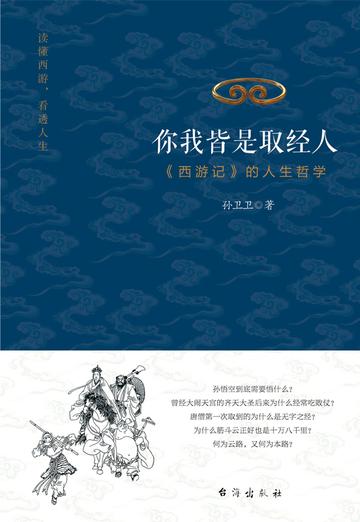

As one of China's four great classics, "Journey to the West" will give us different insights when we read it at different stages of our lives. When I was young, I marveled at Sun Wukong's seventy-two transformations; when I was young, I liked Zhu Bajie's defiant and humorous spirit of defying the sky, the earth, and his master; it was only in middle age that I developed empathy with the unknown Junior Brother Sha; and I only understood Tang Monk's Buddhist realm in his sixties. The author explains it from a philosophical perspective. Through the four masters and apprentices going through eighty-one hardships, it contains philosophical thoughts and has guiding significance for our lives.
Many interpretations of Journey to the West are joking and amusing, but this book is based on the original work of Journey to the West and believes that Journey to the West has important implications for our lives. It attributes the theme of "Journey to the West" to "cultivating the mind", and the process of seeking scriptures from the West is also the process of "cultivating the mind". Some of the specific interpretations are quite innovative, such as why is Sun Wukong a stone and why is it a monkey? Why did the Jade Emperor let monkeys take care of the peach garden? Why did Sun Wukong's somersault cloud also happen to be 18,000 miles away? What is the cloud road and the main road? Why did Monk Tang get the wordless sutra for the first time? Why did he have to change the customs clearance document every time he went? Etc... It can allow people to understand more philosophy of life behind the interesting stories of Journey to the West.
This book is an interpretation of the text of "Journey to the West" from the perspective of "cultivation of the mind", and presents the philosophy of life in this famous book in three parts: self, life, and wisdom. It is worth noting that the author's interpretation strives to be faithful to the original work, and at the same time conducts a social scientific analysis of "Journey to the West" with the help of modern philosophical ideas. For example, at the beginning of the "Self" section, the author points out that the setting of Sun Wukong's "stone" has two meanings: one is infinite possibility in the sense of existence, and the other is primitive nature in nature, and uses Freud's "id, ego, superego" thoughts to point out the tension of his mind cultivation. There are many more analyzes like this.
As one of China's four great classics, "Journey to the West" will give us different insights when we read it at different stages of our lives. When I was young, I marveled at Sun Wukong's seventy-two transformations; when I was young, I liked Zhu Bajie's defiant and humorous spirit of defying the sky, the earth, and his master; it was only in middle age that I developed empathy with the unknown Junior Brother Sha; and I only understood Tang Monk's Buddhist realm in his sixties. The author explains it from a philosophical point of view. Through the four masters and apprentices going through ninety-nine and eighty-one difficulties, it contains philosophical thoughts and has guiding significance for our lives.
A thousand people are a thousand Hamlets. The key is to have the heart to surpass yourself, to deny the negation, and to think critically. Why is your world single? It's because you choose to follow blindly and forget to examine and have your own perspective!
This is a good book. Although it is not a novel, it makes people want to put it down. I think the views in this book are very correct. There are various versions of interpretations. Personally, I like this one the best.
I just got married and was very enlightened after reading this book. It is not a simple "big talk" or "joking", but a deep exploration of the life implications of "Journey to the West" based on the original work. I particularly like the view on "cultivation of the mind" in the book, just like Sun Wukong's learning at Lingtai Fangcun Mountain, which is a process of "cultivation of the mind". Isn't this the same in our lives? After getting married, you must continue to "cultivate your mind" and learn to understand and tolerate. This book gave me a new understanding of "Journey to the West", and I recommend it to you!
Based on the original work of "Journey to the West", the author describes in detail the philosophy of life hidden behind the original work from the three perspectives of "self", "life" and "wisdom". The book often quotes Wu Cheng'en's original sentences, incorporating the author's own opinions on a reasonable basis. Start with the philosophy of life and find answers in familiar stories from classics. The author's language is lively but thought-provoking. After reading this book, I not only relived my childhood, but also found a new self in the baptism of time.
The most familiar story to us when we were children was the story of Sun Wukong and Monk Tang seeking Buddhist scriptures from the West. This book gives some unique insights into this story, allowing us to better understand the philosophy of life and profound wisdom it contains as a famous book. In this book, we can understand the connotation and charm of "Journey to the West" that we couldn't understand when we were young and couldn't understand it. We can achieve a deeper understanding of the famous book and improve our ability and level in dealing with people.
Life is perception
Very good, there are many unexpected things
After reading the whole book, I gained a profound understanding and gained a lot. Just as the Qing Dynasty writer Zhang Shushen said in "New Journey to the West": "In this life, everyone has his own righteousness, that is, everyone has his own scriptures, and each has his own path to the West." The scriptures of life are to be understood and practiced by oneself. The so-called "Buddha is in Lingshan, don't look far away, Lingshan is only in your heart. Everyone has a Lingshan Pagoda, so that he can practice under the Lingshan Pagoda." (Chapter 85) - excerpt from the original text.
Integrating life insights into the interpretation of classics has indeed opened up some new interpretation ideas. Although some opinions may not be tenable, who's life is completely correct? No, so it's good to have your own life, your own perceptions, and your own opinions.
Interpret Journey to the West from the perspective of spiritual practice rather than conspiracy theory. If you don't have time to read the original Journey to the West, you can read this one.
The summary is good, you can compare it with Professor Jin Haifeng's interpretation of Journey to the West
"Journey to the West" was a must-read during my childhood summer vacation. I thought it was the most familiar book among the four famous classics. However, after reading this book, I realized that I didn't understand it at all. I don't even know why Tang Monk went to get scriptures? Who really needs to seek scriptures? What is the real purpose (motivation to be precise) of the four masters and disciples in seeking scriptures? This book is quite worth reading.
A very good book I understand the difference between joining the world and being born out of it. You have to get involved in the world and feel the joy, anger, sorrow, joy and growth of the character with your heart. You must also tell yourself with a transcendental heart that everything is impermanent and everything is just experience, without attachment. Once you have experienced it, let it go. Don't ask about right or wrong, don't ask about gains and losses!
The insights are unique and refreshing.
Suddenly enlightened and enlightened!
If you use Write and Read, you can come here to read an excerpt and then hand it over.
A great book. I saw things I didn't know in the TV series.
It's quite good. There are a lot of details that I haven't seen in the TV series. I got to know the four masters and apprentices from different perspectives. The book also contains a lot of life philosophy.
Highly recommended! A rare book! The author's unique insights are very beneficial!
The most familiar story to us when we were children was the story of Sun Wukong and Monk Tang seeking Buddhist scriptures from the West. This book gives some unique insights into this story, allowing us to better understand the philosophy of life and profound wisdom it contains as a famous book. In this book, we can understand the connotation and charm of "Journey to the West" that we couldn't understand when we were young and couldn't understand it. We can achieve a deeper understanding of the famous book and improve our ability and level in dealing with people.
2024.2.4 Finished reading, life is a practice, you and I are both Buddhist practitioners🙏🙏🙏
Everyone has their own sutras. Where are the sutras? In heart
After experiencing hardships, you learn to cultivate your mind and obtain the true scriptures.
There is an epiphany, easy to understand
The wordless sutra is the true sutra, and the true sutra has already been integrated into the flesh and blood on the way westward. There is no spiritual "sutra" that can solve all problems. You and I are all pilgrims.
You and I are both Buddhist scripture seekers, and life is a long journey. In life, we learn to learn from scriptures, and the journey of learning scriptures is the road of life. Everyone learns the sutras differently, and the sutras are in the heart.