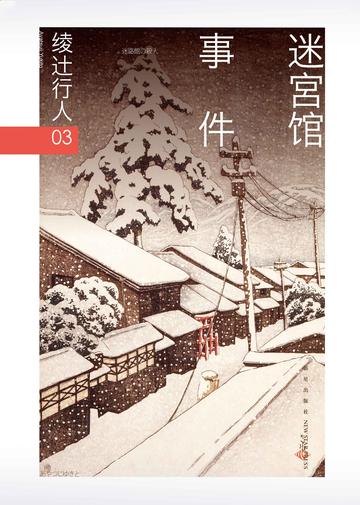
Mystery novelist Miyagaki Haitaro invited four of his best students to attend his birthday party. The banquet was held at the Labyrinth Hall, which was laid out like a maze. However, when the four writers arrived, the old writer Miyagaki had died, and his last words stated that the four writers should write a novel with the "Maze Hall" as the scene and himself as the victim within five days, and the one who writes the best will receive his huge inheritance. The four writers naturally worked hard and showed their talents, but they died unexpectedly one after another, and the way of death was exactly the same as what was written in their novels...
Reader comments
The double narrative is very good, and it feels very good to have reversals all the time. By the way, does the author plan to drop the name Shimada Kiyoshi from this game on? After all, it's a name that's been associated with Shoji Shimada too much, so maybe he wants to start his own business!
It is no exaggeration to say that there are twists and turns, no matter how big or small, until the last page of the novel. This feeling is so refreshing. This is the mystery novel I pursue. Although I still vaguely guessed the details and the murderer written by Kadani Kadani in the maze hall, the final ending still surprised me!
Compared with the Waterwheel Hall, the maze hall's tricks are a step up in excitement.
Yukito Ayatsuji is extremely good at rendering the gloomy environment in the Blizzard Villa mode. This book uses the maze as the main stage, and uses the perspective of editor Udoyama many times to deliver an immersive and thrilling experience to readers. I got goosebumps from time to time while reading. The relevant Greek mythology involved in this case also adds a touch of romanticism to the case. The final answer is also reasonable.
This book can be said to be the beginning of the climax of the Museum series. Until the Clock Museum, Ayatsuji Yukito became a god.
I thought I guessed it, but actually I didn't, and the author made a joke. Kadani Kadani really didn't expect that the author would really sell it out.
Until the end, I thought I had made the same correct reasoning as Shimada Kei, but I didn't expect that the content after the epilogue was the truth, and I was completely fooled. But starting from this article, Nakamura Seiji's secret passage design finally comes into play.
However, some of the explanations in the end are still a bit forced, and the disadvantage of adding Nakamura Seiji's agency is that it completely destroys the charm of the secret room.
Spoilers caution.
To be honest, as a reader of mystery novels, I love and hate the narrator's tricks. In the book, Shimada and others expressed their pursuit of mystery novels. For me, what I pursue is the rigor of the reasoning logic and the challenge of the reader and the author, that is, both parties have the same clues. Whether the reader can see through the author's tricks or the author can hide the truth from the competition, the narrator's tricks can add a twist at the end of the mystery novel, which is irrefutable to the improvement of the story. However, at the same time, the author will have more information than the reader, and this will be an "unfair battle."
However, even so, although I don't really like the narrator's tricks (including the small narrative tricks of the previous works Jukkaokan and Mizuchikan, in the final analysis 010 likes to use the narrator's trick a little too much), the multiple narrators' tricks in this book and the traps laid from the beginning still make me admire the wonderfulness.
I did not catch the ambiguity about the gender of the murderer in the article. Although I considered the issue of menstrual period, at that time I had already determined that all four writers would be killed, that is, Maranka would not be the murderer, and Keiko would not have menstrual bleeding due to her pregnancy. I ruled it out (as expected, you still have to concentrate on reading mystery novels, and it is easy to miss clues while playing games, haha. Although you may miss it if you don't play games, let me make up for it for myself), so I directly missed the murderer.
The second mistake is who Shikaya is in the book. I have to say that when Shimada read the book at the beginning, it gave me a huge wrong direction. Although when I read the postscript, I had a strong feeling of "Ah, this is what Shimada Kiyoshi would say" when I read the postscript. However, I was still misled by Shimada as a reader and the use of a pseudonym. I never expected that he did not use a pseudonym for himself. Therefore, I targeted the writer who has a good relationship with Shimada Kiyoshi (because the author personally gave "Shimada" a copy) and was not a writer, so I directly chose the wrong answer Udoyama.
Although there were many correct guesses and many misguided guesses (the most unacceptable thing for me was that the car model was highlighted at the time and I paid special attention to the result because I didn't know it was a cheap car and didn't guess it was a poem by a fake doctor because I didn't know the car model), for me, this is a very wonderful ending.
All in all, it's wonderful!
9.5 Points. Originally, if I saw the ending in the book, this work could only be rated around 8 points, with one point added for the wonderful twist at the end, and 0.5 Points added for the narration of the names of the two Shimadas.
Next, let me talk about my thoughts after reading this work. In fact, the plot of the book is relatively easy to guess. From the beginning, readers will understand that all four novelists will be killed. As the murderer's suspicion among the remaining people is gradually eliminated, it can be guessed that the master faked his death. And the arrangement of the secret room this time is also quite exciting. It not only contains the code of death message, but also combines it with mythology. I think it is quite successful.
However, while reading the book, I also had doubts. First, this story is not like the general procedure, where the suspects are questioned one by one. It can be found that the descriptions of the suspects of the three judges are minimal, as if leaving no clues for the readers to reason. Second, I would naturally wonder why the critic Samejima has so few scenes. Third, there are some contradictions in the description of Miyagaki as the murderer. How could he still have the energy to complete the crime of shuttling back and forth between secret passages even though he was terminally ill? Also, he coughed up blood at the crime scene, which was louder than the murderer, but no one noticed it.
Of course, the author gives the answer in the postscript, which is also the most wonderful twist in the book. The narrative trick about gender is indeed difficult to guess. Although this provides almost no clues to the readers, I still think this method is very interesting. During the reading process, it seemed that I could only grasp the fragments of the solved case and could not piece together the whole picture. However, the author gave an enlightening reversal at the end and even further revealed the narrative trick in Shimada's name to express the tone of the entire work. I feel like I was hit twice by the truth twice in a row. I can only say it's wonderful!
Ps: Finally, I want to say that the design of Shimada's name is actually quite simple [laughing][laughing] I checked Kadani Kadani's Japanese and I can tell at a glance that Shimada is Shimada, and the rest can spell kiyoshi.
In the Museum series, due to the existence of the secret passage in the secret room, I feel that the reasoning element has always been relatively weak, but in comparison, the plot is particularly prominent. As well as the unique plot development in this film, the unique reason for the formation of Blizzard Villa, and the work within a work within a work, etc., Are all eye-catching. Snack Pedestrian portrays the characters very well and the plot advances smoothly. As for the best trick in the book, I think it's laid in the beginning.
I guessed it from the beginning of my menstrual period, and I felt a little regretful in the end. I didn't expect that the reversal would make me feel better. The fusion of narrative and character aspects is handled extremely well, and the double reversal of Shimada and her killing is also very exciting.
Personally, I feel it is comparable to a watch museum, or has almost the same status in my mind. It is a great reading experience.
The plot of this book is like a maze, full of suspense and surprises! I especially like the part in the book where the four writers each show their unique talents. They create novels based on last words, but they don't know that they have become part of the story. This reminds me of "No One Survived", which is similar in style, where everyone is trapped in one place and then die one by one. Yukito Ayatsuji's writing style is very unique, and I'm looking forward to reading his other works to see what surprises await me.
Very exciting.
There are "ingenious ideas" (traps) from beginning to end
The first impression was that Shimada was Shimada, and then came to "Bunzhongwen". At the beginning, Miyagaki said that he had "never killed anyone", so he pinned his impression on a "madman" who would do anything for "art", and then step by step, until the end, he still believed that he was the murderer. The ending was a big reversal.
Let's talk about Samejima, snacks don't teach readers how to recognize people. At the beginning, at a certain moment, yes, when Samejima talked about her child with an unnatural expression in someone's conversation, I regarded her as a female (but I can't remember the name), and later I still subconsciously view Samejima as a man (and forget that she is the one with the child)... Ah [crying] I just said to myself a few days ago. There is an author who likes to use neutral words to describe a woman (man) who is supposed to be a man (woman).
Finally, the real point is, April 1st, April Fool's Day
All in all, very exciting
Being fooled around by the author Ayatsuji Yukito, ah.
The last chapter is really exciting. This is indeed a kind of deception for domestic readers because we don't call each other's last names, but this is also the most interesting thing when we read this book.
010'S books are still as good-looking as ever. He is really good at rendering the atmosphere. Reading it at three in the morning made my hair stand on end. The twists and turns in the final ending are so interesting. This Shimada is not the other Shimada.
I originally wanted to give it four stars, but the last star represents my love for the Shimada brothers [laughs] I always thought that my reasoning was almost done, but in the end I was tricked by 010.
The story kept me stunned. Every time I read Yukito Ayatsuji's description of the characters' psychology and the architectural environment, I would feel chills and fear. It was very delicate and made people nervous to watch. Moreover, every building in the museum event was so special. It was simply a structure that only a genius could come up with.
He is truly the god of mystery! I enjoyed watching it. At first, I was smart, thinking that I was going to be the villain all at once, and I said it was nothing more than that. I didn't expect the big twist at the end to be so cool, and I felt so good about being deceived.
A particularly wonderful book. It is obvious that Ayatsuji Yukito has found his own writing style in this book. This book is obviously different from the previous two books. Moreover, the fact that the mystery novel writer dies in the same way as the novel he wrote is very attractive to continue reading. I almost read it in one sitting. While reading, I almost forgot that this was a book.
Regarding the issue of the consistency between the method of death and the work, it is actually easy to solve the mystery by reversing the thinking. This time the murderer still had amazing physical strength, killing three people in a row in one night. The old writer's physical condition was obviously not strong enough to support him in completing a series of crimes.
At the same time, the disadvantage of Blizzard Villa is still that the more deaths there are, the smaller the scope of the murderer, so it becomes easier to deduce the murderer the further you go.
I really didn't guess who Kadani Kadani was. There is also quite a bit of narrative trickery in this work, and the final twist is worth watching.
I was really disappointed when I saw that the old writer was the murderer. I thought it was just a cliched secret passage murder case. Unexpectedly, the writer used narrative tricks to obscure the real murder situation, and the reversal was smooth. The design of the core plot is relatively simple, unlike some works where each case can be analyzed separately. The whole case is quite good when viewed together, the dialogue in the postscript is also very interesting, and the detective image is even cuter [full]
After I selected Dr. Gideon Phil and HM, I selected this book again (the translations of HM in the two books were not consistent). It is hard not to think of HM's representative case Judas' Window. The motives are the same, and the relationship between the murderer and the victim is the same. They both knew the tricks and used tricks to kill people. I am full of tributes.
Having read Watch House, I had some expectations for this book. The overall background is a bit like Agatha's "The Card", but the writing technique is indeed unique, and the final twist still leaves people unsatisfied.
Previous: In the clouds and fog, finally deciphered: Huh? Ah? Ah! ! In the first half, the detective role was very strange (yes, I suspected Shimada). In the second half, the murderer was right. Old man, you are very bad. The ending, huh? ? ?
Oh my god! ! ! This kind of work is simply a work within a work! ! ! God! ! ! At first, because the building this time was extremely complicated, and the mythical characters and the functions of the house did not correspond to the people, it took me a long time to get into the mood. But the reversal later is so exciting! ! !
Yukito Ayatsuji is the god of atmosphere creation! The description of the psychology and behavior of people facing the murder scene is so realistic! And the last "Shimada" and Kadani Kadani, oh my god!
It is reasonable to suspect that all the novelists out there have some prototypes. You really are the one, Ayatsuji. Pull out Shimada-sensei and his colleagues and write them to death (nonsense)
The plot is as good as the clock museum incident
I guessed the murderer correctly, but I didn't expect that Lu Gu is just a pen name, okay
Finished reading on 2023.4.13 13:42. The ending was completely unexpected, with twist after twist, I thought it was his death, but in fact it was her.
I'm sorry for not giving full marks for this rigorous reasoning and surprising reversal!
Better looking than the previous two, I recommend it
I almost missed the truth, the author knows how to reverse it
It's beautiful. I always thought Shimada was the protagonist in the end, hahaha
I wasn't surprised when the book part ended. I didn't expect the easter eggs to be hidden in the epilogue. I was really surprised by the further twist in the dialogue between the last two Shimadas!
The double narrative is very good, and it feels very good to have reversals all the time. By the way, does the author plan to drop the name Shimada Kiyoshi from this game on? After all, it's a name that's been associated with Shoji Shimada too much, so maybe he wants to start his own business!
It is no exaggeration to say that there are twists and turns, no matter how big or small, until the last page of the novel. This feeling is so refreshing. This is the mystery novel I pursue. Although I still vaguely guessed the details and the murderer written by Kadani Kadani in the maze hall, the final ending still surprised me!
Compared with the Waterwheel Hall, the maze hall's tricks are a step up in excitement. Yukito Ayatsuji is extremely good at rendering the gloomy environment in the Blizzard Villa mode. This book uses the maze as the main stage, and uses the perspective of editor Udoyama many times to deliver an immersive and thrilling experience to readers. I got goosebumps from time to time while reading. The relevant Greek mythology involved in this case also adds a touch of romanticism to the case. The final answer is also reasonable. This book can be said to be the beginning of the climax of the Museum series. Until the Clock Museum, Ayatsuji Yukito became a god.
I thought I guessed it, but actually I didn't, and the author made a joke. Kadani Kadani really didn't expect that the author would really sell it out.
Until the end, I thought I had made the same correct reasoning as Shimada Kei, but I didn't expect that the content after the epilogue was the truth, and I was completely fooled. But starting from this article, Nakamura Seiji's secret passage design finally comes into play. However, some of the explanations in the end are still a bit forced, and the disadvantage of adding Nakamura Seiji's agency is that it completely destroys the charm of the secret room.
Spoilers caution. To be honest, as a reader of mystery novels, I love and hate the narrator's tricks. In the book, Shimada and others expressed their pursuit of mystery novels. For me, what I pursue is the rigor of the reasoning logic and the challenge of the reader and the author, that is, both parties have the same clues. Whether the reader can see through the author's tricks or the author can hide the truth from the competition, the narrator's tricks can add a twist at the end of the mystery novel, which is irrefutable to the improvement of the story. However, at the same time, the author will have more information than the reader, and this will be an "unfair battle." However, even so, although I don't really like the narrator's tricks (including the small narrative tricks of the previous works Jukkaokan and Mizuchikan, in the final analysis 010 likes to use the narrator's trick a little too much), the multiple narrators' tricks in this book and the traps laid from the beginning still make me admire the wonderfulness. I did not catch the ambiguity about the gender of the murderer in the article. Although I considered the issue of menstrual period, at that time I had already determined that all four writers would be killed, that is, Maranka would not be the murderer, and Keiko would not have menstrual bleeding due to her pregnancy. I ruled it out (as expected, you still have to concentrate on reading mystery novels, and it is easy to miss clues while playing games, haha. Although you may miss it if you don't play games, let me make up for it for myself), so I directly missed the murderer. The second mistake is who Shikaya is in the book. I have to say that when Shimada read the book at the beginning, it gave me a huge wrong direction. Although when I read the postscript, I had a strong feeling of "Ah, this is what Shimada Kiyoshi would say" when I read the postscript. However, I was still misled by Shimada as a reader and the use of a pseudonym. I never expected that he did not use a pseudonym for himself. Therefore, I targeted the writer who has a good relationship with Shimada Kiyoshi (because the author personally gave "Shimada" a copy) and was not a writer, so I directly chose the wrong answer Udoyama. Although there were many correct guesses and many misguided guesses (the most unacceptable thing for me was that the car model was highlighted at the time and I paid special attention to the result because I didn't know it was a cheap car and didn't guess it was a poem by a fake doctor because I didn't know the car model), for me, this is a very wonderful ending. All in all, it's wonderful!
9.5 Points. Originally, if I saw the ending in the book, this work could only be rated around 8 points, with one point added for the wonderful twist at the end, and 0.5 Points added for the narration of the names of the two Shimadas. Next, let me talk about my thoughts after reading this work. In fact, the plot of the book is relatively easy to guess. From the beginning, readers will understand that all four novelists will be killed. As the murderer's suspicion among the remaining people is gradually eliminated, it can be guessed that the master faked his death. And the arrangement of the secret room this time is also quite exciting. It not only contains the code of death message, but also combines it with mythology. I think it is quite successful. However, while reading the book, I also had doubts. First, this story is not like the general procedure, where the suspects are questioned one by one. It can be found that the descriptions of the suspects of the three judges are minimal, as if leaving no clues for the readers to reason. Second, I would naturally wonder why the critic Samejima has so few scenes. Third, there are some contradictions in the description of Miyagaki as the murderer. How could he still have the energy to complete the crime of shuttling back and forth between secret passages even though he was terminally ill? Also, he coughed up blood at the crime scene, which was louder than the murderer, but no one noticed it. Of course, the author gives the answer in the postscript, which is also the most wonderful twist in the book. The narrative trick about gender is indeed difficult to guess. Although this provides almost no clues to the readers, I still think this method is very interesting. During the reading process, it seemed that I could only grasp the fragments of the solved case and could not piece together the whole picture. However, the author gave an enlightening reversal at the end and even further revealed the narrative trick in Shimada's name to express the tone of the entire work. I feel like I was hit twice by the truth twice in a row. I can only say it's wonderful! Ps: Finally, I want to say that the design of Shimada's name is actually quite simple [laughing][laughing] I checked Kadani Kadani's Japanese and I can tell at a glance that Shimada is Shimada, and the rest can spell kiyoshi.
In the Museum series, due to the existence of the secret passage in the secret room, I feel that the reasoning element has always been relatively weak, but in comparison, the plot is particularly prominent. As well as the unique plot development in this film, the unique reason for the formation of Blizzard Villa, and the work within a work within a work, etc., Are all eye-catching. Snack Pedestrian portrays the characters very well and the plot advances smoothly. As for the best trick in the book, I think it's laid in the beginning.
I guessed it from the beginning of my menstrual period, and I felt a little regretful in the end. I didn't expect that the reversal would make me feel better. The fusion of narrative and character aspects is handled extremely well, and the double reversal of Shimada and her killing is also very exciting. Personally, I feel it is comparable to a watch museum, or has almost the same status in my mind. It is a great reading experience.
The plot of this book is like a maze, full of suspense and surprises! I especially like the part in the book where the four writers each show their unique talents. They create novels based on last words, but they don't know that they have become part of the story. This reminds me of "No One Survived", which is similar in style, where everyone is trapped in one place and then die one by one. Yukito Ayatsuji's writing style is very unique, and I'm looking forward to reading his other works to see what surprises await me.
Very exciting. There are "ingenious ideas" (traps) from beginning to end The first impression was that Shimada was Shimada, and then came to "Bunzhongwen". At the beginning, Miyagaki said that he had "never killed anyone", so he pinned his impression on a "madman" who would do anything for "art", and then step by step, until the end, he still believed that he was the murderer. The ending was a big reversal. Let's talk about Samejima, snacks don't teach readers how to recognize people. At the beginning, at a certain moment, yes, when Samejima talked about her child with an unnatural expression in someone's conversation, I regarded her as a female (but I can't remember the name), and later I still subconsciously view Samejima as a man (and forget that she is the one with the child)... Ah [crying] I just said to myself a few days ago. There is an author who likes to use neutral words to describe a woman (man) who is supposed to be a man (woman). Finally, the real point is, April 1st, April Fool's Day All in all, very exciting
Being fooled around by the author Ayatsuji Yukito, ah. The last chapter is really exciting. This is indeed a kind of deception for domestic readers because we don't call each other's last names, but this is also the most interesting thing when we read this book.
010'S books are still as good-looking as ever. He is really good at rendering the atmosphere. Reading it at three in the morning made my hair stand on end. The twists and turns in the final ending are so interesting. This Shimada is not the other Shimada. I originally wanted to give it four stars, but the last star represents my love for the Shimada brothers [laughs] I always thought that my reasoning was almost done, but in the end I was tricked by 010.
The story kept me stunned. Every time I read Yukito Ayatsuji's description of the characters' psychology and the architectural environment, I would feel chills and fear. It was very delicate and made people nervous to watch. Moreover, every building in the museum event was so special. It was simply a structure that only a genius could come up with.
He is truly the god of mystery! I enjoyed watching it. At first, I was smart, thinking that I was going to be the villain all at once, and I said it was nothing more than that. I didn't expect the big twist at the end to be so cool, and I felt so good about being deceived.
A particularly wonderful book. It is obvious that Ayatsuji Yukito has found his own writing style in this book. This book is obviously different from the previous two books. Moreover, the fact that the mystery novel writer dies in the same way as the novel he wrote is very attractive to continue reading. I almost read it in one sitting. While reading, I almost forgot that this was a book. Regarding the issue of the consistency between the method of death and the work, it is actually easy to solve the mystery by reversing the thinking. This time the murderer still had amazing physical strength, killing three people in a row in one night. The old writer's physical condition was obviously not strong enough to support him in completing a series of crimes. At the same time, the disadvantage of Blizzard Villa is still that the more deaths there are, the smaller the scope of the murderer, so it becomes easier to deduce the murderer the further you go. I really didn't guess who Kadani Kadani was. There is also quite a bit of narrative trickery in this work, and the final twist is worth watching.
I was really disappointed when I saw that the old writer was the murderer. I thought it was just a cliched secret passage murder case. Unexpectedly, the writer used narrative tricks to obscure the real murder situation, and the reversal was smooth. The design of the core plot is relatively simple, unlike some works where each case can be analyzed separately. The whole case is quite good when viewed together, the dialogue in the postscript is also very interesting, and the detective image is even cuter [full]
After I selected Dr. Gideon Phil and HM, I selected this book again (the translations of HM in the two books were not consistent). It is hard not to think of HM's representative case Judas' Window. The motives are the same, and the relationship between the murderer and the victim is the same. They both knew the tricks and used tricks to kill people. I am full of tributes.
Having read Watch House, I had some expectations for this book. The overall background is a bit like Agatha's "The Card", but the writing technique is indeed unique, and the final twist still leaves people unsatisfied.
Previous: In the clouds and fog, finally deciphered: Huh? Ah? Ah! ! In the first half, the detective role was very strange (yes, I suspected Shimada). In the second half, the murderer was right. Old man, you are very bad. The ending, huh? ? ?
Oh my god! ! ! This kind of work is simply a work within a work! ! ! God! ! ! At first, because the building this time was extremely complicated, and the mythical characters and the functions of the house did not correspond to the people, it took me a long time to get into the mood. But the reversal later is so exciting! ! ! Yukito Ayatsuji is the god of atmosphere creation! The description of the psychology and behavior of people facing the murder scene is so realistic! And the last "Shimada" and Kadani Kadani, oh my god!
It is reasonable to suspect that all the novelists out there have some prototypes. You really are the one, Ayatsuji. Pull out Shimada-sensei and his colleagues and write them to death (nonsense)
The plot is as good as the clock museum incident
I guessed the murderer correctly, but I didn't expect that Lu Gu is just a pen name, okay
Finished reading on 2023.4.13 13:42. The ending was completely unexpected, with twist after twist, I thought it was his death, but in fact it was her.
I'm sorry for not giving full marks for this rigorous reasoning and surprising reversal!
Better looking than the previous two, I recommend it
I almost missed the truth, the author knows how to reverse it
It's beautiful. I always thought Shimada was the protagonist in the end, hahaha
I wasn't surprised when the book part ended. I didn't expect the easter eggs to be hidden in the epilogue. I was really surprised by the further twist in the dialogue between the last two Shimadas!