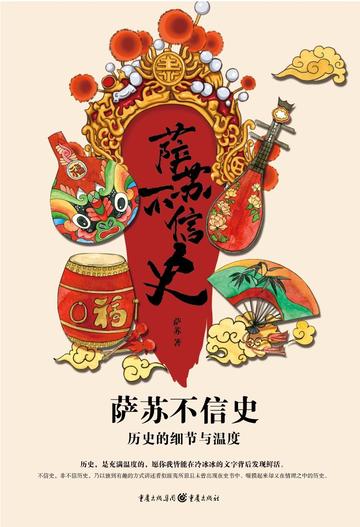
Do Not Believe in History ≠ Do Not Believe in History is a unique and interesting way of telling history that seems unbelievable and has never appeared in history books, but is also reasonable to touch. The "joking" Marquis Haihun, the delinquent Cao Cao, the emperor who "knows nothing but being an official", the queen who is more powerful than Mi Yue, is Yang Guifei an Iranian beauty? ! Who dares to compete with the two empress dowagers of the east and west for husbands? ... Is there a lively story behind Yizhuang Yixue, or is it just a gimmick?
[Introduction] No one has the same face, but there are thousands of books. Most Chinese people like to judge people and discuss matters, explore details and discover different histories. Different from grand historical narratives, in this book, the author selects some fragments of well-known historical figures, such as Liu Bang, Sima Qian, Haihunhou Liu He, Cao Cao, Fu Jian, Tang Taizong, Song Renzong, Cixi, etc., From a perspective that is neither conventional nor sensational. He uses historical materials, quotes from experts, or folklore, and adds his own analysis to uniquely and interestingly tell unexpected but reasonable historical stories, so that people can appreciate the vividness of history and feel the warmth of history in the lost corners. History is recorded by people. In the process of recording, it is inevitable that things will be taboo for the respected, for the relatives, and for the sages. Many histories are difficult to verify because of their long history, and there are errors and omissions. It is understandable to have doubts about historical records. As for the definition of "belief in history" (referring to recorded history, which is a concept opposite to prehistory), is it possible that "Does Not Believe in History" is a work of great imagination and is not a documented work. The name "Don't Believe in History" is a bit interesting, but it can be seen that "Sassou Doesn't Believe in History" is a non-serious reading work. Some people say that although China and the West equally value history, they do so in different ways. The Chinese are diligent in recording history, while Western scholars are diligent in thinking about history. It seems to be true. History is not a simple pile of details. There may be a subversive conclusion hidden in the details. "Sassu Doesn't Believe in History" has made a good attempt in this regard. Regarding many little-known historical knowledge, Mr. Sassou, who once served as the director of the cultural comedy program "Hello! History Master", has given interesting interpretations in the book. For example, the "joking" Marquis Haihun actually tells the story of the harp, tripod, and lacquer screen unearthed from the tomb of Marquis Haihun, which corrected many cognitive biases of modern people, and seemed to be making a joke on future generations. In the section about the emperor who "can't do anything but be an official", we saw the emperor's cowardice and kindness, and we couldn't help but sigh, it turns out that the aloof emperor also has the emotions and desires of ordinary people. "The imperial doctor's prescription does not cure the disease" tells the story of Jiaqing's death, which not only corrects the inertial perception that the imperial doctor did not dare to prescribe medicine for self-protection, but also shows that everyone is equal in the face of life and death, and the emperor is no exception. These methods of learning history while talking and laughing are more suitable for readers who want to learn some historical knowledge, expand their horizons, and add some conversation topics in a fragmented time. Although some stories seem to be scary, bizarre, and beyond the knowledge of ordinary people, as Mr. Sassou said, "This kind of subversion is only tactical." He just used this unique and interesting way to record the appearance of history in his eyes.
Reader comments
This book is very interesting, telling many historical stories from a unique perspective and in a light and humorous way. I especially like the descriptions of characters such as Haihunhou and Cao Cao in the book. I feel that they have become more vivid. Moreover, the author will also quote some interesting legends and historical materials, which gave me a new understanding of history. As the book says, history is like a thread. If you pull it, you may pull out many unexpected things. Recommended to friends who like history, you will definitely have a different reading experience!
Exploring the historical process is interesting and informative


This book is very interesting, telling many historical stories from a unique perspective and in a light and humorous way. I especially like the descriptions of characters such as Haihunhou and Cao Cao in the book. I feel that they have become more vivid. Moreover, the author will also quote some interesting legends and historical materials, which gave me a new understanding of history. As the book says, history is like a thread. If you pull it, you may pull out many unexpected things. Recommended to friends who like history, you will definitely have a different reading experience!
Exploring the historical process is interesting and informative