Beauty keeps the world from spiritual decay.
Yukio Mishima, a modern master who cannot be ignored in the contemporary Japanese literary world, was twice shortlisted for the Nobel Prize, but passed away in a tragic way.
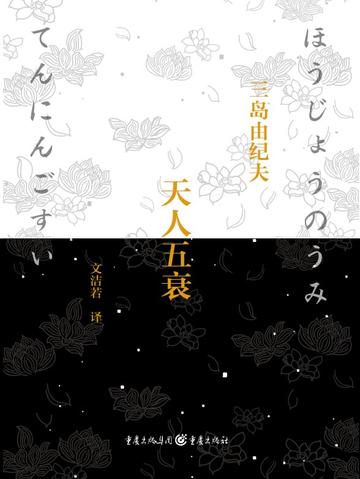
[Introduction to the content] "This is an unsurprisingly quiet and bright garden. The chirping of cicadas like counting rosary beads has occupied the entire courtyard. There is no other sound, and it is extremely lonely. There is nothing in this courtyard. Honda feels that he has arrived at a place where neither memory nor anything exists." "The Five Decline of Heavenly Man" is the final chapter of the "Sea of Fertility" series. "Sea of Fertility" is a "big river novel", that is, a multi-volume continuous masterpiece with historical significance. For this reason, Mishima Yukio once said: "I am planning to write a novel next year. However, how can I write a novel without a philosophy that forms the core of the era? I have searched hard for this, even though there are countless ready-made themes." The Sea of Fertility means "Sea of the Moon". Although the huge craters on the moon are called "fertility", they are actually scarcity. The Sea of Fertility is divided into four parts - "Spring Snow", "Running Horse", "Dawn Temple", and "Five Decline of Heaven and Man". "Sea of Fertility" brings his romance, aesthetics and classicism to perfection, and brings an end to Mishima's literary career. The seventy-eight-year-old Honda Shibukuni in the Five Decline of Heavenly Being adopts Tohru Yasunaga, a young man who is suspected of being reincarnated, as his adopted son. Tohru Yasunaga's pride prompts him to kick his adoptive father out of the loser position and enjoy the benefits himself. Honda waited wholeheartedly for the arrival of Tohru Yasunaga at the age of 20 and hoped to confirm whether he was the reincarnation of Jinrang. Unexpectedly, Honda's friend Keiko couldn't stand Yasunaga's behavior and told him all about the reincarnation. Honda broke off relations with Keiko. Tohru Yasunaga committed suicide after reading the dream diary left by Matsueda Kiyaki many years ago (or to prove that he was the reincarnation of Matsueda, Iinuma, and Kinjo), but failed and became blind. He lived through the age of twenty-one without dying, but already depressed. Honda was reported in a magazine because of the peeping scandal, so he decided to visit Tsukishuji Temple, which he had not visited for 61 years, and meet Satoko again. During the conversation, Satoko denied Kiyoaki's existence, saying that it was all just Honda's dream. Finally, the entire novel has an epilogue that serves as the ending point of the play: "This is an unsurprisingly quiet and clear garden. The chirping of cicadas like counting rosary beads has occupied the entire courtyard. There is no other sound, and the loneliness is extremely lonely. There is nothing in this courtyard. Honda feels that he has arrived at a place where neither memory nor anything exists."
[About the author] Yukio Mishima is a Japanese novelist, playwright, journalist, film producer, and film actor. He is one of the masters of Japanese post-war literature. He not only has a high reputation in the Japanese literary world, but also has high evaluation in the Western world. Some people even call him "Japan's Hemingway". He is also the contemporary writer with the most works translated into English and other foreign languages. The famous Japanese comparative literature researcher Nobuichi Chiba believes that Mishima is as famous as Proust, Joyce and Thomas Mann.
Reader comments
If you really forget, why should you listen attentively; but if it really happens, why will everything return to silence. After all, Honda could not escape the shackles of ordinary people throughout his life and became a slave of memory. In the end, he would only come to this place where there is neither memory nor anything, and he was not even aware of "this is the end". Perhaps Toru Anyong was really the reincarnation of Princess Moonlight, and his final end was just to burn the last trace of memory. His end was just like the title and the "Five Decline of Heaven and Humanity" mentioned in the previous article. Tohru finally died. Although his life was not over yet, the arrogance of the world finally ended him, and the five declines of Heaven and Humanity still came to him. This may be why Yueshuji did not give Honda a final response, because such a response had already been rejected by Honda himself.
This book made me feel the unique literary charm of Mishima Yukio. The description of the courtyard in the book is so detailed that it made me feel like I was actually there. The complex relationships and inner entanglements between the characters are also well portrayed, especially Tohru Yasunaga's pride and Honda's persistence, which are impressive. As the book says, "This is an unsurprisingly quiet and bright garden." The seemingly ordinary scene contains endless profound meanings. All in all, this is a great book worth reading!
The mouse who wants to prove that he is a cat has no choice but to commit suicide
If you really forget, why should you listen attentively; but if it really happens, why will everything return to silence. After all, Honda could not escape the shackles of ordinary people throughout his life and became a slave of memory. In the end, he would only come to this place where there is neither memory nor anything, and he was not even aware of "this is the end". Perhaps Toru Anyong was really the reincarnation of Princess Moonlight, and his final end was just to burn the last trace of memory. His end was just like the title and the "Five Decline of Heaven and Humanity" mentioned in the previous article. Tohru finally died. Although his life was not over yet, the arrogance of the world finally ended him, and the five declines of Heaven and Humanity still came to him. This may be why Yueshuji did not give Honda a final response, because such a response had already been rejected by Honda himself.
This book made me feel the unique literary charm of Mishima Yukio. The description of the courtyard in the book is so detailed that it made me feel like I was actually there. The complex relationships and inner entanglements between the characters are also well portrayed, especially Tohru Yasunaga's pride and Honda's persistence, which are impressive. As the book says, "This is an unsurprisingly quiet and bright garden." The seemingly ordinary scene contains endless profound meanings. All in all, this is a great book worth reading!
The mouse who wants to prove that he is a cat has no choice but to commit suicide