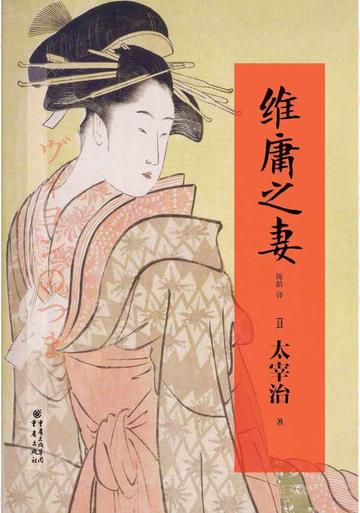
"Viyong's Wife" looks at the life of a decadent man from a woman's perspective! "Weiyong's Wife" is a collection of short stories by Osamu Dazai, and the book of the same name is Dazai's masterpiece. "Wei Yong's Wife" is a metaphor for "the wife of a wanton man". A woman kept the family together and worked as a maid to pay off her husband's debts when her husband became an alcoholic, owed money, eloped with a woman, and finally committed suicide by diving into the water. In 2009, at the 33rd World Film Festival held in Montreal, Canada, the film "Villon's Wife" directed by Negishi Yoshitaro and starring Matsu Takako and Asano Tadanobu won the Best Director Award.
[Editor's Recommendation] Japanese rogue master Dazai Osamu, a master of the aesthetics of destruction! Thirty-nine years of life, twenty years of creation, five suicides of love, and finally death of love. The popular Dazai Osamu ultimate hardcover collection contains dozens of photos of Dazai and precious manuscript materials, revealing the eternal Osamu Dazai for the first time. He analyzes himself and his unsolvable loneliness, melancholy and despair, arousing a deep trembling and nostalgia-like feeling deep in our hearts, allowing us to have a glimpse of the abyss of human nature.
[About the author] Dazai Osamu (1909-1948), a representative writer of the Japanese rogue school (or new drama school). His real name is Shuji Tsushima, and he was born into a wealthy landowner family in Kaneki Village, Kitatsugaru County, Aomori Prefecture. His father, Gen'emon, was a member of the House of Lords and the House of Representatives. He was a local celebrity and was known as Mr. Kaneki. Dazai Osamu is the sixth son of his parents. He is the youngest of eleven brothers and sisters. His father was often busy with his career and his mother was sick. Dazai Osamu grew up under the care of his aunt and nanny. In 1927, when Dazai Osamu was studying at Hirosaki High School, he was greatly shocked when he heard the news that the talented writer Akutagawa Ryunosuke he admired had committed suicide. In 1930, he entered the French Department of Tokyo Imperial University and soon retired. Joined the left-wing movement and then "turned". In 1930, he met Atsumi Tanabe, the mistress of a certain painter, in Ginza's "Hollywood". The two went to Kamakura Beach to have a love affair. Tanabe died, but Dazai survived. The novels "Leaf", "Clown's Flower", "The Crowned Ape Face" and "Run, Mellor" all have plots of "suicide by drowning". Dazai later studied under the famous writers Sato Haruo and Ibushi Tsuuji. Since he was a child, he was influenced by the rough and wild natural climate of the northern seaboard and the influence of the family tradition of the declining aristocracy. He developed a strange and changeable, bohemian, sometimes arrogant and sometimes inferior character. In his short life of thirty-nine years, he and his women committed suicide five times, and attempted love four times. Finally, he and Yamazaki Tomei drowned themselves in the Tamagawa River. It just so happened that June 19th, a week after the two people jumped into the water, coincided with Dazai Osamu's thirty-ninth birthday. Early that morning, the body was fished ashore and, in accordance with his last wish, he was buried at the Mitaka Kobe Zenrinji Temple in Tokyo, located directly opposite the Ogai Tomb in Meiji Bunhausen. The following year, an anniversary ceremony was held on this day, and it was named "Cherry Ji" from then on. Every year on June 19th, literary young people who admire the writer's reputation gather at Zenrinji Temple or Tamagawa Shosui to commemorate and mourn, and the scenery will last forever.
Reader comments
This book is very Osamu Dazai's style, decadent and true. The woman in the book reminded me of Songzi in "The Life of the Disliked Songzi", who also sacrificed everything for love. I hate the men in the story, they have no redeeming qualities, but I admire the women's tenacity. Like Osamu Dazai's other works, this book also made me feel the complexity of human nature.
Why are none of the men in Osamu Dazai's works reliable?




This book is very Osamu Dazai's style, decadent and true. The woman in the book reminded me of Songzi in "The Life of the Disliked Songzi", who also sacrificed everything for love. I hate the men in the story, they have no redeeming qualities, but I admire the women's tenacity. Like Osamu Dazai's other works, this book also made me feel the complexity of human nature.
Why are none of the men in Osamu Dazai's works reliable?