If you don't understand the Song Dynasty, you can't truly understand Chinese history;
If you don't read the history of Liao, Xia and Jin, you can only understand a quarter of the history of Song.
If you could travel back in time, which dynasty would you like to return to? Many people may choose the Song Dynasty. However, the Song Dynasty was the most controversial dynasty in Chinese history. It was both the most prosperous dynasty in China and also "poor and weak."
Regimes at the same time as the Song Dynasty include Liao, Xixia, Jin, Dali, Tubo, etc. The relationship between them is intricate and has left a strong mark in history. The great changes in the era from the 10th to the 13th century also left room for imagination and exploration for future generations: Jin Yong's martial arts novel "The Eight Parts of the Dragon" was written against the background of that period of history.
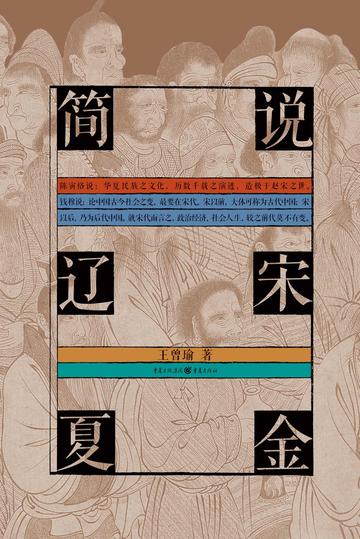
1. "A Brief Introduction to Liao, Song, Xia and Jin" is a general introduction to history.
Nowadays, historical research has become more sophisticated and in-depth, and most of the research works are based on new theories or perspectives. Works that briefly introduce the most basic conditions of a certain era have become scarce. The opening chapter of "A Brief Introduction to Liao, Song, Xia and Jin" introduces the basic situation of the Liao, Song, Xixia, Jin, Dali, Tubo and other regimes in all aspects (politics, economy, culture, society, etc.), So that readers can have an overall impression of the complicated history of China from the 10th to the 13th century. It is "very friendly for newcomers to Song history."
2. "A Brief Introduction to the Liao, Song, Xia and Jin Dynasties" is a brief review by a historian
Mr. Wang Zengyu is a master who studies the history of the Song Dynasty. He has a profound academic foundation. He has a large number of historical allusions and quotations from the Song Dynasty at his fingertips and can use them with ease. "A Brief Introduction to Liao, Song, Xia and Jin" reveals his knowledge and wisdom everywhere. For example, regarding the problem of redundant officials in the Song Dynasty, based on the traditional theory of "decentralization" and "checks and balances", Mr. Wang further proposed that "the central problem of redundant officials is the system of compensation"; he criticized the autocratic shortcomings of the Song Dynasty without mercy, believing that "the root of corruption in feudal society is nothing more than the hierarchical conferment system of authoritarian centralization."
If you don't want to passively accept the history that others tell you, but also want to quickly understand the full picture of a certain period of history and truly establish your own cognitive system, choosing the right introductory book is key. To understand and study the Song Dynasty and even the Liao, Xia, and Jin Dynasties, "A Brief Introduction to the Liao, Song, Xia, and Jin Dynasties" is a great introductory book. Start your reading!
Introduction
From the 10th to the 13th century, multiple ethnic regimes such as the Liao, Song, Xia, Jin, Uighur, Tubo, and Dali coexisted in China. Therefore, this period is also regarded as the "second Northern and Southern Dynasties" in Chinese history.
Wang Zengyu, a well-known expert on the history of the Liao, Song, and Jin Dynasties, used a lofty historical pattern to outline the politics, economy, society, military, culture, and conflicts and integration of the four coexisting and passing dynasties of Liao, Song, Xia, and Jin.
The book also contains in-depth discussions on historical events. For example, the Liao Dynasty had strong nomadic political characteristics, the Yinbu system was the main reason for redundant officials in the Song Dynasty, the founding of Xixia took advantage of the desertification of the northwest, the Jurchens were highly sinicized and then quickly corrupted, the agricultural multiple cropping system and the desertification of the northwest were important reasons for the southward shift of the economic center of gravity and the eastward shift of the political center, etc.
Zang's comments on historical figures in the book are also very distinctive, being outspoken and full of warmth and respect.
Author:
Wang Zengyu
Well-known contemporary expert on the history of Liao, Song and Jin Dynasties, Honorary Scholar of the Chinese Academy of Social Sciences
Reader comments
This book is like a knowledgeable guide taking you on a journey through Chinese history from the 10th to 13th centuries. It is simple and easy to understand, giving me, a novice on Song history, a clear understanding of that complex era. Mr. Wang Zengyu is like a wise old man, telling history vividly and interestingly. His analysis of the problem of redundant officials in the Song Dynasty gave me a deeper understanding of the politics of that era.
This book is like a knowledgeable guide taking you on a journey through Chinese history from the 10th to 13th centuries. It is simple and easy to understand, giving me, a novice on Song history, a clear understanding of that complex era. Mr. Wang Zengyu is like a wise old man, telling history vividly and interestingly. His analysis of the problem of redundant officials in the Song Dynasty gave me a deeper understanding of the politics of that era.