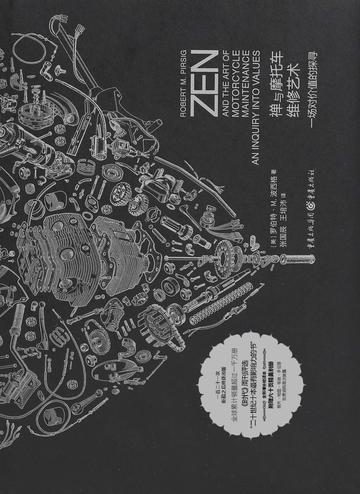
As an autobiographical novel, the story of Phædrus is actually the life of Robert M. Pirsig, the author of this book. In "Plato's Dialogues", Phædrus is an ordinary Athenian young man who loves philosophy. In this book, Phædrus returns to earth. He was once a student of philosophy and a teacher of rhetoric, but due to the conflict between his philosophical ideas and the cultural worldview, he finally suffered a mental breakdown and was hospitalized. After being discharged from the hospital, he hoped to free himself from his narrow and restricted self, so he embarked on a long journey across the American continent on a motorcycle. After complex experiences and introspection along the way, he finally temporarily restored spiritual integrity and tranquility. This process of returning to oneself is achieved by constantly seeking "good quality", which is the Zen meditation in Eastern philosophy, and interpreting it with motorcycle maintenance methods. This is where the name Zen and the Art of Motorcycle Maintenance comes from. At the same time, the book also criticizes the dichotomies or dualisms in the Western world, such as humanities and technology, spirit and matter, mysticism and mechanics, art and industry, mind and machinery, East and West, and other relative consciousnesses.
Reader comments
When you want to do something quickly, it means that you no longer care about it and want to do something else. Some of the sentences here are really classic. For example, we are often too busy to have a good chat, and as a result, we live a boring life day after day. The monotonous days make people think about it a few years later and wonder how they lived, and time has slipped away quietly. A very nice book. Really highly recommended.
This is the first time I have read such an interesting philosophical book. Although I was very repelled at first and did not want to read on and felt a little bored. That was my heart. But when you read carefully to the end, you will find it very interesting. The author takes you in step by step and constantly outputs rich content such as quality, human flaws, social flaws, and the divided spirit. This is a book worth reading again and again. I really can't read anything at the first time, and I can't write anything about it, but I've basically mastered the book in general, and I'm just going to read it slowly in the future. I learned two writing skills from this book: 1) When writing, it's best to narrow the scope and discuss it in a smaller way, otherwise you won't have any inspiration even if you think about it; 2) List all the several ideas in your brain, and then sort them by importance to write, so that you can clearly write what you want to express.
The road we traveled was twists and turns... We occasionally stopped to rest, have lunch, and have a chat, and then we continued to concentrate on riding along the long road. In the afternoon I started to feel a little tired, which was just in balance with the excitement of this first morning. We moved steadily, neither too fast nor too slowly. The southwest wind blew sideways, and our car cut diagonally into the wind, as if to feel the power of the wind. Recently, I feel that this road is a bit weird, and I always feel worried, as if someone is watching or following us. However, there was no car in front, and there were only people far behind in the rearview mirror.
"Buddha or Jesus would be as comfortable sitting next to the gears of computers and transmissions practicing as they are sitting on the top of a mountain or on a lotus seat. If this is not the case, it is tantamount to blaspheming the Buddha - that is, blaspheming yourself." Greatness means being great since birth, and disrespecting great things is also blaspheming yourself. To acknowledge the greatness is to acknowledge your own greatness. You must show respect and express your respect for the things you respect at all times.
The story is very simple. It is just a trip by a father and his son across the east and west coasts of the United States on a motorcycle. It has almost no adventures and magnificent plots. But what's remarkable is that it is also a Chautauqua movement (an educational reform movement in the United States in the late 19th century, which held educational gatherings in the wild during the summer vacation to provide religious and adult education courses, including entertainment, acting, music, discussions, and reports). (Later disappeared due to the rise of automobiles, radios, and movies). In the process of Chautauqua, I felt like I was reliving the history of Western philosophy. I followed Phædrus to reflect on the Western rational cultural tradition, and even at that moment I became an anti-Aristotle in class. What's even more remarkable is that this is a true mental illness's journey of ideological redemption. In the author's words, it is "the Odyssey of Phædrus in the 20th century" which couldn't be more appropriate. The author himself is the deranged person, and salvation is brought to him by his son Chris, "I didn't take him anywhere at all, he took me."
He was a pagan, and everyone praised him for saving his soul, but only he knew that what he saved was only his body. The narrator is basically a person who is dominated by the values of society. As he said at the beginning: "I haven't had new ideas for many years." Except for telling some carefully designed lines, he never reveals his heart in order to make you like him.
Phædrus was a man governed by the value of knowledge. He didn't care whether others liked him or not; he was devoted to pursuing truths that he believed to be of world-shattering importance.
"I knew it". Things are slowly getting better.
The second half of the book is a physical book, so the displayed reading time should probably triple.
A Chautauqua opened in order to analyze the "ugliness of science". The author analyzed in detail the commonly used scientific research methods and the theories of Kant, Aristotle, Socrates, Plato, etc., Denying the dualism of dialectics and proposing "good quality". /Quality" (i. E. "Tao", i. E. "Excellence," i. E. "Goodness", i. E. "Oneness") is the monism that is the source of mind and things, subjectivity and objectivity, classical and romantic... It believes that "value" is neither subject nor object but occurs before the "dichotomy of subject and object". The "ugliness of science" does not lie in science itself, but in a kind of mechanized rationality that has lost the perception of quality. He then suggested that people should care about the here and now, and feel the direct experience of "what is happening" before knowledge is produced, so as to truly realize "good quality".
The relationship with his son was frowned upon at first, but gradually it turned out to be a well-written hidden line, which is a test and confirmation of the theory of quality in reality; the part about education and teaching and the defense of rhetoric are boring, and they are parts that the author cares about but the readers are not interested in.
In a busy and utilitarian society, the necessity of setting aside some quiet moments for myself has given me a new way of thinking and perspective on life through this book. The protagonist in the book compares the process of repairing a motorcycle to the process of repairing his own heart. Through the observation of details and the pursuit of quality, he re-establishes his connection with the world and finds inner peace. It gave me inspiration and thinking, allowing me to re-examine and understand the true meaning of life.
A motorcycle trip, a spiritual self-healing, a philosophical exploration, and a blend of spirit and machinery. On a hot summer day, the father and son and John and his wife rode motorcycles from Minnesota to California, crossing the continental United States. Along the way, his father combined the natural scenery he saw, experiences of camping in the wild, conversations in hotels at night, motorcycle repair techniques and other daily life with philosophy in the form of a philosophical sketch, leading his son to learn and explore human civilization.
It is a very good book. The author mixes rational and emotional thinking in the gaps between travels. Through the dialogues, conflicts, and journey experiences of the characters in the novel, I felt as if I was following the author riding on the American highway, with the hot wind blowing.
I picked up this book intermittently and couldn't finish reading it. This time I happened to see this book in the library and started reading it. This time it was still difficult to read the previous content or the very obscure parts, but I persevered and after reading it, I felt that this book was really well written.
The author completed a self-salvation during his motorcycle trip. Chris found his father who insisted on the truth. Quality is the origin of subjectivity and objectivity, or it maintains an order of subjectivity and objectivity. The sentence that stood out to me the most was that if your values are frozen, all you can do is slow down and reexamine whether the things you thought were important in the past are still important. Do or think about things that are important to you. Some of the other small things are not very important. It is just that the brain is too noisy and creates chaos for you. Sometimes you can ignore the voice of the brain and just see the essence of things clearly, and you are doing something beneficial to this matter. All other problems can be solved. Starting from the essence, you will pull yourself out of the messy little things and look at things from another big perspective.
I finished reading it on November 6, 2025. I hope I will be inspired differently next time I read it.
This book is very interesting! I like the protagonist Phædrus. He is constantly thinking and introspecting in the process of searching for "good quality", which resonates with me. But I hate the dichotomy in the book, it feels too absolute. Moreover, this book is not only about motorcycle maintenance, but also explores many philosophical issues, which is very interesting. Recommended to friends who like to think about life!
After reading it, I felt a trembling feeling in my soul. There was life, characters, philosophy, fun, and sadness.
It's quite interesting, a very true portrayal of one's heart, and it's easy to relate to it 😊
The author's speculation is interesting.
I didn't quite understand what I read, so I gave it four stars.
What is the boundary of thought? It is probably the infinite thinking while riding a motorcycle on the road.
It's pretty good, a bit fantasy [face covering] I didn't understand it, watch it again
Motorcycles and philosophy coexist
It's very interesting. It's a book that is only suitable for reading when you are in a calm mood.




When you want to do something quickly, it means that you no longer care about it and want to do something else. Some of the sentences here are really classic. For example, we are often too busy to have a good chat, and as a result, we live a boring life day after day. The monotonous days make people think about it a few years later and wonder how they lived, and time has slipped away quietly. A very nice book. Really highly recommended.
This is the first time I have read such an interesting philosophical book. Although I was very repelled at first and did not want to read on and felt a little bored. That was my heart. But when you read carefully to the end, you will find it very interesting. The author takes you in step by step and constantly outputs rich content such as quality, human flaws, social flaws, and the divided spirit. This is a book worth reading again and again. I really can't read anything at the first time, and I can't write anything about it, but I've basically mastered the book in general, and I'm just going to read it slowly in the future. I learned two writing skills from this book: 1) When writing, it's best to narrow the scope and discuss it in a smaller way, otherwise you won't have any inspiration even if you think about it; 2) List all the several ideas in your brain, and then sort them by importance to write, so that you can clearly write what you want to express.
The road we traveled was twists and turns... We occasionally stopped to rest, have lunch, and have a chat, and then we continued to concentrate on riding along the long road. In the afternoon I started to feel a little tired, which was just in balance with the excitement of this first morning. We moved steadily, neither too fast nor too slowly. The southwest wind blew sideways, and our car cut diagonally into the wind, as if to feel the power of the wind. Recently, I feel that this road is a bit weird, and I always feel worried, as if someone is watching or following us. However, there was no car in front, and there were only people far behind in the rearview mirror.
"Buddha or Jesus would be as comfortable sitting next to the gears of computers and transmissions practicing as they are sitting on the top of a mountain or on a lotus seat. If this is not the case, it is tantamount to blaspheming the Buddha - that is, blaspheming yourself." Greatness means being great since birth, and disrespecting great things is also blaspheming yourself. To acknowledge the greatness is to acknowledge your own greatness. You must show respect and express your respect for the things you respect at all times.
The story is very simple. It is just a trip by a father and his son across the east and west coasts of the United States on a motorcycle. It has almost no adventures and magnificent plots. But what's remarkable is that it is also a Chautauqua movement (an educational reform movement in the United States in the late 19th century, which held educational gatherings in the wild during the summer vacation to provide religious and adult education courses, including entertainment, acting, music, discussions, and reports). (Later disappeared due to the rise of automobiles, radios, and movies). In the process of Chautauqua, I felt like I was reliving the history of Western philosophy. I followed Phædrus to reflect on the Western rational cultural tradition, and even at that moment I became an anti-Aristotle in class. What's even more remarkable is that this is a true mental illness's journey of ideological redemption. In the author's words, it is "the Odyssey of Phædrus in the 20th century" which couldn't be more appropriate. The author himself is the deranged person, and salvation is brought to him by his son Chris, "I didn't take him anywhere at all, he took me."
He was a pagan, and everyone praised him for saving his soul, but only he knew that what he saved was only his body. The narrator is basically a person who is dominated by the values of society. As he said at the beginning: "I haven't had new ideas for many years." Except for telling some carefully designed lines, he never reveals his heart in order to make you like him. Phædrus was a man governed by the value of knowledge. He didn't care whether others liked him or not; he was devoted to pursuing truths that he believed to be of world-shattering importance. "I knew it". Things are slowly getting better.
The second half of the book is a physical book, so the displayed reading time should probably triple. A Chautauqua opened in order to analyze the "ugliness of science". The author analyzed in detail the commonly used scientific research methods and the theories of Kant, Aristotle, Socrates, Plato, etc., Denying the dualism of dialectics and proposing "good quality". /Quality" (i. E. "Tao", i. E. "Excellence," i. E. "Goodness", i. E. "Oneness") is the monism that is the source of mind and things, subjectivity and objectivity, classical and romantic... It believes that "value" is neither subject nor object but occurs before the "dichotomy of subject and object". The "ugliness of science" does not lie in science itself, but in a kind of mechanized rationality that has lost the perception of quality. He then suggested that people should care about the here and now, and feel the direct experience of "what is happening" before knowledge is produced, so as to truly realize "good quality". The relationship with his son was frowned upon at first, but gradually it turned out to be a well-written hidden line, which is a test and confirmation of the theory of quality in reality; the part about education and teaching and the defense of rhetoric are boring, and they are parts that the author cares about but the readers are not interested in.
In a busy and utilitarian society, the necessity of setting aside some quiet moments for myself has given me a new way of thinking and perspective on life through this book. The protagonist in the book compares the process of repairing a motorcycle to the process of repairing his own heart. Through the observation of details and the pursuit of quality, he re-establishes his connection with the world and finds inner peace. It gave me inspiration and thinking, allowing me to re-examine and understand the true meaning of life.
A motorcycle trip, a spiritual self-healing, a philosophical exploration, and a blend of spirit and machinery. On a hot summer day, the father and son and John and his wife rode motorcycles from Minnesota to California, crossing the continental United States. Along the way, his father combined the natural scenery he saw, experiences of camping in the wild, conversations in hotels at night, motorcycle repair techniques and other daily life with philosophy in the form of a philosophical sketch, leading his son to learn and explore human civilization.
It is a very good book. The author mixes rational and emotional thinking in the gaps between travels. Through the dialogues, conflicts, and journey experiences of the characters in the novel, I felt as if I was following the author riding on the American highway, with the hot wind blowing.
I picked up this book intermittently and couldn't finish reading it. This time I happened to see this book in the library and started reading it. This time it was still difficult to read the previous content or the very obscure parts, but I persevered and after reading it, I felt that this book was really well written. The author completed a self-salvation during his motorcycle trip. Chris found his father who insisted on the truth. Quality is the origin of subjectivity and objectivity, or it maintains an order of subjectivity and objectivity. The sentence that stood out to me the most was that if your values are frozen, all you can do is slow down and reexamine whether the things you thought were important in the past are still important. Do or think about things that are important to you. Some of the other small things are not very important. It is just that the brain is too noisy and creates chaos for you. Sometimes you can ignore the voice of the brain and just see the essence of things clearly, and you are doing something beneficial to this matter. All other problems can be solved. Starting from the essence, you will pull yourself out of the messy little things and look at things from another big perspective. I finished reading it on November 6, 2025. I hope I will be inspired differently next time I read it.
This book is very interesting! I like the protagonist Phædrus. He is constantly thinking and introspecting in the process of searching for "good quality", which resonates with me. But I hate the dichotomy in the book, it feels too absolute. Moreover, this book is not only about motorcycle maintenance, but also explores many philosophical issues, which is very interesting. Recommended to friends who like to think about life!
After reading it, I felt a trembling feeling in my soul. There was life, characters, philosophy, fun, and sadness.
It's quite interesting, a very true portrayal of one's heart, and it's easy to relate to it 😊
The author's speculation is interesting.
I didn't quite understand what I read, so I gave it four stars.
What is the boundary of thought? It is probably the infinite thinking while riding a motorcycle on the road.
It's pretty good, a bit fantasy [face covering] I didn't understand it, watch it again
Motorcycles and philosophy coexist
It's very interesting. It's a book that is only suitable for reading when you are in a calm mood.