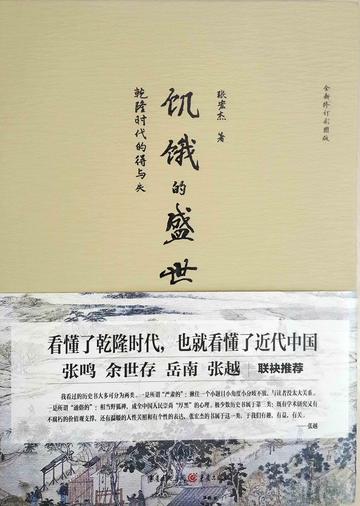
The content of this book mainly writes about the gains and losses of the Qianlong era. Through the deconstruction of the Qianlong era, the author paints a colorful picture of the "prosperous age" for readers, and at the same time profoundly reveals the lost secrets of modern China.
China under Qianlong's rule was the most populous and most powerful period in China's thousands of years of history. Horizontally, it was the most powerful and wealthy country in the world at that time. It is no exaggeration to call it the greatest prosperous era in Chinese history. The Qianlong era created unprecedented political stability, supported an unprecedented population, and established today's territory. However, the author sees from a deeper level that behind the superficial prosperity is a huge crisis. Qianlong's sixty-year reign coincided with Britain going through the entire process of the industrial revolution.
In the thirteenth year of Qianlong's reign (1748), Montesquieu published his famous work "The Spirit of the Laws". In the forty-first year of Qianlong's reign (1776), the United States declared independence. In the fifty-fourth year of Qianlong's reign (1789), the Bourgeois Revolution broke out in France. On the other side of the earth, Emperor Qianlong was immersed in the dream of a "prosperous age" and could not extricate himself, trying every means to maintain his feudal rule. It can be said that during this period, China missed the opportunity to contact world civilizations and failed to catch up with the tide of world development. This directly led to China's continued decline and even its status as the "sick man of East Asia." In addition, this book also introduces Qianlong's origin, personal life, personality, etc.
This is a very good book written by the famous historian Zhang Hongjie, and it is also his masterpiece. This book, like the author himself, is low-key, rigorous, and profound. The first time I met Hongjie was on the side of the road. He made several appointments to come to my place, but he couldn't come because he was busy. Later I simply went to find him. Hongjie and I were very pressed for time, so we agreed to talk over dinner at noon. I arrived 10 minutes early and waited on the side of the road. When he saw me, he first apologized and said that I had to wait a little long. He doesn't talk much, but he is very sincere, doesn't use many clichés, and is very straightforward. The most profound impression is that he is law-abiding and does not compromise easily. We talked about revising the content of the book and the cover, and we all agreed that we should make a good book, a book that is good-looking but not sensational. That meal cost less than 100 yuan in total. A bottle of beer, he drank a small glass and the rest was mine. Compared with his low-key persona, his works are much richer and more surprising. Hongjie is a Ph. D. In history. After reviewing the manuscript for the first time, I felt that he had a broad vision and thoughtful thinking. Vertically, he combined the gains and losses of the Qianlong era with the gains and losses of the previous and subsequent dynasties; horizontally, he studied Chinese history in the context of world history. This book helps us look at a local major historical event, look at the prosperous times from a higher perspective, and is very useful for us today to grasp the opportunities for economic, political, cultural and other development. Another feature of this book is its rigorous content and popular language.
Reader comments
When I was reading, I bought this book specifically to read
I felt extremely angry while watching it. Qianlong was disliked by most people for no reason. He was very proud of his achievements and thought highly of himself. He used the Han people's system and talents, but did not give them good evaluation and treatment. Although he was generous to the people, he did not allow them to have the right to political expression. When discussing with a friend, I agreed with his point of view, "The closer the feudal era comes to an end, the more brutal and authoritarian the ruling class becomes."
Very good. It writes a true history. It is neither a boast nor a slander. It is not a castle in the air. Qianlong in the ivory tower can never imagine that his hard work did not make the Qing Dynasty strong but fell into the abyss. It is true that Qianlong was the pinnacle of feudal autocracy in the Qing Dynasty, and he also had the strongest control from top to bottom. However, its harsh literary inquisition, strict hierarchical order, and unpredictable governance methods are all exacerbating social conflicts all the time. The untouchables are struggling, natural and man-made disasters, bullying by powerful people have no place to complain, and the emperor will confiscate the family and exterminate the family if they complain about the imperial edict. The ministers lived quietly, made suggestions and made suggestions, caring about the world was the original sin, and the emperor would be executed by the nobles if he was in a bad mood; the royal family lived secretly, followed the rules of ethics, and obeyed the hierarchy conscientiously. Even unintentional transgressions would bring cold-blooded punishment from the emperor. The emperor who loves great achievements only likes dull and obedient people and treacherous ministers who are good at observing people's words and flattering others. This period of time, which lasted for several decades, was enough to change everything and Qingshi died in Qianlong.
The contrasting naming method immediately attracted me. History says that after two generations of emperors, Qianlong developed the Qing Dynasty into an unprecedented prosperous age. However, the suffering of ordinary people in the prosperous age was not described in history books. This book allows you to see the grand situation at a macro level and also look down at the micro world. It is really a very good history book about the Qianlong period. As a feudal emperor, he was extremely successful. As the helmsman of the empire in a situation that has not seen major changes in a thousand years, he has failed extremely. He is a product of history, shaped by past closed historical experiences. Although his application of past experiences is extremely successful, it cannot change the inevitable trend of a closed system towards entropy increase.
It elaborates on various national conditions in the early, middle and late periods of Qianlong and his policy agenda in multiple dimensions, and shows a magnificent prosperous age and its limitations with reasonable evidence. The analysis of Qianlong's character also vividly shows the multi-layered diversity of an emperor's character. This fascinating popular science reading allows us to have a more comprehensive understanding of Qianlong and his prosperous age.
The Kangxi, Yongzong and Qianlong periods are considered to be the peak of social development in China's feudal era. However, ironically, this period was also an important node in the rise of Western civilization. After that, Eastern civilization was left far behind. Through rich historical materials, this book truly reproduces the economic, political and cultural conditions of Chinese society during the prosperous era of Qianlong. Based on multi-angle comparisons between tradition and modernity, East and West, it reveals the institutional roots of China's backwardness in modern times: the so-called prosperous era is just growth on the track of the old system, while Western society has embarked on a new development path through institutional reforms.
Qianlong - Emperor of the Qing Dynasty. This is a historical work that explores the social and economic conditions of China's Qianlong era. Through the combing and analysis of historical materials and documents, the author shows the gap between rich and poor, peasant suffering and social problems behind the prosperous times of the Qianlong era. This book provides in-depth thinking and reflection on history and is of great significance for understanding Chinese history and social changes. After reading this book, you will have a clearer understanding of Qianlong.
The merits and demerits are all laid out, and the purpose and motivation are clear and reasonable. It quotes many historical materials and explains them in vernacular, which is really considerate. This book is indeed a good book to understand the psychological methods of Qianlong's governance and its impact on society. It is worth reading.
I bought the physical book and it is quite good. I especially like the passage in it, "Kingship is a malignant tumor... Until society suffocates in its tight embrace."
I posted this passage on my pen holder. It's been a long time since I read it in my first year of high school. I'm about to take the college entrance examination this year.
During the Qianlong era, we were the country with the largest population in the world, the richest country in the world, and the most prosperous country in the world. However, from a different perspective, it was also the weakest era. Britain began the industrial revolution and colonization, and Europe began the Renaissance and religious reform. They were developing towards a more civilized modern era, but we were complacent with our achievements, did not want to make progress, closed the country, and thus lagged behind the trend of the times.
Overall, this book is very nice to read, the narrative style is plain and approachable, and the content is well-referenced.
This book narrates the life of Qianlong, including his growth experience and governing style, analyzes his character and personal likes and dislikes, reveals the many shortcomings of human rule and feudal rule, and serves as a warning to people.
Overall it's pretty good, but there are a lot of personal emotions involved, and I don't agree with some of the opinions.
A very good book about Qianlong's life and policies. This book can not only understand the situation of Qianlong, but also understand our current policies through the policies of the Qianlong period. The form has changed but the logic behind it has not. After reading this book, I found that China's five thousand years of history have only come back and forth on a few things. No matter what policies the rulers make, the essence behind them is always to maintain rule.
Everyone has two sides, good and bad, but Qianlong's bad qualities were enough to completely offset his good qualities. He made China completely lag behind the world. He made Chinese people's thoughts fall into the abyss, making people have no faith and no spiritual pursuits, and completely reduced them to ignorant, backward and numb people, making modern China fall into a bottomless abyss.
Re-expose historical facts objectively and fairly, interpret facts digitally, and like all records that are objective and true, including all the scars and scars left on this land that is dear to you and me, accept them all, and use history as a mirror.
The year 2025 begins with the six hundred years of the Yin and Shang Dynasties and ends with the prosperous age of hunger.
I read this book mainly because I wanted to understand the social life in the Qianlong era. Cao Xueqin lived during the prosperous period of Qianlong, and in the book A Dream of Red Mansions, he also mentioned that "taking advantage of this to prosper the Taiping Dynasty", the actual social background depicted is indeed one of frequent natural and man-made disasters, including wars outside and starvation inside. It has always been difficult for me to understand this contradiction. After reading this book, I got the answer.
A prosperous age, but indeed a prosperous age of hunger.
Feudal society has reached its end of development, or in other words, feudal society has entered a time when it is blocked at both ends. The outcome of not caring about people's livelihood is serious land annexation, which will eventually lead to peasant uprisings, social unrest and even political instability, such as in the late Ming Dynasty; the outcome of not caring about people's livelihood is social stability, economic prosperity, and population growth until the land can no longer support so many people. From this, unstable factors begin to appear in society, and, catalyzed by hunger, they gradually develop into civil forces that shake society and political power.
All in all, this land needs to develop new productive forces. The feudal dynasty did not have such soil.
In the end, this book was much easier to read than expected. You can buy a physical book and read it again in a few years.
This book uses a large amount of historical materials, the content is authentic, and the author's evaluations are of the essence. It is a good book that deeply analyzes the Qianlong era. If you want to know more, you can read more. When reading this book, you must be calm and don't be too hasty or impatient.
A sigh, not wanting to speak
The works are all contemporary. This book by Mr. Zhang Hongjie and another book "The Retrograde Empire" are Hong Zhongdalu in the current era of transformation. Only by profoundly exposing the reactionary nature of feudal autocracy can the influence of those reactionary words and deeds that advocate the perfection of the feudal system in the transformation process be eliminated.
Both books should be read by everyone today.
This book is very interesting! The author Zhang Hongjie interpreted the rise and fall of the Qianlong era from a unique perspective, which gave me a new understanding of history. His research is very in-depth, and he analyzes the Qianlong era in the context of world history and has unique perspectives. Moreover, the content of this book is rigorous, but the language is very easy to understand, making it easy to read. I think this book is very helpful for us to understand both history and reality. I recommend you read it!
I feel that the writing is really good, comprehensive and concrete, with both macro-elaboration and detailed description. It is also written with an objective and responsible attitude toward history, giving readers a lot of inspiration. It's enchanting to read and even better to think about.
It is very objective. Many people have assumptions about the prosperous age. This book disenchants the prosperous age of the feudal dynasty.
Learn something you didn't know before
A good book can enlighten people's wisdom and educate all living beings, and has a lot of benefits. However, its theory of "corruption cannot be defeated" is a stroke of genius.
The wording is accurate and powerful, the views are thoughtful and engaging
It's very interesting. I have a more comprehensive understanding of Qianlong and learned a lot.
A comprehensive and detailed introduction to the characteristics of Qianlong's governance.
It's so good, I want to buy the book now
The writing style is easy to read.
The reality is that history keeps repeating itself
Regarding the Manchu and Qing Dynasties, in the past few years, the screen was full of Qing palace dramas when they were highly sought after; but now the Qing Dynasty has mistaken me for the XX year of China. This book is more objective!




When I was reading, I bought this book specifically to read I felt extremely angry while watching it. Qianlong was disliked by most people for no reason. He was very proud of his achievements and thought highly of himself. He used the Han people's system and talents, but did not give them good evaluation and treatment. Although he was generous to the people, he did not allow them to have the right to political expression. When discussing with a friend, I agreed with his point of view, "The closer the feudal era comes to an end, the more brutal and authoritarian the ruling class becomes."
Very good. It writes a true history. It is neither a boast nor a slander. It is not a castle in the air. Qianlong in the ivory tower can never imagine that his hard work did not make the Qing Dynasty strong but fell into the abyss. It is true that Qianlong was the pinnacle of feudal autocracy in the Qing Dynasty, and he also had the strongest control from top to bottom. However, its harsh literary inquisition, strict hierarchical order, and unpredictable governance methods are all exacerbating social conflicts all the time. The untouchables are struggling, natural and man-made disasters, bullying by powerful people have no place to complain, and the emperor will confiscate the family and exterminate the family if they complain about the imperial edict. The ministers lived quietly, made suggestions and made suggestions, caring about the world was the original sin, and the emperor would be executed by the nobles if he was in a bad mood; the royal family lived secretly, followed the rules of ethics, and obeyed the hierarchy conscientiously. Even unintentional transgressions would bring cold-blooded punishment from the emperor. The emperor who loves great achievements only likes dull and obedient people and treacherous ministers who are good at observing people's words and flattering others. This period of time, which lasted for several decades, was enough to change everything and Qingshi died in Qianlong.
The contrasting naming method immediately attracted me. History says that after two generations of emperors, Qianlong developed the Qing Dynasty into an unprecedented prosperous age. However, the suffering of ordinary people in the prosperous age was not described in history books. This book allows you to see the grand situation at a macro level and also look down at the micro world. It is really a very good history book about the Qianlong period. As a feudal emperor, he was extremely successful. As the helmsman of the empire in a situation that has not seen major changes in a thousand years, he has failed extremely. He is a product of history, shaped by past closed historical experiences. Although his application of past experiences is extremely successful, it cannot change the inevitable trend of a closed system towards entropy increase.
It elaborates on various national conditions in the early, middle and late periods of Qianlong and his policy agenda in multiple dimensions, and shows a magnificent prosperous age and its limitations with reasonable evidence. The analysis of Qianlong's character also vividly shows the multi-layered diversity of an emperor's character. This fascinating popular science reading allows us to have a more comprehensive understanding of Qianlong and his prosperous age.
The Kangxi, Yongzong and Qianlong periods are considered to be the peak of social development in China's feudal era. However, ironically, this period was also an important node in the rise of Western civilization. After that, Eastern civilization was left far behind. Through rich historical materials, this book truly reproduces the economic, political and cultural conditions of Chinese society during the prosperous era of Qianlong. Based on multi-angle comparisons between tradition and modernity, East and West, it reveals the institutional roots of China's backwardness in modern times: the so-called prosperous era is just growth on the track of the old system, while Western society has embarked on a new development path through institutional reforms.
Qianlong - Emperor of the Qing Dynasty. This is a historical work that explores the social and economic conditions of China's Qianlong era. Through the combing and analysis of historical materials and documents, the author shows the gap between rich and poor, peasant suffering and social problems behind the prosperous times of the Qianlong era. This book provides in-depth thinking and reflection on history and is of great significance for understanding Chinese history and social changes. After reading this book, you will have a clearer understanding of Qianlong.
The merits and demerits are all laid out, and the purpose and motivation are clear and reasonable. It quotes many historical materials and explains them in vernacular, which is really considerate. This book is indeed a good book to understand the psychological methods of Qianlong's governance and its impact on society. It is worth reading.
I bought the physical book and it is quite good. I especially like the passage in it, "Kingship is a malignant tumor... Until society suffocates in its tight embrace." I posted this passage on my pen holder. It's been a long time since I read it in my first year of high school. I'm about to take the college entrance examination this year.
During the Qianlong era, we were the country with the largest population in the world, the richest country in the world, and the most prosperous country in the world. However, from a different perspective, it was also the weakest era. Britain began the industrial revolution and colonization, and Europe began the Renaissance and religious reform. They were developing towards a more civilized modern era, but we were complacent with our achievements, did not want to make progress, closed the country, and thus lagged behind the trend of the times.
Overall, this book is very nice to read, the narrative style is plain and approachable, and the content is well-referenced. This book narrates the life of Qianlong, including his growth experience and governing style, analyzes his character and personal likes and dislikes, reveals the many shortcomings of human rule and feudal rule, and serves as a warning to people.
Overall it's pretty good, but there are a lot of personal emotions involved, and I don't agree with some of the opinions.
A very good book about Qianlong's life and policies. This book can not only understand the situation of Qianlong, but also understand our current policies through the policies of the Qianlong period. The form has changed but the logic behind it has not. After reading this book, I found that China's five thousand years of history have only come back and forth on a few things. No matter what policies the rulers make, the essence behind them is always to maintain rule.
Everyone has two sides, good and bad, but Qianlong's bad qualities were enough to completely offset his good qualities. He made China completely lag behind the world. He made Chinese people's thoughts fall into the abyss, making people have no faith and no spiritual pursuits, and completely reduced them to ignorant, backward and numb people, making modern China fall into a bottomless abyss.
Re-expose historical facts objectively and fairly, interpret facts digitally, and like all records that are objective and true, including all the scars and scars left on this land that is dear to you and me, accept them all, and use history as a mirror.
The year 2025 begins with the six hundred years of the Yin and Shang Dynasties and ends with the prosperous age of hunger. I read this book mainly because I wanted to understand the social life in the Qianlong era. Cao Xueqin lived during the prosperous period of Qianlong, and in the book A Dream of Red Mansions, he also mentioned that "taking advantage of this to prosper the Taiping Dynasty", the actual social background depicted is indeed one of frequent natural and man-made disasters, including wars outside and starvation inside. It has always been difficult for me to understand this contradiction. After reading this book, I got the answer. A prosperous age, but indeed a prosperous age of hunger. Feudal society has reached its end of development, or in other words, feudal society has entered a time when it is blocked at both ends. The outcome of not caring about people's livelihood is serious land annexation, which will eventually lead to peasant uprisings, social unrest and even political instability, such as in the late Ming Dynasty; the outcome of not caring about people's livelihood is social stability, economic prosperity, and population growth until the land can no longer support so many people. From this, unstable factors begin to appear in society, and, catalyzed by hunger, they gradually develop into civil forces that shake society and political power. All in all, this land needs to develop new productive forces. The feudal dynasty did not have such soil. In the end, this book was much easier to read than expected. You can buy a physical book and read it again in a few years.
This book uses a large amount of historical materials, the content is authentic, and the author's evaluations are of the essence. It is a good book that deeply analyzes the Qianlong era. If you want to know more, you can read more. When reading this book, you must be calm and don't be too hasty or impatient.
A sigh, not wanting to speak
The works are all contemporary. This book by Mr. Zhang Hongjie and another book "The Retrograde Empire" are Hong Zhongdalu in the current era of transformation. Only by profoundly exposing the reactionary nature of feudal autocracy can the influence of those reactionary words and deeds that advocate the perfection of the feudal system in the transformation process be eliminated. Both books should be read by everyone today.
This book is very interesting! The author Zhang Hongjie interpreted the rise and fall of the Qianlong era from a unique perspective, which gave me a new understanding of history. His research is very in-depth, and he analyzes the Qianlong era in the context of world history and has unique perspectives. Moreover, the content of this book is rigorous, but the language is very easy to understand, making it easy to read. I think this book is very helpful for us to understand both history and reality. I recommend you read it!
I feel that the writing is really good, comprehensive and concrete, with both macro-elaboration and detailed description. It is also written with an objective and responsible attitude toward history, giving readers a lot of inspiration. It's enchanting to read and even better to think about.
It is very objective. Many people have assumptions about the prosperous age. This book disenchants the prosperous age of the feudal dynasty.
Learn something you didn't know before
A good book can enlighten people's wisdom and educate all living beings, and has a lot of benefits. However, its theory of "corruption cannot be defeated" is a stroke of genius.
The wording is accurate and powerful, the views are thoughtful and engaging
It's very interesting. I have a more comprehensive understanding of Qianlong and learned a lot.
A comprehensive and detailed introduction to the characteristics of Qianlong's governance.
It's so good, I want to buy the book now
The writing style is easy to read.
The reality is that history keeps repeating itself
Regarding the Manchu and Qing Dynasties, in the past few years, the screen was full of Qing palace dramas when they were highly sought after; but now the Qing Dynasty has mistaken me for the XX year of China. This book is more objective!