The book "Nine Chapters of the Book of Numbers" is divided into nine chapters and eighteen volumes, one chapter and one category. There are nine categories including "Dayan Category", "Celestial Category", "Field Category", "Forecast Category", "Taxation Category", "Money and Cereal Category", "Construction Category", "Military Category" and "City Category". Each category is distributed in two volumes. There are 9 questions in each category, totaling 81 questions. The book is extremely rich in content, ranging from astronomy, astrology, calendars, meteorology, to rivers, water conservancy, architecture, transportation, various geometric figures and volumes, calculations and exchanges of money, taxes, markets, and grains, which fully reflects the Chinese people's outlook on mathematics and life. To this day, many calculation methods and empirical constants recorded in "Nine Chapters of the Book of Numbers" still have high reference value and practical significance.
The first category is the "large category", including Volume 1 and Volume 2. After Qin Jiushao raised the first question "The Wei Gua Wei", he first introduced a new calculation method in a longer space: Dayan Total Technique. This includes the definition of number types such as positive integers, decimals, fractions, etc., As well as methods of using these numbers to find common divisors and simplifications, such as "about even times" and "complex multiplication to find definite" and other operations. It also includes the "Dayan Qiyi Technique", which is a method of solving linear congruence problems. It was later also called the "Chinese Remainder Theorem". More than 500 years later, the German mathematician Gauss proposed a similar calculation method. After that, Qin Jiushao used Dayan to solve congruence problems in nine different fields, involving divination, calendar, architecture, currency conversion, grain trading, transportation, etc.
The second category is "Tianshi category", including Volume 3 and Volume 4. The problems mainly involve three aspects. "Pushing Qi to govern the calendar", "Governing the calendar to push leaps" and "Governing the calendar to push the calendar" are calculation problems related to calendars. "Zhushu Pushing Stars" and "Kui Sun Studying Micro" apply mathematical methods to astronomical calculations, while "Tianchi Rain Measurement", "Yuan Yao Rain Measurement", "Junji Snow Test" and "Bamboo Ware Snow Test" use different containers to measure the amount of rainfall and snowfall, involving volume calculation and other methods.
The third category is "Field Category", including Volumes 5 and 6. The nine questions in this category summarize the calculation methods of field areas of various shapes, such as irregular quadrilaterals, triangles, trapezoids, banana leaf shapes, rings, etc., And flexibly handle various practical situations related to field areas, such as the calculation of the remaining area after a part is washed away by water, the calculation of the area of the fields allocated by three people, etc. The highlight of this category is the introduction of two advanced calculation methods: one is the "triclinic quadrature" for finding the area of a triangle when the three side lengths of a triangle are known, which is similar to the Western Heron's formula; the other is the "positive and negative open method" for solving higher-order equations of one variable.
The fourth category is "prediction category", including Volume 7 and Volume 8. This category mainly applies the Pythagorean and Double Difference techniques in "Nine Chapters of Arithmetic" to practical problems, imagining a number of complex scenarios to measure the height and distance of mountain peaks, the width of rivers, the side lengths of square city walls, the diameter and circumference of circular city walls, etc. In this category, the author further applies the positive and negative square roots introduced in the previous category to solve the 10th degree equation of one variable.
The fifth category is "tax and servitude category", including Volume 9 and Volume 10. This category explores how mathematics can be applied to one of the most important issues of ancient social economy and people's livelihood.
Reader comments
The book "Nine Chapters of the Book of Mathematics" is rich in content and covers many fields, and some of the calculation methods and empirical constants mentioned in it are still of reference value today. Just like the "Dayan Yi Technique" proposed by Qin Jiushao in "Dayan Class", compared with the similar calculation method of the German mathematician Gauss, it is more than 500 years earlier! Moreover, the language of this book is also very easy to understand, just like chatting with friends, making people feel very friendly. I think this book is very suitable for people who are interested in mathematics, and they will definitely gain a lot.
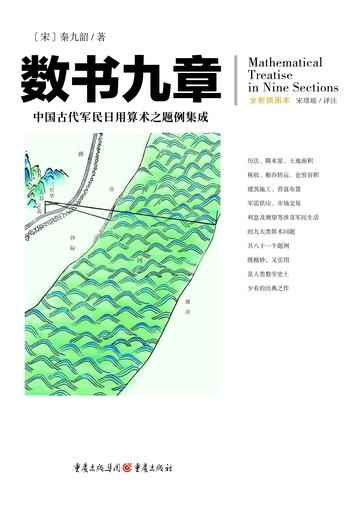





The book "Nine Chapters of the Book of Mathematics" is rich in content and covers many fields, and some of the calculation methods and empirical constants mentioned in it are still of reference value today. Just like the "Dayan Yi Technique" proposed by Qin Jiushao in "Dayan Class", compared with the similar calculation method of the German mathematician Gauss, it is more than 500 years earlier! Moreover, the language of this book is also very easy to understand, just like chatting with friends, making people feel very friendly. I think this book is very suitable for people who are interested in mathematics, and they will definitely gain a lot.