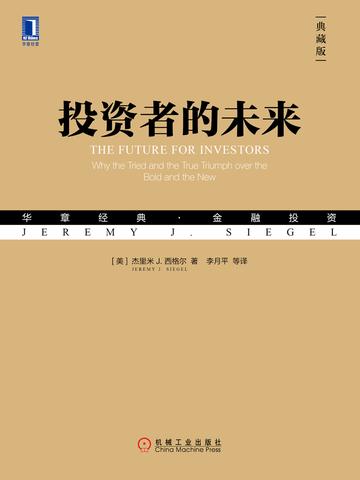
This book has a unique perspective and powerful conclusions, and is worthy of reading and reference by the majority of investors in my country. Conventional investment guides generally start from the basic principles of investment and use pricing theory to tell investors how to invest, but this is not the case in this book. The author abandons the more popular "value" investment strategies and "growth" investment strategies, examines investment strategies from the source of value, and emphasizes the importance of "valuation". At the same time, it analyzes the psychology of investors who have high expectations for fast-growing industries, and believes that fast-growing industries are not suitable for long-term investment. Finally, it predicts how social issues such as the "baby boom" and "aging population" will affect the financial market, providing investors with advice on adjusting their investment portfolio allocation.
Reader comments
It's an investor's compass that shatters conventional wisdom and provides a framework for selecting stocks for those seeking to be winners over the long term. This book, both in terms of perspective and conclusions, is worthy of reading and reference by investors. I also learned a lot of knowledge about economic management, such as examining investment strategies from the source of value. While emphasizing the importance of "valuation", I also analyzed investors' psychology of overexpecting high-speed growth industries. Finally, my unique insights into predicting how social issues such as "population aging" will affect the financial market are also very avant-garde. This book made me understand that investment direction is not blind. It also made me reflect on life, such as investment. We must set clear goals. Only in the right direction can we go further and further.
Financial markets do not operate independently of society, and it is obvious that methods that focus purely on the logic of financial investment fail to pay attention to the essential properties of financial markets. On the one hand, investment is a psychological warfare, involving the objective recognition and adjustment of one's own psychological cognition, as well as the control of the psychology and behavior of other participants in the market; on the other hand, the operation of the financial market is always embedded in the external social environment and is affected by the future socio-economic growth potential and the world's political and economic pattern. Good investors should be aware of this.
In this ever-changing era, how investors can invest and minimize the chance of losing their money is the most important quality that an investor should possess and some methods on how to control their own money in the future and how to deal with their own money. The book introduces some situations that investors may face and how to deal with them so that their money can remain stable. This is what we should know and should do.
This book provided a unique perspective and powerful conclusion that left me deeply inspired. It does not tell you how to invest like a general investment guide, but analyzes investment strategies from the source of value. The author's analysis of investor psychology is also very good, which made me understand that high-speed growth industries are not necessarily suitable for long-term investment. In particular, predictions about the impact of social issues on financial markets gave me a clearer understanding of future investments. All in all, this is a book worth reading!
12 Chapters, 4 sections worth reading.
Very good investment book
Clear summary, general point of view
It shows what you need to pay attention to when investing in the future. It is well worth reading.
A good book, the author is very clear and has a high point of view.
After reading this book, I understand why Buffett does not invest in technology stocks.





It's an investor's compass that shatters conventional wisdom and provides a framework for selecting stocks for those seeking to be winners over the long term. This book, both in terms of perspective and conclusions, is worthy of reading and reference by investors. I also learned a lot of knowledge about economic management, such as examining investment strategies from the source of value. While emphasizing the importance of "valuation", I also analyzed investors' psychology of overexpecting high-speed growth industries. Finally, my unique insights into predicting how social issues such as "population aging" will affect the financial market are also very avant-garde. This book made me understand that investment direction is not blind. It also made me reflect on life, such as investment. We must set clear goals. Only in the right direction can we go further and further.
Financial markets do not operate independently of society, and it is obvious that methods that focus purely on the logic of financial investment fail to pay attention to the essential properties of financial markets. On the one hand, investment is a psychological warfare, involving the objective recognition and adjustment of one's own psychological cognition, as well as the control of the psychology and behavior of other participants in the market; on the other hand, the operation of the financial market is always embedded in the external social environment and is affected by the future socio-economic growth potential and the world's political and economic pattern. Good investors should be aware of this.
In this ever-changing era, how investors can invest and minimize the chance of losing their money is the most important quality that an investor should possess and some methods on how to control their own money in the future and how to deal with their own money. The book introduces some situations that investors may face and how to deal with them so that their money can remain stable. This is what we should know and should do.
This book provided a unique perspective and powerful conclusion that left me deeply inspired. It does not tell you how to invest like a general investment guide, but analyzes investment strategies from the source of value. The author's analysis of investor psychology is also very good, which made me understand that high-speed growth industries are not necessarily suitable for long-term investment. In particular, predictions about the impact of social issues on financial markets gave me a clearer understanding of future investments. All in all, this is a book worth reading!
12 Chapters, 4 sections worth reading.
Very good investment book
Clear summary, general point of view
It shows what you need to pay attention to when investing in the future. It is well worth reading.
A good book, the author is very clear and has a high point of view.
After reading this book, I understand why Buffett does not invest in technology stocks.