Stats
Synopsis
No synopsis yet.
We haven’t got an English blurb for this one. It appears once the source description has been translated.
Reader comments
In booklists 9
Earth - Realm of Cultivation - Immortal Realm - Divine Realm - Holy Realm - Chaos Realm - Hongmeng Realm
Hongmeng Realm - Nothingness Realm - Annihilation Realm - Taichu Realm - Origin Realm - Source Realm
The Protagonist's Family Is Very Powerful, and He Is the Only Direct Heir.
The Best Historical Article on Tomato at Present, If You Don't Agree, Come and Argue
I want to read a book similar to "About the Southern Dynasty's Noble Young Master I Impersonated".
Leave a Big Book Empty
I would like to recommend two books with a large space. They are not too amazing, just short stories in ordinary life. I have read his two books three or four times. It seems that I just remembered it, so I flipped through it without re-reading. I just thought of that fragment and read it.
The Protagonist Takes the Ancients to See the WPC United Nations
The Book That Saved History and Geography
I want to read a book similar to "A Half-Hour Comic History of China (Five Volumes)". Similar to this
Looking for Historical Novels, Personally I Prefer Historical Novels
I want to read a book similar to "The Soul Crosses the Spring and Autumn Period and Becomes a Lord (The Little Lord of the Spring and Autumn Period)". Dear book friends, would you like to ask if there are any other realistic novels like "Medieval Life", "Spring and Autumn Little Lords" and "Diary of an Anxi Soldier" that focus on history, politics, economy, war and farming.
Guqiu Is a Book of the Same Type as "Kings of All Dynasties Have Descended One After Another Since Ying Zheng"
I would like to read a book similar to "Starting with Yingzheng: The Arrival of Kings from Past Dynasties". Fantasy history
Zizhi Tongjian Complete Book
I want to read a book similar to "Zi Zhi Tong Jian". Very good lecture, learn knowledge
Qin Xiaogong re-employed Wei Yang to start the reform. It took more than 20 years to change the poor and weak image of Qin and laid the foundation for the rise of the Qin Empire. King Qin Huiwen, the first king of the Qin Empire, and Zhang Yi, the first prime minister, complemented each other. Zhang Yi broke the alliance between Su and Qin with Liheng, which bought time for the rise of the Qin Empire. It further deepened the popular foundation of Wei Yang's reform, making Wei Yang's reform deeply rooted in the Qin State, further consolidating the foundation for the rise of the Qin Empire. King Wu of Qin fought bravely and fiercely, and finally went to Luoyang and Wang Ji raised a tripod and smashed him to death. He left his posthumous photos and was succeeded by King Zhaoxiang of Qin. King Zhaoxiang returned to Qin safely from the state of Yan under the escort of Bai Qi. He also met his mother, Queen Mother Xuan and Bai Qi Wei Ran. Under the protection of the generals, Ying Zhuang's rebellion was completely wiped out and he secured the throne. With the brave battles of Bai Qi and other generals and the careful transportation of military supplies by Prime Minister Wei Ran, he finally annihilated the 320,000-strong army of the Six Nations Allied Forces, completely shattering the Six Nations' conspiracy to destroy Qin. This battle became a classic example in the history of the Warring States Period, and Bai Qi became famous in this battle.
This classic work of cultivating a sword in ten years tells the story of the rise of the Qin Empire more than 2,000 years ago. The author has profound writing skills and is compatible with knowledge from hundreds of schools of thought including history, astronomy, geography, military strategists, and political strategists. He recreates the magnificent scenes of the war and the fate of the country, and also adds his own analysis of the demise of the six kingdoms. It is still a classic in the past 20 years.
Reading it 8 times is not enough! The mysteries of this book are endless, please savor this historical fantasy!
This book is very cost-effective. I came across it when I was in junior high school. I read it seven or eight times, and I remember it deeply. Unfortunately, Tomato is not free to read, and I couldn't read the book at home during college. I couldn't stand the last part of the book. The powerful and glorious Qin Empire was destroyed in such a ridiculous way. If Qin Xiaogong and Daliang Zao knew about it, they would be very sad. The old Qin Dynasty bravely fought against the national calamity together, long live the Qin Dynasty
Restore history and reproduce the true style of the Qin Empire for future generations, so that future generations can get out of the misunderstanding of tyrannical Qin and non-Qin, and no longer criticize Qin Shihuang and Qin's politics. We are emotional and proud that we once had such a great and selfless holy king.
Not only is the history rich, but also the literary power is worth learning.
Great, this book is worth reading more than five times
When I watched the first episode of The Fission of the Qin Empire, I was so excited that I couldn't sleep all night. I also finished watching Zongheng and Rise. This series has the epic quality of swallowing mountains and rivers, scheming the world, and stirring the heart. Especially the first part has a thick and deep plot, and the core ideas in it can be pondered by contemporary young people. Now let's watch the original work, hoping to have a better experience [Like]
After reading Mr. Sun Haohui's immortal work "The Great Qin Empire", people can clearly understand the magnificent historical picture of the Qin Dynasty from Qin Xiaogong to the ancestor Longshi Emperor. The glorious and profound history is slowly unfolding in front of the readers, correcting the theory that Qin did not violently conquer Qin. This work can be called an immortal work and is worth reading again and again.
It took me one year and six months to read "The Empire of Qin". I would like to thank the author and pay tribute to the author for letting me learn about the inspirational, hard-working, tenacious and wise Great Qin in the history of Chinese civilization. , Qin Zhuangxiang King Ying Yiren, to Qin Shihuang Ying Zheng, step by step from weak to reform and strengthen and then to unify the six countries, I often read: Jiujiu and Lao Qin, together faced the national disaster. I burst into tears when I read about Shang Yang and Lu Buwei's dedication to the common good of the world. I was so angry when I read about Zhao Gao, Li Si, and Hu Hai's later misdeeds... When I read about Mencius, Mozi, Xunzi, and Han Feizi, I gained even more admiration for the author! A masterpiece! It is worthy for every Chinese son and daughter to learn to read! ! !
The author's literary talent is advanced and delicate, and he depicts vivid and vivid characters! Especially the first part is very touching, the characters in it are vivid and vivid, which made me feel like I was inside the story, and their stories seemed to be happening before my eyes. The king is righteous and the minister is affectionate. Explaining their magnificent lives, their wisdom and perseverance are vividly displayed before your eyes. Be able to empathize with them and understand their true inner thoughts. The author outlines their words and deeds in a legendary way, making me think that this is a conversation between those charming ancestors from two thousand years ago. This is an article with a strong historical and legendary color. The technique is delicate and the language is appropriate. It demonstrates the style of China as a great country. It is worth reading.
Strong logic, multi-dimensional description, and rich content. The first and second parts are more exciting, and I still have more to say after watching (listening) them. The third and fourth parts were a little confusing for me, especially the fourth part, which I read three times from scratch and was still confused after reading it. The fifth part is slightly inferior to the first and second parts, but is more engaging than the third and fourth parts. The sixth part is very objective in its evaluation of the history of Qin. It is based on actual facts and made an in-depth analysis based on the social background of the time. It neither completely denies its value nor unanimously affirms it. I like this writing better. There are six parts in the book. I started reading (listening to) it on February 6, 2024, and read it on and off for more than a year. The first part was combined with the TV series, and I felt that it was very engaging. After reading the second part, I also wanted to watch it in combination with the TV series. But halfway through the TV series, I found that many characters and plots were very different from the descriptions in the book, so I finally gave up watching TV and returned to the text. During this period, I also purchased a complete set of books called "The Qin Empire", which I collected and read. I have to read this book over and over again, and the results will definitely be different each time.
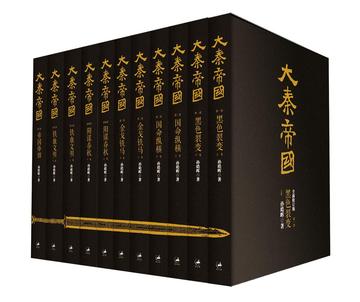
I started reading Daqin Empire in 13 or 14 years old. I bought the black hardcover version at home and it is still on my bookcase at home ten years later. It can be said that this series of books has opened up my understanding of Chinese history, although it is a bit exaggerated to say so. I can say with certainty that although there are certain fictional elements, the Great Qin Empire has a very detailed introduction and description of the rise and fall of each prince, including the Five Hegemons of the Spring and Autumn Period and even the Seven Heroes of the Warring States Period, involving the regional humanistic environment, customs and culture, and the level of economic development. It is very suitable for friends who just want to understand the culture of the Spring and Autumn Period and the Warring States Period. There is almost no threshold. The only thing you may need is to look up some uncommon words.
"The Qin Empire" is a long historical novel with great historical depth and literary value. The book was written by Sun Haohui. It takes the Qin State from weak to strong and finally unified the world as the main line. It shows the background of the warring states period when heroes competed for power and iron-blooded competition. First of all, from a historical perspective, "The Great Qin Empire" rigorously restores the historical process of the Qin State, including major historical events such as Shang Yang's Reform, Zhang Yilian's Hengda Zong, Bai Qi and Changping Battles, as well as key historical figures such as Qin Xiaogong and Qin Zhaoxiang. Through rich details and vivid descriptions, readers can immerse themselves in that changing era. Secondly, from a literary point of view, the author's writing style is smooth, the narrative is grand, and the historical events are cleverly combined with the character's personality and mentality, making the whole work rich in history without losing the artistic quality of literature. In addition, the book's analysis of national governance, intrigues, strategies, etc. Is also extremely profound, demonstrating the author's profound historical knowledge and literary skills. In addition, "The Great Qin Empire" has also successfully created a number of historical figures with distinctive personalities, such as the resolute and courageous Qin Xiaogong, the wise and cunning Zhang Yi, the ruthless Bai Qi, etc. These characters not only enrich the connotation of the novel, but also enable readers to have a deeper understanding of historical events and the background of the times. In general, "The Qin Empire" is an excellent historical novel that integrates history, literature, and characterization. It is undoubtedly a rare masterpiece for readers who like historical themes. It not only allows readers to appreciate the historical features of the Qin Dynasty during reading, but also gives readers profound inspiration and thinking. The characters are vividly drawn, the events are well-founded, and the plot is thrilling. Not only can you learn about history from it, but you can also ask questions and questions about historians, poets, and critics of various dynasties and generations. People will no longer have the feeling of preconception.
What I read in the library was an abridged version, and the author compressed and removed the sixth part. After reading five of them, each book is as thick as a brick🧱The ones I remember most about these five are Ying Quliang and Ying Zheng. The best kings have their own right-hand men, such as Wei Yang, Zhang Yi, Bai Qi, Wang Jian, Meng Yi and Meng Tian, etc. Although I am not good at history, I like the Qin Dynasty because Ying Zheng wanted to see how the Qin Dynasty was under the governance of Brother Zheng. My charming ancestor. But Zhao Gao, you kid, I, Brother Zheng, trust you the most, you🤬. My brother Zheng will not let you go! ! ! ! ! Fusu, Brother Zheng is the one who let you inherit the throne and loves you the most! ! ! !
I have experienced the author's writing skills and literary qualities in the Great Qin Empire Essence Edition. The writing is majestic, smooth, heroic, passionate and contagious, allowing readers to unknowingly enter the plot of the book while reading and feel the greatness of the world of great war at that time!
Wonderful and wonderful. I have to come and review it after listening to three parts. The first part is fission. Qin Xiaogong and Shang Martingale reform to strengthen the Qin Dynasty. The second part is vertical and horizontal. Winning King Huiwen and Zhang Yi. Su Qin. The third part is winning the king of Ji and Zhaoxiang. Fighting with gold and iron horses. The God of Killing Bai Qi and Fan Ju. The fourth part🔛
Based on a large number of historical documents, this book truly and objectively reproduces the difficult development process of the Warring States and Qin Dynasties until the unification of the six kingdoms to create the unified Qin Empire, and presents to readers a true and great Qin Shihuang, the one emperor through the ages! In addition, the writing technique of the author of this book is very good. He does not quote historical documents in rigid original texts, but writes in a unique way of expression that is close to vernacular but retains the charm of ancient prose. It will not be boring and confusing for readers, and it can also provide a more objective and in-depth understanding of history and historical figures!
I really can't read anymore. The First Emperor was indeed unprecedentedly great. He rarely made mistakes in his life. Once he made a mistake, it would be fatal. Especially when he later realized that the alchemist had deceived him and that he was seriously ill and that he was not going to die soon. He still refused to establish a crown prince and stubbornly insisted on going to Jiuyuan to see Fusu. As a result, he was devastated. Death, and Fusu. History books describe how suitable he is to be a monarch, but he is outrageously pedantic and stubborn. He has an army of 300,000 men. He and his father only have political disagreements. When faced with the death decree, he has no opinion or question. There is no one in the world who kills ministers because of political disagreements. , Not to mention whether he is a wise emperor or a father and son. Such a simple truth is not clear. He ignored how his subordinates persuaded Jian to meet the emperor to confirm the truth. Even if such a person became the emperor, the fate of the empire would be worrying. His ambition was not even one percent of that of the first emperor. Faced with the betrayal of his mother, the first emperor planned to kill himself with his lover and establish a new life. When Lao Ai's son became the King of Qin, although he was heartbroken, he immediately calmed down and carried out a counterattack. If it were Fusu, I would have died because my mother wanted me to die, and then there would be no unification of China. It took me nearly four months to read 90+% of it, and I understood the customs and customs of the Warring States Period. The whole book explains a truth, character determines destiny! Learn from history!
After reading the entire set of books, it feels like I have traveled through the history of the Warring States Period. I feel that the characters portrayed by the author are vivid in my mind. Each historical figure has its own human advantages and disadvantages, which are still the same today. It gave me a better understanding of the history of my hometown, Jimo. In short, the whole set of books will make people's hearts and souls feel inspired and memorable! Very nice!
It's a magnificent historical masterpiece. It's a pity that no one has read it. I don't know why no one has read serious literary masterpieces now. Internet novels are full of people.
I read physical books borrowed from the library during the day and listened to them at night. It was wonderful! Recommend! The love between the king and his subjects in the first part was really touching!
This book is a good reference book for the history of the Spring and Autumn and Warring States periods.
I haven't finished watching the first part yet, but I just finished watching the commentary for the first TV series a few days ago, so I wanted to write a review. The author Mr. Sun said in the preface that the Spring and Autumn Period and the Warring States Period were the time when the native civilization of the Chinese nation was conceived. After reading the first part, I really felt this way. In that era, hundreds of schools of thought contended, seven kingdoms competed for supremacy, and in a time of great strife, only the able ones prevailed; technological progress, institutional innovation, constant wars, and social changes... It was truly heart-wrenching to read. The ideas and scholar-official spirit born in that era are still dazzling today. Shang Jun said in the book: "Among the hundreds of schools of thought, there are many who are pragmatic and theoretical, but few who apply the world; there are many who are nostalgic for the past, but few who promote the trend of the times; there are many who are obsessed with details, but few who stick to the main points." Today, when I read history and historical novels, while I am nostalgic for the past, I am trying to find a glimmer of hope for myself, a moment of relief, or a glimpse of the future. History always has similarities, and what this book showed me is a historical method worth pondering over and over again.
It comprehensively explains the national strength and development of the Qin Dynasty. In the face of the five great powers, the Qin people used their wisdom and decision-making to make the Qin country strong and victorious. The realization of Liuhe provided a rare treasure trove of knowledge for the rise of subsequent dynasties and laid a solid foundation for Chinese civilization.
It's really beautiful. How much effort the author put into it [Like] [Like] Fei, there was a typo
Recreating the fission era of the Warring States Period with majestic writing power, the tragic rise of the old Qin Dynasty is shocking. The thunderous means of Shang Yang's reform and the heroic strategy of Qin Xiaogong are vividly displayed on the paper, and the feelings of family and country are fully displayed between the warriors and the iron horses.
I came here because of its reputation and planned to calm down and read it carefully to learn about my charming and great ancestors. The history is long and flowing. If there is one change, we would not be where we are now. Without the unification of Qin, there would be no unity among the 56 nationalities. Qin is great, and its merits outweigh its faults.
Very good! It would be perfect if the audio version of the audiobook version could be improved a little more. Being able to read for free is of great merit [Like][Like][Like][Like]
It's quite good. I watched it for two months and haven't finished the fourth part yet. The writing is delicate and engaging. Generally, when you read a novel, you forget it after reading it, but "The Qin Empire" can be remembered after reading it, and it can also be combined with history to deepen your memory. The first one is the most impressive, and the first TV series is also the best.