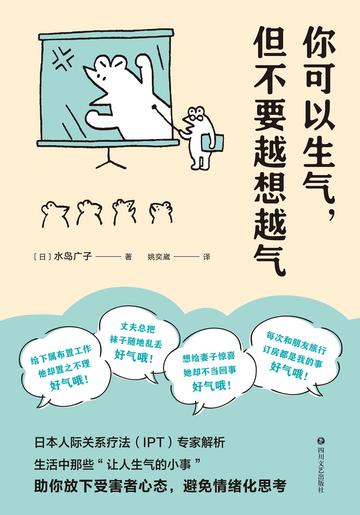
Many people are looking for ways not to get angry, such as suppressing patience, being positive and optimistic, etc. But the author of this book tells us: Those are not solutions to the problem in essence, because "emotional" is not the fault of the emotion, but the fault of the idea!
As an expert in interpersonal therapy (IPT), the author believes that negative emotions are not right or wrong in themselves. They just convey psychological messages to remind us to seek help or protect ourselves. In fact, what keeps anger growing is our "emotional thinking" - this kind of thinking is based on our inner "victim mentality" and our excessive pursuit of "rightness" due to a low sense of self-affirmation.
This book aims to address emotional distress at its essential level. The author analyzes those "little things that make people angry" in life, allowing readers to see the ins and outs of "emotional thinking", and also allows readers to understand how to express and communicate in such situations. In addition to analyzing the problem of "emotional thinking", the author also teaches us how to develop 7 habits to avoid emotional thinking, and how to deal with "flammable and explosive" people in life. This book uses clear and easy-to-read words to tell readers: when you understand your emotions and feel your inherently tough and gentle nature, you can learn to let your emotions protect you instead of trapping you.
Reader comments
When I see the title of this book, I will remember that every time I have a conflict with others, I am the silent party, and I am forced to think that I am wrong. And when I think of this incident late one night, I will review it, and the more I think about it, the angrier I get, thinking how I should have performed and how I should have spoken at that time. Many psychological books I have read advise you to be generous and do whatever you want. But this book is different. She thoroughly analyzed the value of my emotions. She affirmed the value of my negative emotions. I hope that one day I will let go of something right away after encountering it. People can't remember too many things and they will be overwhelmed.
Many cases in this book resonated with me, so I was deeply touched and benefited a lot.
1. Accept emotions. It's normal to have emotions
2. When others invade your territory, don't keep silent or get emotional. To communicate eg: "It's hurtful when you speak like this" and let the other party realize how I feel.
3. If you get emotional, you can
(1) When writing a friend's diary, first write about me....(Encounters), and then write down what my friend may advise me.
(2) Closing the window of the soul (I only understand this literally) is mainly to clear out the conditions that trigger one's emotions from the consciousness, but how to do it specifically may be difficult to implement at the time (you can't control yourself)
(3) Be self-identified! Be confident
This book analyzes the essence behind my emotions. [Thinking] When I think about it carefully, it seems that it is really the case. I suddenly feel that psychology/psychologists are very powerful hahahahahahahaha
Ahem, finally, thank you for the peace and comfort this book brings to my soul.
. . . . . . . . . . . . 2023/5/4 Ten o'clock in the evening [Note]
How to control our inner dissatisfaction is a required course for us modern people. The author expresses his views on anger simply and clearly through the title of the book. Indeed, when we feel angry or angry, we often find ourselves trapped in a negative emotional cycle. The more we dwell on angry thoughts, the more intense our emotions may become, even affecting our behavior and mental health. However, if we don't let ourselves be immersed in angry emotions and become more and more angry, it can help us manage our emotions better.
The author Mizushima Hiroko graduated from Keio University School of Medicine and Graduate School and holds a doctorate in medicine. He once worked in the Department of Neuropsychiatry at Keio University School of Medicine. While serving as a member of the House of Representatives from June 2000 to August 2005, he promoted the thorough revision of the Child Abuse Prevention Act. This book aims to address emotional distress at its essential level. The author analyzes those "little things that make people angry" in life, allowing readers to see the ins and outs of "emotional thinking", and also allows readers to understand how to express and communicate in such situations.
It's very well written. After reading it, I can understand why I always get emotional. Although it may not change in a short period of time, due to the great pressure recently, I have a tendency to have more frequent outbursts, and I may hurt my family and friends accidentally...
How to put it, emotions represent needs. Negative emotions such as anger and sadness mean that your needs are not taken seriously and you are hurt by the outside world. When others are angry and criticizing me, weak people see being bullied, while strong people see the other person feeling hurt, dissatisfied, not "seen", and disrespected. On the contrary, you can understand the other party's true thoughts and needs and resolve conflicts.
It is also important to see your own needs. Only by hugging yourself and understanding why you are emotional (the real deep reasons) can you comfort yourself. I find the therapy of being one's own friends to comfort oneself very interesting. I have kept diaries for many years and unintentionally used this method, pretending to be in the third person to talk to and write letters to myself. This allows me to have a sense of companionship, and I have written in my diary more than once, "The diary is my best friend." So writing a diary is also a way to understand yourself.
The writing style of this book is very clear and the content is easy to understand! It taught me the reasons for being emotional and taught me ways to avoid thinking emotionally. I think it is a bit similar to "Nonviolent Communication", both teaching us how to express our emotions better. Moreover, the "victim mentality" mentioned in the book reminded me of Er Qing in "Story of Yanxi Palace". She always feels that she is a victim, so she gets angry so easily. I think this book is not only helpful for us high school students, but also for adults!
Many people are looking for ways not to get angry, such as suppressing patience, being positive and optimistic, etc. But the author of this book told me: Those are not solutions to the problem in essence, because "emotional" is not the fault of the emotion, but the fault of the idea! I originally expected to learn about interpersonal therapy through this book, but this book does not introduce a complete theoretical system, but only provides some coping methods for some case situations. These methods are not supported by theory or data, nor are they very different from other psychological theories and cognitive behavioral therapy. Instead, they seem to have extracted and pieced together passages related to "emotion" from other theories and therapies, exaggerating the importance of "emotion", and only dealing with superficial behaviors without analyzing and solving the deep psychological roots.
When we are in a negative mood, we always try to persuade ourselves to think better. But does this really work? Often at this time we will despise ourselves, why do we always hold on to this point, and why are we always affected by this matter. See the essence through the phenomenon. This is not what bothers us. It's because the message conveyed by this incident feels disapproving and unacceptable. This book is different from other books I have read. It is short and concise. It also writes about an emotional person from a special perspective.
When we are in emotional trouble, more people want us to have a positive and optimistic attitude and not to be angry. But sometimes appropriate emotions are good for us. When we feel angry, it is our body's way of protecting itself. "The view of positive thinking is to deny and suppress your emotions like this. Over time, one day, you will either explode in the stagnation or perish in the stagnation." Always thinking about how to suppress your emotions and force yourself to be happy, over time, it is likely to cause greater harm to yourself. Learn to face your emotions correctly, learn to express them, and let your emotions protect you.
I was bullied as a student! Don't dare to fight back! I have been in a state of insecurity, self-loathing, and hating my own cowardice! Afraid of other people's eyes! Afraid of being yelled at loudly! After reading this book, I suddenly felt relieved!
I really like the last section, I learned a lot
It really makes sense and is very good.
Awesome, the examples given are concise and easy to understand. You can also add more content.
I have been having troubles lately. After reading this book, I learned how to deal with anger correctly. Thank you very much to the author [Blow kiss]
It should be replaced by hope, correctness should be replaced by truth, the victim should be replaced by injury, other people's anger is caused by his own inferiority and trauma, and empathy should be replaced by empathy and coexistence.
This book made me realize my emotional problems. I hope I will work hard to change my original thoughts. It's a very good book [Love] [Laughs]
A good choice to calm your mood
Essential for emotional instability
It makes sense. Don't be defensive and deviate when you are in trouble. Learn to change your thinking.
It's still okay. There is a sentence that you think is right, but others also think they are right.
Thanks to this book for helping me feel relieved now!
This book made me realize that when faced with my bad emotions, I should not reject them, but use a positive way to resolve them, so as to solve this "emotional" problem.
After reading it, some of the words were really enlightening. Respect each other, do not impose values on others, do not pursue "rightness" or "should", focus on self-feeling, dare to express emotions starting from "me", improve self-affirmation, and do not rely on or care about the evaluation of others.
This book is also very useful for those who have trouble sleeping [laughing][laughing]
Avoiding emotional thinking is the fast track to happiness. Reducing expectations of others is a catalyst for promoting close relationships. Let yourself be the master of your emotions~
Healing book ~ How can confused people better correct their emotions ~
Can see a comeback in emotional behavior.
It is a very practical book. It not only analyzes the causes of emotions thoroughly, but also provides adaptive solutions. The cases are also very representative. It is worth reading and practicing.




When I see the title of this book, I will remember that every time I have a conflict with others, I am the silent party, and I am forced to think that I am wrong. And when I think of this incident late one night, I will review it, and the more I think about it, the angrier I get, thinking how I should have performed and how I should have spoken at that time. Many psychological books I have read advise you to be generous and do whatever you want. But this book is different. She thoroughly analyzed the value of my emotions. She affirmed the value of my negative emotions. I hope that one day I will let go of something right away after encountering it. People can't remember too many things and they will be overwhelmed.
Many cases in this book resonated with me, so I was deeply touched and benefited a lot. 1. Accept emotions. It's normal to have emotions 2. When others invade your territory, don't keep silent or get emotional. To communicate eg: "It's hurtful when you speak like this" and let the other party realize how I feel. 3. If you get emotional, you can (1) When writing a friend's diary, first write about me....(Encounters), and then write down what my friend may advise me. (2) Closing the window of the soul (I only understand this literally) is mainly to clear out the conditions that trigger one's emotions from the consciousness, but how to do it specifically may be difficult to implement at the time (you can't control yourself) (3) Be self-identified! Be confident This book analyzes the essence behind my emotions. [Thinking] When I think about it carefully, it seems that it is really the case. I suddenly feel that psychology/psychologists are very powerful hahahahahahahaha Ahem, finally, thank you for the peace and comfort this book brings to my soul. . . . . . . . . . . . . 2023/5/4 Ten o'clock in the evening [Note]
How to control our inner dissatisfaction is a required course for us modern people. The author expresses his views on anger simply and clearly through the title of the book. Indeed, when we feel angry or angry, we often find ourselves trapped in a negative emotional cycle. The more we dwell on angry thoughts, the more intense our emotions may become, even affecting our behavior and mental health. However, if we don't let ourselves be immersed in angry emotions and become more and more angry, it can help us manage our emotions better.
The author Mizushima Hiroko graduated from Keio University School of Medicine and Graduate School and holds a doctorate in medicine. He once worked in the Department of Neuropsychiatry at Keio University School of Medicine. While serving as a member of the House of Representatives from June 2000 to August 2005, he promoted the thorough revision of the Child Abuse Prevention Act. This book aims to address emotional distress at its essential level. The author analyzes those "little things that make people angry" in life, allowing readers to see the ins and outs of "emotional thinking", and also allows readers to understand how to express and communicate in such situations.
It's very well written. After reading it, I can understand why I always get emotional. Although it may not change in a short period of time, due to the great pressure recently, I have a tendency to have more frequent outbursts, and I may hurt my family and friends accidentally... How to put it, emotions represent needs. Negative emotions such as anger and sadness mean that your needs are not taken seriously and you are hurt by the outside world. When others are angry and criticizing me, weak people see being bullied, while strong people see the other person feeling hurt, dissatisfied, not "seen", and disrespected. On the contrary, you can understand the other party's true thoughts and needs and resolve conflicts. It is also important to see your own needs. Only by hugging yourself and understanding why you are emotional (the real deep reasons) can you comfort yourself. I find the therapy of being one's own friends to comfort oneself very interesting. I have kept diaries for many years and unintentionally used this method, pretending to be in the third person to talk to and write letters to myself. This allows me to have a sense of companionship, and I have written in my diary more than once, "The diary is my best friend." So writing a diary is also a way to understand yourself.
The writing style of this book is very clear and the content is easy to understand! It taught me the reasons for being emotional and taught me ways to avoid thinking emotionally. I think it is a bit similar to "Nonviolent Communication", both teaching us how to express our emotions better. Moreover, the "victim mentality" mentioned in the book reminded me of Er Qing in "Story of Yanxi Palace". She always feels that she is a victim, so she gets angry so easily. I think this book is not only helpful for us high school students, but also for adults!
Many people are looking for ways not to get angry, such as suppressing patience, being positive and optimistic, etc. But the author of this book told me: Those are not solutions to the problem in essence, because "emotional" is not the fault of the emotion, but the fault of the idea! I originally expected to learn about interpersonal therapy through this book, but this book does not introduce a complete theoretical system, but only provides some coping methods for some case situations. These methods are not supported by theory or data, nor are they very different from other psychological theories and cognitive behavioral therapy. Instead, they seem to have extracted and pieced together passages related to "emotion" from other theories and therapies, exaggerating the importance of "emotion", and only dealing with superficial behaviors without analyzing and solving the deep psychological roots.
When we are in a negative mood, we always try to persuade ourselves to think better. But does this really work? Often at this time we will despise ourselves, why do we always hold on to this point, and why are we always affected by this matter. See the essence through the phenomenon. This is not what bothers us. It's because the message conveyed by this incident feels disapproving and unacceptable. This book is different from other books I have read. It is short and concise. It also writes about an emotional person from a special perspective.
When we are in emotional trouble, more people want us to have a positive and optimistic attitude and not to be angry. But sometimes appropriate emotions are good for us. When we feel angry, it is our body's way of protecting itself. "The view of positive thinking is to deny and suppress your emotions like this. Over time, one day, you will either explode in the stagnation or perish in the stagnation." Always thinking about how to suppress your emotions and force yourself to be happy, over time, it is likely to cause greater harm to yourself. Learn to face your emotions correctly, learn to express them, and let your emotions protect you.
I was bullied as a student! Don't dare to fight back! I have been in a state of insecurity, self-loathing, and hating my own cowardice! Afraid of other people's eyes! Afraid of being yelled at loudly! After reading this book, I suddenly felt relieved!
I really like the last section, I learned a lot
It really makes sense and is very good.
Awesome, the examples given are concise and easy to understand. You can also add more content.
I have been having troubles lately. After reading this book, I learned how to deal with anger correctly. Thank you very much to the author [Blow kiss]
It should be replaced by hope, correctness should be replaced by truth, the victim should be replaced by injury, other people's anger is caused by his own inferiority and trauma, and empathy should be replaced by empathy and coexistence.
This book made me realize my emotional problems. I hope I will work hard to change my original thoughts. It's a very good book [Love] [Laughs]
A good choice to calm your mood
Essential for emotional instability
It makes sense. Don't be defensive and deviate when you are in trouble. Learn to change your thinking.
It's still okay. There is a sentence that you think is right, but others also think they are right.
Thanks to this book for helping me feel relieved now!
This book made me realize that when faced with my bad emotions, I should not reject them, but use a positive way to resolve them, so as to solve this "emotional" problem. After reading it, some of the words were really enlightening. Respect each other, do not impose values on others, do not pursue "rightness" or "should", focus on self-feeling, dare to express emotions starting from "me", improve self-affirmation, and do not rely on or care about the evaluation of others.
This book is also very useful for those who have trouble sleeping [laughing][laughing]
Avoiding emotional thinking is the fast track to happiness. Reducing expectations of others is a catalyst for promoting close relationships. Let yourself be the master of your emotions~
Healing book ~ How can confused people better correct their emotions ~
Can see a comeback in emotional behavior.
It is a very practical book. It not only analyzes the causes of emotions thoroughly, but also provides adaptive solutions. The cases are also very representative. It is worth reading and practicing.