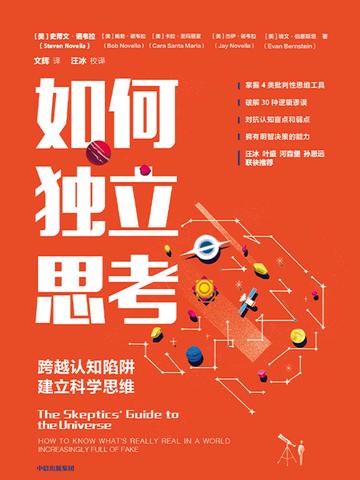
In the "post-truth" era, our world is filled with misinformation, prejudices, myths, pseudoscience, hoaxes, and flawed "knowledge." What should we believe and what should we doubt? How to think and make decisions? This book by Steven Novella, PhD from Yale University and internationally renowned podcast host, starts with four types of critical thinking tools and analyzes 30 types of logical fallacies in detail. Combined with a wealth of interesting cases, from ghost hunting experts to the anti-vaccination movement, as well as popular genetically modified myths, it helps us understand how to discuss conspiracy theories with crazy friends, how to persuade parents to reject pseudoscience and fake news, how to educate children to learn to think independently, and how to fight against hasty reasoning, poor arguments and superstitious thinking. "How to Think Independently" tells us that there are "design flaws" in our brains, and the first person we should doubt is ourselves. The scientific thinking toolbox provided in the book will help us see cognitive traps clearly, master critical thinking skills, easily distinguish between science and pseudoscience, become a person with independent thinking ability, and improve decision-making skills.
Reader comments
The book mentions that "our brains have 'design flaws', and the first person we should doubt is ourselves." This sentence is really enlightening. In the era of information explosion, we need to learn to think independently and not blindly believe everything. This book provides many practical methods so that we can distinguish between true and false and make more informed decisions. I think everyone should read it and make yourself smarter!
The book mentions that "our brains have 'design flaws', and the first person we should doubt is ourselves." This sentence is really enlightening. In the era of information explosion, we need to learn to think independently and not blindly believe everything. This book provides many practical methods so that we can distinguish between true and false and make more informed decisions. I think everyone should read it and make yourself smarter!
Very useful book