Stats
5.8Score
Synopsis
No synopsis yet.
We haven’t got an English blurb for this one. It appears once the source description has been translated.
We haven’t got an English blurb for this one. It appears once the source description has been translated.


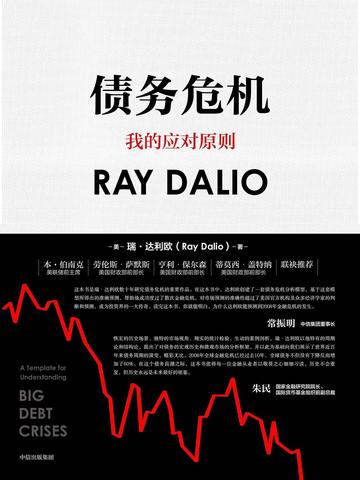
If you master the secrets of finance, you will master the key to wealth. This is not an exaggeration at all. Ray Dalio, one of the world's first-tier investors, sincerely shares his principles for dealing with debt crises in this book: explaining how debt crises occur and the principles that should be followed to properly respond to crises. Through the author's detailed narration, we can enhance our ability to resist risks, accurately foresee the development of events, and survive crises safely. The language is plain and vivid, and I benefited a lot from reading it.
This book provides a unique perspective to understand the debt crisis, and Dalio uses his experience and research to tell us how to respond to changes in the economy and markets. Reminds me of the book "The Intelligent Investor", which also provides practical investment strategies. As Buffett said: "Be fearful when others are greedy, and be greedy when others are fearful." In a debt crisis, we need to stay calm and follow principles in order to better deal with challenges. This book will be of great help to both investors and policymakers.
Readers who have read this book and can understand it will realize that this is a financial book that provides a template for understanding large-scale debt crises. This book can give readers a different perspective on things. When you learn to look at the debt crisis from the perspective of a model, you will be able to see mountains as mountains but not mountains, and water as water but not water. Everyone's cognitive level and thinking and cognitive ability are different. Therefore, when people look at the same thing with different phenomena and essences, the external appearance and inner essence of the thing they see are naturally completely different. What supports the model is logic and relationships, and what enables us to see through the essence of things are details and external phenomena. The search for causal relationships creates models, manifests essence, and balances inner wisdom.
A very good economic management book is written by the world's top investor Ray Dalio. The book provides a detailed analysis of the principles and mechanisms of the debt crisis, establishes a large model of the debt cycle, and proposes corresponding countermeasures to the debt crisis. The book also analyzes typical cases of the world's famous economic debt crises, such as the 2008 subprime mortgage crisis in the United States and the hyperinflation during the German Einstein period. Highly recommended to friends who are interested in economics.
The methodology for studying things mentioned by Dalio in the book is based on facts and full of useful information. Mainstream macroeconomic models assume conditions, and often the determinants of the facts are not one or several factors and are complex. At the same time, we analyze the debt macro-cycle model that has been constructed and is open to continuous improvement, Detailed analysis of 3 typical cases 1. Germany's Weimar Republic after World War I, 1918-1924 (main events of inflation and countermeasures) 2. From Bubble to Great Depression in the United States from 1928 to 1937 (responses to deflation) 3. The adjustment of the United States to the 2008 financial crisis 2007-2011 Comparative analysis of historical cases and data of 21 typical deflationary deleveraging cycles and 27 typical inflationary deleveraging cycles in different countries and different time periods. A significant contraction of the U. S. Economy is defined as: GDP fell by 3.3%, The unemployment rate rose to 8.9%, And house prices fell by 22%. Methods to solve the crisis: 1. Cut spending, 2. Debt default and restructuring, 3. Money printing and balance sheet expansion, 4. Transfer the wealth of people with high credit and high income to people with low credit and low income. Among them, 1 and 2 are austerity measures, and 3 is stimulus measures. The key is to strike a balance between stimulus measures and austerity measures. The best-case scenario is that debt-to-income ratios fall but economic activity and asset prices recover, allowing the economy to grow above nominal interest rates. When a country's economy hits bottom, there are some signals: 1. Imports fell off a cliff and its current account improved. From -6% GDP to positive 2% GDP. 2. Capital outflows have eased and stabilized. 3. The IMF provides capital assistance to the country. 4. Short-term interest rates began to fall, but long-term interest rates remained stable. 5. Currency price difference between futures and current prices narrows 6. Inflation stabilizes
Look at history in terms of currency substitution in the world economy. Looking at history through the economic debt cycle. Provides a different perspective.
The author is very professional
This is a very research-oriented book. It takes a little time to understand. It can be combined with AI.