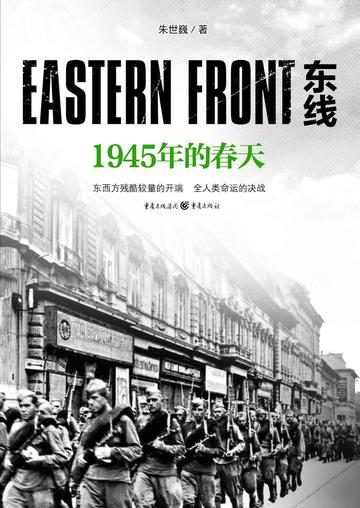
Stats
5.8Score
Synopsis
No synopsis yet.
We haven’t got an English blurb for this one. It appears once the source description has been translated.
We haven’t got an English blurb for this one. It appears once the source description has been translated.

From this book, I learned more details about World War II, and also learned more about World War II knowledge and events that I didn't know before. The Eastern Front in the title usually refers to the Eastern Front on the European battlefield during World War II, especially the front between Nazi Germany and the Soviet Union. Since 1945, the Soviet Red Army has continuously launched wars. First, starting in January 1945, the Soviet Red Army began the Vitebsk-Minsk Offensive, with the goal of liberating Minsk, the capital of Belarus. Since the launch of this war, the Soviet Union has gradually ushered in the spring.
The Battle of Berlin, also known as the Battle of Berlin, took place from April 16 to May 9, 1945. It was the last strategic offensive campaign carried out by the Soviet army during the Soviet-German War in World War II. During the Battle of Berlin, the army made extensive use of night fighting. In all front battles, artillery density reached its maximum value during the war, and the principle of establishing artillery groups at all levels based on organizational and tactical characteristics was most fully demonstrated. The Battle of Berlin was the last battle on the European battlefield in World War II. In a sense, it was a battle with far greater political significance than military significance.
In this book, Mr. Zhu Shiwei describes the changes in the war situation between the Soviet army and the German army from September 1944 to 1945. Every time I open a book about war, I dare not read on. The plot in the article makes me feel the cruelty of war. Those bloody scenes, the wailings from the soldiers, the freezing environment, and the barren land all made it difficult for me to continue reading. When talking about war, there is always darkness in front of us, and this dark road has no end in sight. It is despair, helplessness, and even death. The past has become history, and what is in front of us is now. We can only remember those countless souls who have passed away, and hope that they can have food, clothing and food in another world, and that there will be no more wars in the world.
A very historical novel that conforms to historical facts. If you are interested in the history of World War II, or you are a military fan, then this book will be completely to your liking. All the descriptions in the book are very detailed, and the description of the war is very complete. When I was reading, I felt as if I was immersed in the scene, which really made me sigh at the depth of the author's knowledge. All in all, this is a great book not to be missed! Also called a new recommendation for everyone to read!
As the sequel to "Eastern Front: The Great Collapse", the author reproduces the panoramic view of the Eastern Front in the spring of 1945 through vivid writing and detailed historical materials. During this period, the Soviet and German armies launched a desperate struggle. The German army suffered repeated defeats in the battles in Poland, East Prussia, and Hungary, and ultimately faced the fate of complete defeat. Through the restoration and analysis of these historical events, the author reveals the cruelty and devastation of the war at that time, as well as the deep harm it caused to the people. The entire book is extremely sophisticated both in terms of collection and arrangement of historical materials and in terms of written expression, from which we can perceive the reality, cruelty and human sorrow of war.
Time entered 1945, and the Third Reich also entered its moment of destruction!