Stats
5.8Score
Synopsis
No synopsis yet.
We haven’t got an English blurb for this one. It appears once the source description has been translated.
We haven’t got an English blurb for this one. It appears once the source description has been translated.
Friends who are familiar with "Director Fox" must be familiar with "Hai Cuo Tu". This is an encyclopedia of ancient creatures. Of course, most of them are marine creatures. It was once a book specially read by the royal family and is of very high value. For each biological species, this book is based on the original book and adds a preface by a famous person. At the same time, because the introductory text in the book is in classical Chinese and is limited by the cognitive level at the time, it may be biased. Therefore, the book adds contemporary general understanding of organisms before the main text, and adds many annotations to make the book easy for general readers to read.
Friends who are familiar with "Director Fox" must be familiar with "Hai Cuo Tu". This is an encyclopedia of ancient creatures. Of course, most of them are marine creatures. It was once a book specially read by the royal family and is of very high value. For each biological species, this book is based on the original book and adds a preface by a famous person. At the same time, because the introductory text in the book is in classical Chinese and is limited by the cognitive level at the time, it may be biased. Therefore, the book adds contemporary general understanding of organisms before the main text, and adds many annotations to make the book easy for general readers to read.
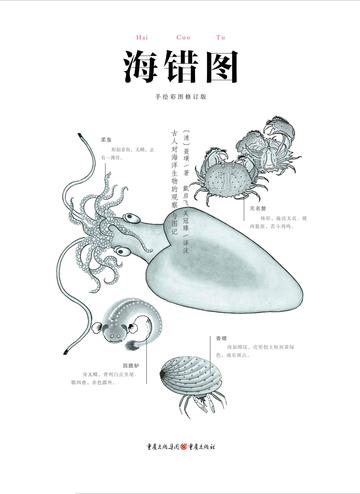
The book not only contains detailed and gorgeous meticulous paintings, but also the author's field observation records and documentary research for more than ten years. It can be said to be the last handed down marine life chart in ancient China. The book "Hai Cuo Tu" was handed over to the Qing Palace Construction Office by Su Peisheng, a close servant of Yongzheng, and was deeply loved by emperors such as Qianlong, Jiaqing and Xuantong. "Hai Cuo Tu" is divided into four volumes. The first three volumes are kept in the National Palace Museum in Beijing, and the fourth volume is in the National Palace Museum in Taipei. Because it is extremely precious, it is particularly rare to see it. This book meticulously records 255 entries and 336 species of creatures, most of which are marine creatures.
"Hai Cuo Tu" was written by Nie Huang, a writer in the Qing Dynasty, and has a history of more than 300 years. The book describes more than 300 marine creatures, including major groups of invertebrates and vertebrates. It also records many seaside plants and legendary magical creatures. It is recorded in detail in the form of pictures and text. It is the only set of books on marine life in the Qing Dynasty. The pictures are vivid and vivid. Compared with ordinary popular science stories, they are less boring and more humorous, making people look more relaxed and natural. You can also learn more about marine life through this book. There are many marine creatures involved. Nie Huang's unique painting method makes the creatures lifelike. You can not only appreciate the good pictures, but also learn a lot of marine knowledge.
This book "Hai Zhuo Tu" is simply great! The hand-painted pictures inside are so exquisite that they made me feel like I was in a magical ocean world. Moreover, this book also has detailed annotations and translations, making it easy for a novice like me to understand. I remember when my girlfriend and I went to the beach and saw those weird sea creatures, but I couldn't name them. I was really embarrassed at the time. Now with this book, I feel like I'm half an expert on marine life! Next time I go to the beach, I can educate my girlfriend about it!
As the only work handed down by the author Nie Huang, this atlas records the various creatures he saw and heard along the coast of China. Although the descriptions in the book are sometimes slightly exaggerated, they are full of wit and humor and were deeply loved by successive emperors of the Qing Dynasty. The word "bug" in the title of the book means the variety and complexity, that is, the wide variety of creatures in the ocean. This book can be regarded as an ancient illustrated book of marine life. This book not only retains the full text, but also contains professional annotations and translations, which lowers the reading threshold.
The book not only contains detailed and gorgeous meticulous paintings, but also the author's field observation records and documentary research for more than ten years. It can be said to be the last handed down marine life chart in ancient China. The book "Hai Cuo Tu" was handed over to the Qing Palace Construction Office by Su Peisheng, a close servant of Yongzheng, and was deeply loved by emperors such as Qianlong, Jiaqing and Xuantong. "Hai Cuo Tu" is divided into four volumes. The first three volumes are kept in the National Palace Museum in Beijing, and the fourth volume is in the National Palace Museum in Taipei. Because it is extremely precious, it is particularly rare to see it. This book meticulously records 255 entries and 336 species of creatures, most of which are marine creatures.
Are there any "Pictures of Mistakes by Land", "Pictures of Mistakes by Heaven" or "Pictures of Mistakes by Man"?
From a book in the Qing Dynasty to continuous exploration in modern times, the author's spirit is worth learning. Moreover, the logic of this book is clear, the writing is gray and humorous, and the illustrations are beautiful. I highly recommend it.