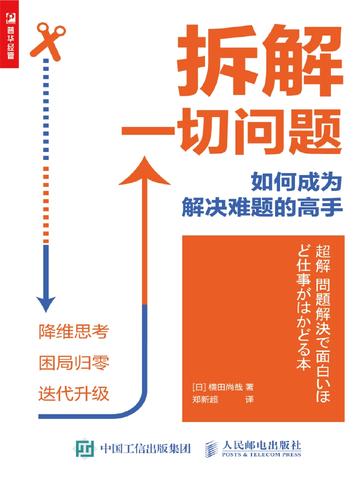
In work and life, we often face complex problems. But, can you really solve the problem? The key to solving problems lies in "dismantling", that is, by optimizing ideas, turning difficult problems into easy ones, dismantling and reconstructing them into specific executable steps, and then breaking through one by one to easily solve them.
"Dismantling All Problems" advocates a new thinking and methodology for dismantling problems in multiple dimensions. The book has 5 chapters, using "locking-analysis-creation-tempering-perfection" as the clue to concretely and clearly present the whole process of dismantling problems to readers. Each sub-process corresponds to a kind of dismantling thinking, which explains the specific application of ruler thinking, scissors thinking, needle and thread thinking, hammer thinking and screwdriver thinking in solving problems. The author also combines interesting cases in life to deeply interpret classic thinking methods such as "4M Management Method" and brainstorming, and provides 1 mind map, 4 dismantling lists, 5 dismantling guides, and more than 30 chapter maps, pointing out an innovative path to dismantling problems for readers.
"Dismantling All Problems" is not only suitable for professionals who want to learn how to solve problems efficiently and improve their personal abilities. It is also a guide for everyone to solve real-life problems, solve life problems, and achieve iterative upgrades of personal abilities.
Reader comments
In work and life, we will face many complex problems. The book teaches us how to dismantle complex problems and simplify complex problems to improve our work efficiency. First, clarify what the problem is, make sure you have an accurate understanding of the problem, and then break the problem down into smaller, more specific sub-problems. This helps break down complex problems into manageable pieces. Based on existing information and personal understanding, form a hypothesis to solve the problem, implement actions according to the plan, and take necessary measures to solve the problem. In addition, you must summarize the problem-solving process, review the effectiveness of the solution, and learn from experience and lessons.
Just like when my boyfriend and I encounter conflicts, I will use ruler thinking to measure the severity of the problem, scissors thinking to analyze the key to the problem, and then needle and thread thinking to solve the problem. These methods have made our relationship more stable and also taught me how to better deal with various problems in life. I think this book is not only suitable for people in the workplace, but also for everyone who wants to improve their problem-solving abilities.
The author advocates a new thinking and methodology for multi-dimensional problem-solving. The book has 5 chapters, using "locking-analysis-creation-tempering-perfection" as clues to concretely and clearly present the whole process of problem-solving to readers. Each sub-process corresponds to a kind of dismantling thinking, which explains the specific application of ruler thinking, scissors thinking, needle and thread thinking, hammer thinking and screwdriver thinking in solving problems. In work and life, we often face complex problems. But, can you really solve the problem? The key to solving problems lies in "dismantling", that is, by optimizing ideas, turning difficult problems into easy ones, dismantling and reconstructing them into specific executable steps, and then breaking through one by one to easily solve them.
In our daily life, there will inevitably be some huge difficulties that overwhelm us. How to face these difficulties and how to deal with them is what we should know and learn and understand. This book explains some of the troubles that may be encountered in daily life, including some insurmountable difficulties. At the same time, it specifically explains some useful methods for our daily life according to the explanation of each kind of suffering, so that we can have a clearer understanding of how to solve problems, so that our future can be smoother.
The writing is a bit professional and is generally suitable for innovative talents to break down problems.
Logical and operable
It should be noted that if you don't work hard when you are young, you will regret it when the book is used.
Introduced many tools and methods to solve problems
There are many methods, tables, and models that can be used to solve problems
Overall, it's good. It mainly talks about how to dismantle problems in industrial management. Of course, it can be used in other places. We need to apply it ourselves.
A book worthy of careful understanding and repeated consideration!







In work and life, we will face many complex problems. The book teaches us how to dismantle complex problems and simplify complex problems to improve our work efficiency. First, clarify what the problem is, make sure you have an accurate understanding of the problem, and then break the problem down into smaller, more specific sub-problems. This helps break down complex problems into manageable pieces. Based on existing information and personal understanding, form a hypothesis to solve the problem, implement actions according to the plan, and take necessary measures to solve the problem. In addition, you must summarize the problem-solving process, review the effectiveness of the solution, and learn from experience and lessons.
Just like when my boyfriend and I encounter conflicts, I will use ruler thinking to measure the severity of the problem, scissors thinking to analyze the key to the problem, and then needle and thread thinking to solve the problem. These methods have made our relationship more stable and also taught me how to better deal with various problems in life. I think this book is not only suitable for people in the workplace, but also for everyone who wants to improve their problem-solving abilities.
The author advocates a new thinking and methodology for multi-dimensional problem-solving. The book has 5 chapters, using "locking-analysis-creation-tempering-perfection" as clues to concretely and clearly present the whole process of problem-solving to readers. Each sub-process corresponds to a kind of dismantling thinking, which explains the specific application of ruler thinking, scissors thinking, needle and thread thinking, hammer thinking and screwdriver thinking in solving problems. In work and life, we often face complex problems. But, can you really solve the problem? The key to solving problems lies in "dismantling", that is, by optimizing ideas, turning difficult problems into easy ones, dismantling and reconstructing them into specific executable steps, and then breaking through one by one to easily solve them.
In our daily life, there will inevitably be some huge difficulties that overwhelm us. How to face these difficulties and how to deal with them is what we should know and learn and understand. This book explains some of the troubles that may be encountered in daily life, including some insurmountable difficulties. At the same time, it specifically explains some useful methods for our daily life according to the explanation of each kind of suffering, so that we can have a clearer understanding of how to solve problems, so that our future can be smoother.
The writing is a bit professional and is generally suitable for innovative talents to break down problems.
Logical and operable
It should be noted that if you don't work hard when you are young, you will regret it when the book is used.
Introduced many tools and methods to solve problems
There are many methods, tables, and models that can be used to solve problems
Overall, it's good. It mainly talks about how to dismantle problems in industrial management. Of course, it can be used in other places. We need to apply it ourselves.
A book worthy of careful understanding and repeated consideration!