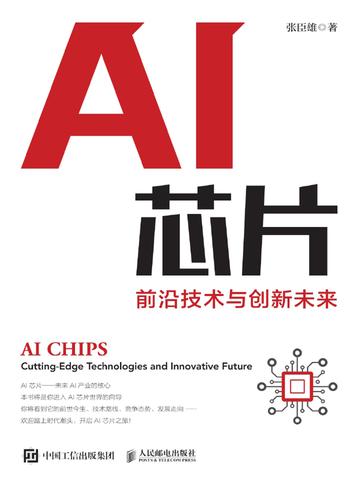
This book starts from the history of AI development and introduces the related algorithms, architecture, circuits, etc. Of the most popular deep learning acceleration chips and neuromorphic computing-based brain-like chips. It also introduces some famous AI chips in the industry and academia in recent years, including generative adversarial network chips and deep reinforcement learning chips. This book focuses on using innovative thinking to design various computing paradigms for AI chips, as well as several examples of next-generation AI chips, including quantum-inspired AI chips, AI chips that further enhance intelligence, organic self-evolving AI chips, photonic AI chips, and self-powered AI chips. This book also introduces the development trend of semiconductor chip technology in the "post-Moore's Law era", as well as basic theories (such as quantum field theory, information theory, etc.) That lead AI chip innovation and will continue to play a huge role. Finally, the book introduces the three levels of AI development, the gap between AI chips and biological brains, and the future development direction.
This book can be used as a reference for graduate students, undergraduates, engineering and technical personnel studying and working in the field of AI chips, and all people interested in AI chips.
Reader comments
This book is very interesting! It introduces a lot of knowledge about AI chips, including various algorithms, architectures and innovative thinking. I particularly like the part in the book about next-generation AI chip examples, like quantum-inspired AI chips, which feels so cool! Moreover, I think the "three levels of AI development" mentioned in the book are also very inspiring. In short, this is a book worth reading and can be understood even by non-professionals.





This book is very interesting! It introduces a lot of knowledge about AI chips, including various algorithms, architectures and innovative thinking. I particularly like the part in the book about next-generation AI chip examples, like quantum-inspired AI chips, which feels so cool! Moreover, I think the "three levels of AI development" mentioned in the book are also very inspiring. In short, this is a book worth reading and can be understood even by non-professionals.