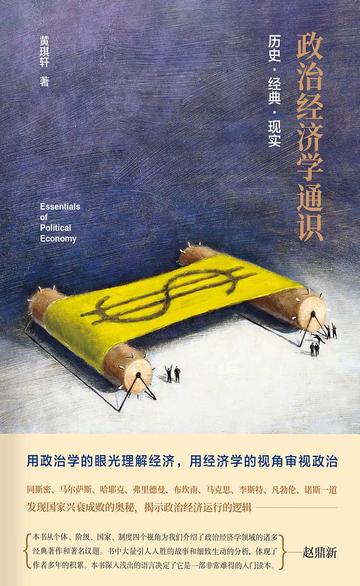
This book is a general reading on political economics. The author starts from more than 50 realistic issues of contemporary political economy such as "Why there are more religious people in the United States than in Europe", "Why openness is conducive to peace and security", "Why the turnout rate in the US presidential election is on a downward trend", "Why the happiness of the Japanese has declined", etc., And introduces important representatives of political economy such as Adam Smith, Malthus, Hayek, Friedman, Marx, Hilferding, Sweezy, List, Veblen, North and other important representatives of political economy and their classic works. While interpreting the classics, it also focuses on the four perspectives of political economics centered on the individual, class, country, and system, and comprehensively introduces how political economists of different schools view the differences in the interaction between the government and the market. The book integrates important classics, basic perspectives and historical issues of political economics, achieving a dialogue between classic political economics and contemporary issues, and inspiring readers to re-understand the connotations of freedom, competition, choice, class, country, and system.
Reader comments
This book is very interesting. It starts from some practical problems and introduces many classic theories of political economy. I particularly liked the comparison of different schools of thought in the book, which made me think more deeply about the relationship between the government and the market. This reminds me of Hayek's "The Road to Serfdom," which also explores the relationship between free markets and government intervention. However, this book is more like a general reader, suitable for friends who are interested in political economics.





This book is very interesting. It starts from some practical problems and introduces many classic theories of political economy. I particularly liked the comparison of different schools of thought in the book, which made me think more deeply about the relationship between the government and the market. This reminds me of Hayek's "The Road to Serfdom," which also explores the relationship between free markets and government intervention. However, this book is more like a general reader, suitable for friends who are interested in political economics.