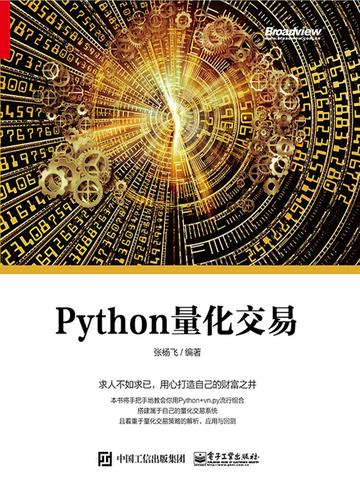
Based on the principle of allowing novices to quickly get started with quantitative trading, this book gradually explains the knowledge required to get started with quantitative trading, as well as a large number of development skills and trading skills, which is highly practical. Vn. Py is an institutional-level quantitative trading software. Mastering the principles of the vn. Py framework and using it proficiently will help novices quickly build their own quantitative trading system. The Python language has a very powerful data analysis library, which has natural advantages for the development of trading strategies, and its ease of learning is also popular among beginners. This book is written with the popular combination of Python+vn. Py. It starts from the origin and development process of quantitative trading. After briefly introducing the basics of quantitative programming in Python and analyzing the vn. Py architecture in detail, it provides an in-depth and comprehensive introduction to the CTA strategy, turtle strategy, and the development process of new strategies.
Reader comments
Securities trading is a modern emerging economy. Winners will make a lot of money, while losers often lose everything. Quantitative trading turns investors' trading concepts into solid computer calculations, preventing the interference and obstruction of investors' subjective emotions. Quantitative trading is a method of success that can be followed, and you can discover patterns and copy success. Use the concepts of modern statistics to analyze historical data to predict market and price changes, realize automatic trading, and expand trading volume.
This book is very practical! It starts from the origin of quantitative trading, introduces the basics of Python quantitative programming and the vn. Py architecture, and is very friendly to novices like me. The book also mentioned that "Another advantage of quantitative trading is that its successful methods can be traced." This sentence gave me a lot of inspiration. The author must have put a lot of thought into writing this book. I feel that he is very professional in quantitative trading and understands the needs of novices. All in all, this book is well worth reading.
Quantitative trading has gradually become mainstream with the development of financial markets. Different from traditional trading methods, quantitative trading builds a more rational, objective and effective trading plan based on comprehensive statistical methods and information technology. The emergence of Python, a powerful data analysis tool, provides the possibility of optimization for quantitative trading, further improving its functionality and applicability. This book systematically introduces the basics of Python programming and its quantitative trading tools, allowing novices to quickly acquire quantitative trading capabilities through content reading and operational training.
There are some people around me who play stocks and futures, but they are just for fun, and I have never seen what tools they use. But after reading this book, I realized that the people around me use subjective trading, that is, they use their gossip about the international environment, financial news, and even their circle of friends to conduct a very superficial analysis and investment in stocks. Relatively speaking, quantitative trading not only focuses on historical data, but also converts market sentiment, financial news keywords, etc. Into indicators that can be understood by machines, thereby using mathematical and statistical methods to perform multi-dimensional quantitative analysis. The latter is undoubtedly more accurate, efficient, and less risky. After reading this book, I decided to recommend this book to my friends, so that they can also learn this scientific and advanced trading method and make more money.
This book should be very friendly to beginners in the field of quantitative trading. The author not only explains the content of quantitative trading from a beginner's perspective, using simple and easy-to-understand language, step by step, but also teaches readers how to install and use the vn. Py software to quickly build their own quantitative trading system. There is also actual strategy analysis, including the introduction of domestic and foreign classic strategies and new strategies, which is both practical and timely. Moreover, the last chapter also describes the process of developing new strategies, allowing readers to prepare for actual combat. It is a complete nanny-level tutorial. Newbies in futures trading and quantitative trading are recommended to study this book.




Securities trading is a modern emerging economy. Winners will make a lot of money, while losers often lose everything. Quantitative trading turns investors' trading concepts into solid computer calculations, preventing the interference and obstruction of investors' subjective emotions. Quantitative trading is a method of success that can be followed, and you can discover patterns and copy success. Use the concepts of modern statistics to analyze historical data to predict market and price changes, realize automatic trading, and expand trading volume.
This book is very practical! It starts from the origin of quantitative trading, introduces the basics of Python quantitative programming and the vn. Py architecture, and is very friendly to novices like me. The book also mentioned that "Another advantage of quantitative trading is that its successful methods can be traced." This sentence gave me a lot of inspiration. The author must have put a lot of thought into writing this book. I feel that he is very professional in quantitative trading and understands the needs of novices. All in all, this book is well worth reading.
Quantitative trading has gradually become mainstream with the development of financial markets. Different from traditional trading methods, quantitative trading builds a more rational, objective and effective trading plan based on comprehensive statistical methods and information technology. The emergence of Python, a powerful data analysis tool, provides the possibility of optimization for quantitative trading, further improving its functionality and applicability. This book systematically introduces the basics of Python programming and its quantitative trading tools, allowing novices to quickly acquire quantitative trading capabilities through content reading and operational training.
There are some people around me who play stocks and futures, but they are just for fun, and I have never seen what tools they use. But after reading this book, I realized that the people around me use subjective trading, that is, they use their gossip about the international environment, financial news, and even their circle of friends to conduct a very superficial analysis and investment in stocks. Relatively speaking, quantitative trading not only focuses on historical data, but also converts market sentiment, financial news keywords, etc. Into indicators that can be understood by machines, thereby using mathematical and statistical methods to perform multi-dimensional quantitative analysis. The latter is undoubtedly more accurate, efficient, and less risky. After reading this book, I decided to recommend this book to my friends, so that they can also learn this scientific and advanced trading method and make more money.
This book should be very friendly to beginners in the field of quantitative trading. The author not only explains the content of quantitative trading from a beginner's perspective, using simple and easy-to-understand language, step by step, but also teaches readers how to install and use the vn. Py software to quickly build their own quantitative trading system. There is also actual strategy analysis, including the introduction of domestic and foreign classic strategies and new strategies, which is both practical and timely. Moreover, the last chapter also describes the process of developing new strategies, allowing readers to prepare for actual combat. It is a complete nanny-level tutorial. Newbies in futures trading and quantitative trading are recommended to study this book.