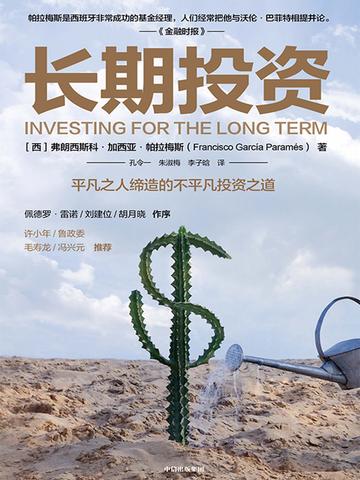
The Value Investment Secrets of a Legendary Investor This book inherits the value investment concepts of Benjamin Graham, Warren Buffett, and Peter Lynch, combined with the business cycle theory of the Austrian School of Economics, details the author's boyhood and nearly 30 years of investment experience, and introduces very practical investment strategies. This book is not only a personal memoir, but also an investment tactics manual. It details how an influential thought leader made difficult choices and measured risks, and successfully shaped his outstanding management talents and dazzling career. Throughout the process, readers can re-understand economics and social forces, rethink the market and people's hearts, readjust investment ideas, and gain insights into long-term investment.
Reader comments
Corporate investment is different from investment by individuals or professional investment institutions. Corporate investment is direct investment, that is, cash is directly invested in productive assets and then used to carry out operating activities and obtain cash. Individuals or professional investment institutions invest cash in enterprises, and then the enterprises use the cash to reinvest in operating assets, which is an indirect investment. Direct investment investors (enterprises) continue to control physical assets after investment, and therefore can directly control investment returns; indirect investment investors (enterprise creditors and shareholders) do not directly control operating assets after investment, so they can only indirectly control investment return through contracts or changing agents.
The ancients said that people should not be short-sighted and only focus on immediate interests. Sometimes it is necessary to take a long-term view to catch the big fish. Long-term investment refers to the external investment of enterprises that are not prepared to be liquidated at any time and are held for more than one year. Long-term returns are reflected in three aspects. First, the development of the enterprise and the return of stock prices to normal valuation processes. The second is long-term fixed dividend income. 3. Minimize the time spent on a single investment product. 4. Long-term investment avoids the economic and political systemic risks of the market.
Why do so many people fail to grasp the secrets of investing? It is closely related to people's lack of planning for future needs, lack of willpower, and the shortness and uncertainty of human life. In this book, the author leads us in-depth into the basic principles and techniques of investment, helping more people open the door to a new world. At the same time, the author's investment thinking can help us control those more short-sighted impulses, help more people avoid property risks and obtain more returns, and improve people's quality of life and happiness in life.
Long-term investment refers to the continuous investment in certain assets or securities over a relatively long period of time, usually including stocks, funds, real estate, etc. Unlike short-term investment, long-term investment focuses on the appreciation potential of assets and future income stability, rather than earning high profits in a short period of time. The advantage of long-term investing is that it minimizes the risks posed to the investment by market fluctuations and allows investors to enjoy long-term growth in the value of their assets. At the same time, long-term investment also leaves enough time for investors to learn, observe and analyze market trends to make more informed investment decisions.
Compared with short-term speculation and quick trading, long-term investment focuses on long-term appreciation and stable investment returns. The methods of long-term investment are very different from short-term investment. The author gives some reference methods and suggestions in this book. Selecting high-quality assets with good fundamentals and long-term growth potential is key to long-term investing. We need to relatively carefully study and analyze the company's financial status, industry prospects, management team and other factors to make wise investment decisions.










Corporate investment is different from investment by individuals or professional investment institutions. Corporate investment is direct investment, that is, cash is directly invested in productive assets and then used to carry out operating activities and obtain cash. Individuals or professional investment institutions invest cash in enterprises, and then the enterprises use the cash to reinvest in operating assets, which is an indirect investment. Direct investment investors (enterprises) continue to control physical assets after investment, and therefore can directly control investment returns; indirect investment investors (enterprise creditors and shareholders) do not directly control operating assets after investment, so they can only indirectly control investment return through contracts or changing agents.
The ancients said that people should not be short-sighted and only focus on immediate interests. Sometimes it is necessary to take a long-term view to catch the big fish. Long-term investment refers to the external investment of enterprises that are not prepared to be liquidated at any time and are held for more than one year. Long-term returns are reflected in three aspects. First, the development of the enterprise and the return of stock prices to normal valuation processes. The second is long-term fixed dividend income. 3. Minimize the time spent on a single investment product. 4. Long-term investment avoids the economic and political systemic risks of the market.
Why do so many people fail to grasp the secrets of investing? It is closely related to people's lack of planning for future needs, lack of willpower, and the shortness and uncertainty of human life. In this book, the author leads us in-depth into the basic principles and techniques of investment, helping more people open the door to a new world. At the same time, the author's investment thinking can help us control those more short-sighted impulses, help more people avoid property risks and obtain more returns, and improve people's quality of life and happiness in life.
Long-term investment refers to the continuous investment in certain assets or securities over a relatively long period of time, usually including stocks, funds, real estate, etc. Unlike short-term investment, long-term investment focuses on the appreciation potential of assets and future income stability, rather than earning high profits in a short period of time. The advantage of long-term investing is that it minimizes the risks posed to the investment by market fluctuations and allows investors to enjoy long-term growth in the value of their assets. At the same time, long-term investment also leaves enough time for investors to learn, observe and analyze market trends to make more informed investment decisions.
Compared with short-term speculation and quick trading, long-term investment focuses on long-term appreciation and stable investment returns. The methods of long-term investment are very different from short-term investment. The author gives some reference methods and suggestions in this book. Selecting high-quality assets with good fundamentals and long-term growth potential is key to long-term investing. We need to relatively carefully study and analyze the company's financial status, industry prospects, management team and other factors to make wise investment decisions.
Must-read books for price investing
It strengthened my idea of long-term investment