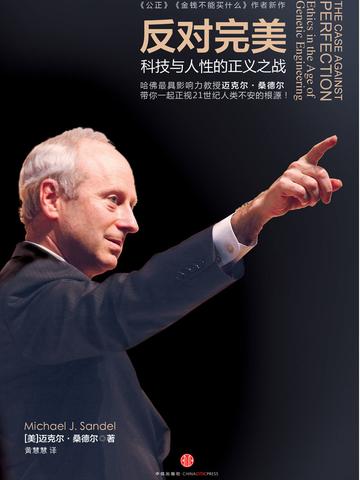
"Against Perfection: The Just Battle between Technology and Humanity is Harvard professor Sandel's work after "Justice" and "What Money Can't Buy". It once again starts from social hot spots and inspires us to grasp real problems more deeply through rational thinking.
In the book, the author keenly points out that the pursuit of perfection by human beings using high-tech means is becoming an increasingly strong trend: parents will be able to freely customize the innate characteristics of their children in the genetic supermarket; athletes will be able to improve their performance on the field through genetic modification; students will be able to take memory pills instead of studying hard in the cold window... Will this bring about individual liberation or social chaos? Sandel pointed out that mankind's use of technology to pursue perfection may seem like a mass carnival, but in fact it contains a deep crisis - the moral foundation that maintains human society is likely to collapse, and mankind's status in the universe will also be disrupted. Through clear arguments and concise language, we will gradually realize that behind the "anti-perfection" stance, the author has a deep thinking about man's position in heaven and earth, and a deep concern for the destiny of mankind. "
Reader comments
This is an interesting book that explores the relationship between technology and human nature. The author's views on genetic technology are very profound, and it made me think about the impact of technological development on society. Some of the ideas in the book are very enlightening, such as his discussion of fairness and justice, which made me realize that there are no absolute answers to these questions. I like the rational thinking part of the book. It makes me have a more cautious attitude towards future technological development.




This is an interesting book that explores the relationship between technology and human nature. The author's views on genetic technology are very profound, and it made me think about the impact of technological development on society. Some of the ideas in the book are very enlightening, such as his discussion of fairness and justice, which made me realize that there are no absolute answers to these questions. I like the rational thinking part of the book. It makes me have a more cautious attitude towards future technological development.