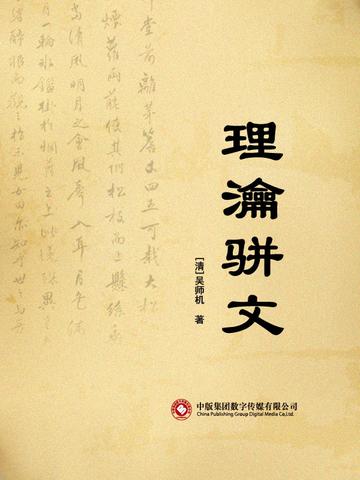
"Li Zhen Parallel Prose" was originally called "External Treatment Medical Theory" and was written in 1864 by Wu Shiji in the Qing Dynasty. The whole book is 1 volume, not divided into volumes. It is divided into four parts: brief introduction, continued addition of brief introduction, rationalization of parallel prose, and revision and delivery of prescriptions and methods of adding medicine in Cunjitang Pharmacy. The first part of the volume contains a "brief introduction", which summarizes the methods of external treatment; the main text describes the external treatment methods of various diseases such as typhoid fever, stroke, paralysis, carbuncle, boils, bruises, etc.; At the end of the book, the formulas and treatment methods of 21 plasters commonly used for external treatment are attached, as well as an article "Treatment of Heart Disease".
Reader comments
Dr. Wu Shiji's "Li Yi Parallel Essay" summarizes 120 external treatment methods. He proposed the five principles of external treatment based on the classification of syndromes by the three burners, observing yin and yang, distinguishing the five elements, seeking the pathogenesis, treating the condition, and distinguishing the form. The prescriptions in this book can cover 80-90% of common diseases. Each prescription can solve many different diseases of the same category, that is, the same syndrome but different diseases. According to historical records, he was a doctor who worked hard and had good medical ethics. He saw nearly 100-200 people every day. This work is the valuable wealth he accumulated in practice, and it is of great reference for our descendants.
A medical book written by Wu Shiji, a great medical master in the Qing Dynasty. This book has a long history and important position in ancient society and traditional medicine. For example, the introduction of acupuncture, massage, cupping, etc. Of traditional Chinese medicine belongs to the category of external medical treatment, and they are all described in detail in the book. In addition, some heat therapy, cold therapy, physical therapy and rehabilitation training can also be classified as external medicine. Readers who are interested in traditional Chinese medicine can read more.
It is sincere to say, "Nowadays people only talk about oral administration, which is not what the ancients did." External medicines are also internal medicines. The preface of this book says: "The principle of external treatment is the principle of internal treatment; the medicine of external treatment is also the medicine of internal treatment. The difference is Faer." Dr. Wu's external treatment method can not only treat surgical diseases, but also treat internal medicine, gynecology, pediatrics, facial features, etc. The content is very rich, the treatment method is simple and convenient, economical and practical, and the effect is remarkable. It is a unique and practical treatment method. It also has great reference value for the development of modern traditional Chinese medicine.
Treating diseases with traditional Chinese medicine is a very professional matter, and it requires a deep foundation of traditional Chinese medicine to accurately differentiate symptoms. For most ordinary people, they simply don't have the energy to study Chinese medicine in depth, and some diseases may not take that long. This book is very suitable for non-professionals to learn Chinese medicine. It does not have so high requirements for syndrome differentiation, but it can always solve problems. In the book, the author describes in detail the external treatment methods for various diseases and syndromes. The rich content not only gave me an overall understanding of traditional Chinese medicine, but also helped me solve most of the common problems in life.
This is the first time I read Wu Shiji's traditional Chinese medicine works. I had only read the "Huangdi Neijing" before. Wu Shiji is a master of traditional Chinese medicine and has his own school. Different from traditional Chinese medicine, Wu Shiji attaches great importance to and focuses on external treatment. In this book, he summarizes 120 external treatment methods. First summarize and then divide, first summarize the methods, and then explain in detail according to different diseases in the main text, including typhoid fever, stroke and other diseases. However, the organization of this book is not very clear, and it feels a bit confusing to read it in its entirety.
The author's writing style is concise and clear, and he also quotes examples from the "Nei Jing" and Zhong Jing, which makes people feel very deep. This reminds me of the "Huangdi Neijing". They are both classics of traditional Chinese medicine, but "Li Zhen Parallel Wen" focuses more on external treatment. The book says that "the principle of external governance is the principle of internal governance." Just like love, external expression and internal feelings are equally important! 😄
The treasures of traditional Chinese medicine have been left in the wilderness, poor and hateful Chinese people!
Dr. Wu Shiji's "Li Yi Parallel Essay" summarizes 120 external treatment methods. He proposed the five principles of external treatment based on the classification of syndromes by the three burners, observing yin and yang, distinguishing the five elements, seeking the pathogenesis, treating the condition, and distinguishing the form. The prescriptions in this book can cover 80-90% of common diseases. Each prescription can solve many different diseases of the same category, that is, the same syndrome but different diseases. According to historical records, he was a doctor who worked hard and had good medical ethics. He saw nearly 100-200 people every day. This work is the valuable wealth he accumulated in practice, and it is of great reference for our descendants.
A medical book written by Wu Shiji, a great medical master in the Qing Dynasty. This book has a long history and important position in ancient society and traditional medicine. For example, the introduction of acupuncture, massage, cupping, etc. Of traditional Chinese medicine belongs to the category of external medical treatment, and they are all described in detail in the book. In addition, some heat therapy, cold therapy, physical therapy and rehabilitation training can also be classified as external medicine. Readers who are interested in traditional Chinese medicine can read more.
It is sincere to say, "Nowadays people only talk about oral administration, which is not what the ancients did." External medicines are also internal medicines. The preface of this book says: "The principle of external treatment is the principle of internal treatment; the medicine of external treatment is also the medicine of internal treatment. The difference is Faer." Dr. Wu's external treatment method can not only treat surgical diseases, but also treat internal medicine, gynecology, pediatrics, facial features, etc. The content is very rich, the treatment method is simple and convenient, economical and practical, and the effect is remarkable. It is a unique and practical treatment method. It also has great reference value for the development of modern traditional Chinese medicine.
Treating diseases with traditional Chinese medicine is a very professional matter, and it requires a deep foundation of traditional Chinese medicine to accurately differentiate symptoms. For most ordinary people, they simply don't have the energy to study Chinese medicine in depth, and some diseases may not take that long. This book is very suitable for non-professionals to learn Chinese medicine. It does not have so high requirements for syndrome differentiation, but it can always solve problems. In the book, the author describes in detail the external treatment methods for various diseases and syndromes. The rich content not only gave me an overall understanding of traditional Chinese medicine, but also helped me solve most of the common problems in life.
This is the first time I read Wu Shiji's traditional Chinese medicine works. I had only read the "Huangdi Neijing" before. Wu Shiji is a master of traditional Chinese medicine and has his own school. Different from traditional Chinese medicine, Wu Shiji attaches great importance to and focuses on external treatment. In this book, he summarizes 120 external treatment methods. First summarize and then divide, first summarize the methods, and then explain in detail according to different diseases in the main text, including typhoid fever, stroke and other diseases. However, the organization of this book is not very clear, and it feels a bit confusing to read it in its entirety.
The author's writing style is concise and clear, and he also quotes examples from the "Nei Jing" and Zhong Jing, which makes people feel very deep. This reminds me of the "Huangdi Neijing". They are both classics of traditional Chinese medicine, but "Li Zhen Parallel Wen" focuses more on external treatment. The book says that "the principle of external governance is the principle of internal governance." Just like love, external expression and internal feelings are equally important! 😄
The treasures of traditional Chinese medicine have been left in the wilderness, poor and hateful Chinese people!