Stats
5.8Score
Synopsis
No synopsis yet.
We haven’t got an English blurb for this one. It appears once the source description has been translated.
We haven’t got an English blurb for this one. It appears once the source description has been translated.



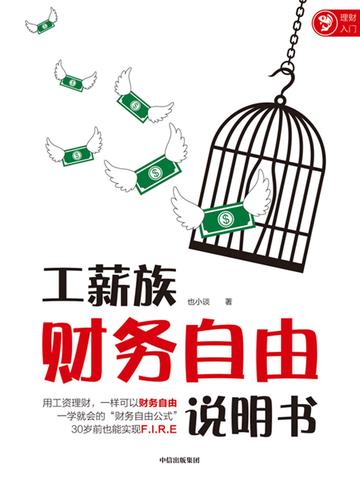
What is "financial freedom"? Most people only have a perceptual understanding of this term, such as being satisfied with food, housing, and transportation, shopping without looking at prices, or worrying about lack of money. This book explains another definition of "financial freedom", which is a quantifiable and rational level, such as passive income greater than expenses, commonly known as making money while lying down. "Financial freedom" focuses on "freedom" rather than "finance". "Financial freedom" allows you to do whatever you don't want to do. So, to truly achieve financial freedom, the author provides you with a reference through his own practice.
If salary earners want to achieve financial freedom and give themselves more financial and monetary relaxation, they must arrange their financial development in a regular and planned manner. The book gives very detailed methods to achieve this, including an introduction to how to increase the value of assets through financial management and investment, including real estate investment, stock investment and other financial management tools. The goal of the book is to help working people understand and deal with financial challenges, providing practical financial advice and tools so that they can better manage their finances, accumulate wealth, and ultimately achieve financial freedom.
Sometimes I wonder why we are living so hard. Is it because we don't work hard enough? In fact, it may be that our efforts are in the wrong direction. As long as you master the direction and methods, salaried workers can also achieve "financial freedom." The book proposes five steps: 1. Make a plan, make a quantifiable timetable, and clarify time nodes and goals and tasks. 2. Increase your active income and passive income. 3. Start saving and consume rationally. 4. Start investing, cultivate your own investment awareness, and maximize your returns. 5. Rational decision-making. The older you get, the less likely people will forgive you for being poor. The earlier you master financial management knowledge, the better.
It is a very practical guide and talks about a very rewarding point for me: the use of budget should be based on one year's accounting data, and an annual budget should be carried out. The monthly balance of the budget can be transferred to the next month, and the budgets of different categories can be transferred to each other. This way of doing things opened up my ideas for using budgets. It has been about a year and a half since I started accounting, but I don't know how to make a budget. Now I decided to try to operate according to the author's ideas, hoping to effectively increase my deposit rate and make myself more aware of where the money is spent.
This book is very good! Although the author Ye Xiaotan has not yet achieved financial freedom, he has shared his practical experience and financial management methods, which feels very real and inspiring. Moreover, his "Financial Freedom Formula" is very practical, easy to use, and very helpful for salary earners like us. I especially hate books that only talk about general principles but have no practical methods. This book is very down-to-earth, I recommend you read it too!
2025.8.6.18.00 This book is pretty good. If you don't know how to manage money, you can study and read it. If you do, you can review and consolidate it. But for those who like to read, they generally know how to manage money. After all, it is a part that is closely related to your own life. The author tells it very well. But it's not the level of knowledge I need, so I only finished a third of it.
The investment part is of little use to me. Based on 10% profit, the annual investment income is 50,000 yuan and I have financial freedom. The principal is at least 500,000 yuan. The risk is too high, so I'd better work hard. The 80/20 rule between consumption and happiness is very interesting. Excessive suppression of consumption does have a negative impact, making you less motivated to work.
The writing is really wonderful, and each chapter has comments that resonate, and it is relatively down-to-earth, which is rare for a person with financial freedom. But to be honest, this book still requires a little bit of financial management foundation to better adapt to the investment knowledge mentioned by the author. It is also easy to pick up and very familiar, which shows that the author has very rich experience. After reading it for the second time, I still feel unsatisfied. Is it suitable for most young people to read?
I plan to repay the money in my hand first, and then start financial management. I am 21 years old this year, and I hope to be able to arrange my own funds well before the age of 23.
It can indeed be called a manual. After reading it, I feel that it has roughly established a framework system that is suitable for workers to carry out practical operations. Of course, the most important thing is execution.
Not bad, worth learning
Very touching and worth watching.
You can still learn something.
It's very practical and provides some guidance on life.
It explains the profound things in simple terms and is very suitable for beginners to read. It is also very valuable for people with basic knowledge and needs to be studied carefully.