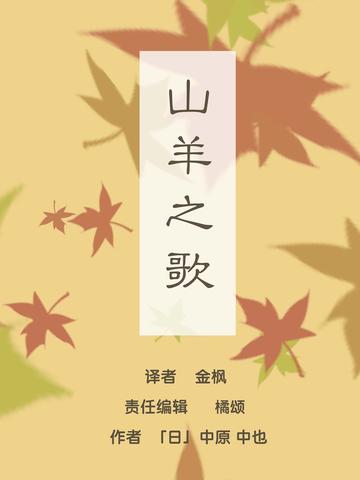
Nakahara Nakaya was a poet, singer, and translator during the Showa period, and was known as "Japan's Rimbaud." More than 350 poems have been handed down to this day, and some of them have been selected into Japanese Mandarin textbooks. His major works include the poetry collections "The Song of the Goat" (1934), "Songs of the Past" (1938), and the collection of translated poems "Selected Poems of Rimbaud". "Goat Song" is Nakahara Chuya's first collection of poems.
Reader comments
I originally came here for the literary field, but Zhongyuan Zhongya's writing is really good. I personally like the later works more, they are more delicate, the emotions are richer, and the writing is more mature.
Coming from a literary field, I feel that many of the sentences are very beautiful, but maybe my level is limited and I don't understand them well. I hope there will be some annotations.
There are really too few articles to read [almost crying] [almost crying] [almost crying]
Compared to Dazai-sensei's Chuuya-sensei's poems, you can see too few of them here.
I don't quite understand some of the words, but there is no doubt that Zhongyuan Zhongya is an excellent poet.
In this version of translation, even the confession letter is so sad.
It's a super good book, although I only read it for Nakahara Chuuya after watching Bungou Stray Dogs.
Like the moon, the goddess, and the chariot in this excerpt, it feels both mysterious and romantic. Moreover, his use of words is very unique, such as "angry eyes" and "lazy", which make the poem more flavorful. Although the plot of the story is not very coherent, each poem can make me have different associations, which is quite amazing! I think he is like Li Bai in Japan, a star in the poetry world!
This book needs to be read in quiet time. Because the images are very abstract and have a strong sense of artistic conception (there are many descriptions of nature and emotions, and the emotions are very delicate), the background of the poem's creation also needs to be understood, and you even need to imagine the background of each poem. But I seem to be able to see Zhongyuan Zhongya's sadness and loneliness from the poem.
If you sit alone on the grass or by the river, with the breeze blowing, you will enjoy reading this poem quietly! It is still recommended to read the physical book
"There is nothing more tragic than not knowing how to be sad." This sentence is absolutely perfect!
Zhongye's poems contain hope in sorrow, are full of rhythm and natural beauty.
Long live Nakahara Chuya≧▽≦! ! !
Angels playing basketballJPG
Whoops—whoops—whoops and whoops (re-reading for dementia)

I originally came here for the literary field, but Zhongyuan Zhongya's writing is really good. I personally like the later works more, they are more delicate, the emotions are richer, and the writing is more mature.
Coming from a literary field, I feel that many of the sentences are very beautiful, but maybe my level is limited and I don't understand them well. I hope there will be some annotations.
There are really too few articles to read [almost crying] [almost crying] [almost crying] Compared to Dazai-sensei's Chuuya-sensei's poems, you can see too few of them here.
I don't quite understand some of the words, but there is no doubt that Zhongyuan Zhongya is an excellent poet.
In this version of translation, even the confession letter is so sad.
It's a super good book, although I only read it for Nakahara Chuuya after watching Bungou Stray Dogs.
Like the moon, the goddess, and the chariot in this excerpt, it feels both mysterious and romantic. Moreover, his use of words is very unique, such as "angry eyes" and "lazy", which make the poem more flavorful. Although the plot of the story is not very coherent, each poem can make me have different associations, which is quite amazing! I think he is like Li Bai in Japan, a star in the poetry world!
This book needs to be read in quiet time. Because the images are very abstract and have a strong sense of artistic conception (there are many descriptions of nature and emotions, and the emotions are very delicate), the background of the poem's creation also needs to be understood, and you even need to imagine the background of each poem. But I seem to be able to see Zhongyuan Zhongya's sadness and loneliness from the poem. If you sit alone on the grass or by the river, with the breeze blowing, you will enjoy reading this poem quietly! It is still recommended to read the physical book
"There is nothing more tragic than not knowing how to be sad." This sentence is absolutely perfect!
Zhongye's poems contain hope in sorrow, are full of rhythm and natural beauty.
Long live Nakahara Chuya≧▽≦! ! !
Angels playing basketballJPG Whoops—whoops—whoops and whoops (re-reading for dementia)