Stats
5.8Score
Synopsis
No synopsis yet.
We haven’t got an English blurb for this one. It appears once the source description has been translated.
Reader comments
In booklists 3


Psychology! ! I Really Like It, Please Read It! Girls Like Psychology
I want to read a book like "Murphy's Law: Learn a little bit of psychology every day". Please recommend some psychological articles. I really like them. I hope to recommend some psychological books. I really like to read them. Please, guys! ! !
70.8MViews482Books1dUpdated

I Am Looking for Books to Improve Myself, Whether It Is About Knowledge or How to Deal with People.
I want to read a book like "Rich People Think Differently from You".
5.6MViews777Books17dUpdated

Is There Any Book That Can Make the Brain React Faster? (My Understanding of Mathematics Is Too Poor😔)
3.1MViews447Books5dUpdated
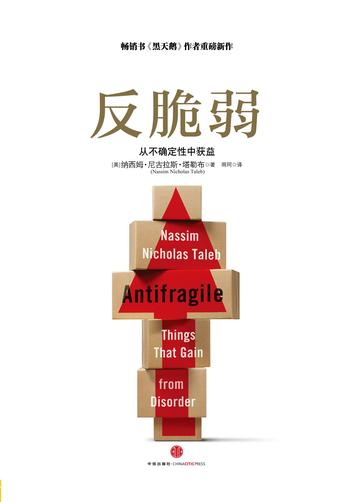
The book "Antifragility" is indeed difficult to understand, but after reading it, it is a different world. This book actually talks about a special perspective on problems. Most people would say that the opposite of fragility is strength, but the author doesn't think so. Strength only resists harm. The author's anti-fragility is to make profit from harm. For example, a gust of wind can blow out a candle, or it can spread a wildfire. Wind is devastating to candles, but it is a fuel for wildfires. Especially when the international situation is turbulent, Sino-US trade frictions, and black swans are flying all over the sky, many people choose to lie down and wait for the danger to pass. However, according to the author's point of view, dangers also come with opportunities. If we can find the opportunities, we can not only avoid harm, but also profit from them.
The book "Antifragility" is indeed difficult to understand, but after reading it, it is a different world. This book actually talks about a special perspective on problems. Most people would say that the opposite of fragility is strength, but the author doesn't think so. Strength only resists harm. The author's anti-fragility is to make profit from harm. For example, a gust of wind can blow out a candle, or it can spread a wildfire. Wind is devastating to candles, but it is a fuel for wildfires. Especially when the international situation is turbulent, Sino-US trade frictions, and black swans are flying all over the sky, many people choose to lie down and wait for the danger to pass. However, according to the author's point of view, dangers also come with opportunities. If we can find the opportunities, we can not only avoid harm, but also profit from them.
This book is amazing! This is the most thought-provoking book I have read in the past two years. Many of these ideas are novel and indeed valid. I agree with its elaboration of antifragility, nonlinearity, education, econometrics, and lessons learned from the lives of the ancients.
This book is the most thought-provoking book I have read recently. It has completely changed my living habits and the way I think about problems. What impressed me most is that you should be a practitioner rather than a theorist. Practice can make people understand many things, while theory may end up being a huge fantasy. Failure is success, and failure is part of success. Courage can fight against many things, and fluctuations, that is, changes, can make people feel alive.
The concepts in the book are very professional. For me, many concepts are relatively profound and difficult to understand. The wording in many places is unfamiliar, which increases the difficulty of understanding. The entire book discusses one concept from different dimensions and angles: antifragility. The author abstracts everything into a three-dimensional structure and describes the world in terms of fragility, resilience, and antifragility. The author says that the opposite of fragility should be antifragility. Objects with antifragility will benefit from fluctuations and uncertainties and become stronger than before. There was still a lot of resonance and thinking during the reading process. This book requires us to study it carefully, rather than just absorbing some fragmented knowledge and thinking that we understand it.
Through this book, I learned that nature, or the biological world, is usually both antifragile and fragile at the same time, depending on the source of variation (and the scope of variation). In the case of humans, the body can benefit (become stronger) from stressors, but only up to a point. For example, if a certain amount of pressure is applied to bones regularly, it will be beneficial to the increase in bone density. This mechanism is named Wolff's law, which originated from a related article written by a German surgeon in 1892. But things like plates, cars, or other inanimate objects don't have this characteristic. That is, they may be tough, but they're not inherently antifragile.
"The system may need some stress and stimulation, and people may experience this in one domain but completely ignore it in other domains. So we can see the domain dependence of our thinking. The so-called domain is a certain category of activities. Some people can be very good in a certain domain, such as the medical field. You can understand an idea well, but you may not be able to understand the same idea in another field, such as society, economy, and life. "The "antifragility" defined by Taleb in the book is the characteristic of things that benefit from chaos and fluctuations and require such chaos and fluctuations to survive and prosper. It is very interesting.
Taleb has written a series of works on uncertainty. As a practitioner in the financial industry, Taleb has deeply realized that the uncertain characteristics of modern society have become prominent, and society is no longer the accurately predictable society it once was. In the face of uncertainty, the first response that many people and even the government think of is to reduce all factors that may cause uncertainty and achieve better control. However, we do not know that this kind of control itself also has costs, and it will reduce our benefits. Therefore, a more effective way is to embrace uncertainty and learn to benefit from uncertainty through contract design and institutional arrangements. This is the original meaning of antifragility.
Most of us prefer a stable environment, a stable job, and stable things. However, the gradual loss of antifragility is ignored. As Mencius said: "Be born in sorrow and die in happiness." Finally, due to the lack of risk resistance, small risks often cause huge, non-linear losses. This also tells us that the harm caused by risks is asymmetric. Just like 500 grams does the same damage to a glass as ten 50 grams. We must always retain our own options and pay attention to agency problems, rather than giving our choices to others for free. Because in the end others will only benefit from us, but we need to bear the harm caused by the risks ourselves.
To sum it up in three sentences: Born in sorrow and died in happiness Heaven is about to give a great responsibility to this people, but they must first harden their resolve. Lao Tzu's rule of inaction ——You must grasp it yourself, practice it with dedication, and be strong together in body and mind.
The best way to verify whether you are alive is to check whether you like changes. If you don't feel hungry, the delicacies will be the same. Without hard work, the results will be meaningless. If you have not experienced pain, you will not know happiness. If you have not experienced hardships, your faith will not be strong.
The author uses many examples to explain the concept of antifragility, and also discusses some issues closely related to our lives, such as work and financial management. I think his views are very original and inspiring. Although the content in the book is a bit profound, it will make people think a lot after reading it. I recommend that you also read it, maybe you will gain something new!
This book has unique insights, and many of its discussions are sharp, penetrating, and enlightening. It clearly explains many common misunderstandings in life and the principles and importance of antifragility. It is a rare good book to improve your cognitive level.
The first book I have read, worth reading
"When you seek order, all you get is superficial order; but when you embrace randomness, you can grasp order and control the situation." Barbell Strategy: Place your energy and resources like a barbell at two extremes. One end pursues extreme stability and conservatism, with the goal of ensuring that no matter what happens, you will not fall into the abyss of destruction. The other end pursues extreme openness and risk-taking, and the goal is that when the positive black swan comes, you are qualified to stand on the cusp of the wind and fully capture the huge opportunities for the upside. Resolutely avoid the mediocre middle ground and completely abandon those "middle choices" that will continue to consume you but will not bring you a breakthrough opportunity.
You have to watch it three times or more to find it interesting.
Super nice book
Distinguish falsehood, seek truth, and be anti-fragile
A super good book
It's a bit abstract, but we can push people's boundaries
I have always been curious about what books I need to read before reading this book to understand some of the professional terms in it. I feel that some of the content in it is confusing and some of the content is difficult to understand [crying]
Eliminate vulnerability and benefit from uncertainty.
The author writes in a stream of consciousness style, which is very jumpy.
Over-intervention sometimes makes everyone tired, and sometimes the problems are not really solved.