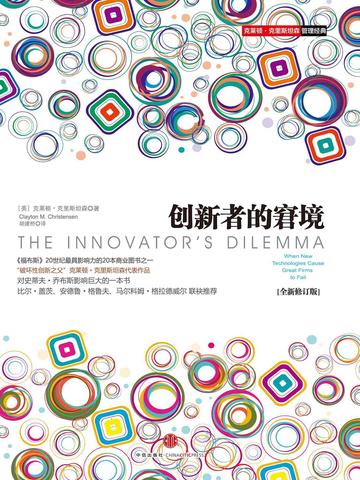
In the global business field, many companies were once all-powerful, but faced with the challenges of market changes and new technologies, they were eventually eliminated. The reason is actually because they are good at management and believe in traditional business concepts such as customer first. This is the "innovator's dilemma" that all companies are facing today.
In "The Innovator's Dilemma", management guru Christensen pointed out that some business actions that focus on precise investment and technology research and development of products that are needed by mainstream customers and have the highest profitability are likely to destroy an excellent company. He analyzed the innovation models in many industries such as computers, automobiles, and steel, and found that it was those critical and breakthrough technologies that were temporarily rejected by mainstream customers that gradually evolved into "disruptive innovations" that dominated new markets. If a company focuses too much on the immediate needs of customers, it will lead to a decline in innovation capabilities, making it impossible to explore new markets, and often inadvertently miss valuable opportunities. And companies that are more nimble and entrepreneurial will be able to innovate and seize the next wave of industry growth.
Based on the success and failure experience of a large number of companies, Christensen proposed a series of rules for capitalizing disruptive innovation: when should you not blindly follow customers, when should you invest in products with lower performance and smaller profit margins, and when should you abandon a seemingly larger and more profitable market and develop market segments instead. "The Innovator's Dilemma" will help you predict the coming changes and achieve longevity in the dangerous business competition.
Reader comments
Throughout the history of global business, there are many industry giants that suddenly collapsed in the midst of great success. Facing the challenges of market changes and new technologies, these mature companies lost to other emerging companies that adopted disruptive technologies, and gradually lost their market dominance. This is the "Innovator's Dilemma." In this book, management guru Christensen analyzes innovation models in multiple industries such as computers, automobiles, steel, and retail, and proposes two important concepts that determine the success or failure of enterprises: sustaining technology and destructive technology. Sustaining technology: technology that continues or enhances product performance based on mainstream customer needs; disruptive technology: technology that meets customer needs in low-end markets or is developed for new markets. Value network.
Clayton Christensen is known as the founder of "disruptive innovation". When writing this book, he fully integrated his knowledge, experience and experience as an economist and business consultant, combined with the technological changes in the four fields of hard drives, excavators, steel and electric vehicles, to provide good reference and guiding suggestions and operational strategies for mature/leading companies. This book has a positive guiding significance, and the solutions mentioned by the author are currently widely used by major enterprises. Take the two well-known companies Microsoft and Google as examples. In order to cope with disruptive innovation and ensure the innovation and vitality of the enterprise, these two companies not only established research institutes and innovation laboratories within the company, but also became independent institutions/companies in order to ensure the implementation of certain innovative/potentially strategic projects. For external companies engaged in innovative technologies, they usually use capital operations, equity participation, or acquisitions.
Having been engaged in business activities, I can understand the author's views very well. He is very rigorous and has his own unique insights. Through various case studies, hard drives, automobiles, and retail. The application of disruptive technologies is even more obvious in China, which has a rich industrial chain.
Reflect on why companies have gone from customer-centric core values to demise! When the core company discovered new technologies and new markets, it did not find new customers. Instead, it focused on old customers and let them test them! This is what is bound to happen!
Sometimes, they focus so much on immediate needs at work that they ignore potential opportunities for innovation. As the book says, you can't blindly follow customers, you must have a vision for the future. I think the cases of well-managed but still failed companies mentioned in the book are worth thinking about. However, I kind of disliked some of the characters in the book because they were too stubborn and unwilling to accept new ideas. In short, this book gave me a lot of inspiration, and I recommend it to you!
This book is worth reading by many small entrepreneurs and entrepreneurial managers, and they will gain a lot if they think deeply about it. The book analyzes the various development paths of sustainable technological innovation and destructive technological innovation. It can be said that destructive technological innovation is a major bottleneck for the future development of large enterprises. It also reasonably proposes new solutions to this problem and provides new theoretical and practical guidance for small enterprises to face emerging markets in the future. This book is an excellent work for small enterprises to achieve rapid development and even overtake in corners. It is worth reading, thinking, research analysis and theoretical practice.


Throughout the history of global business, there are many industry giants that suddenly collapsed in the midst of great success. Facing the challenges of market changes and new technologies, these mature companies lost to other emerging companies that adopted disruptive technologies, and gradually lost their market dominance. This is the "Innovator's Dilemma." In this book, management guru Christensen analyzes innovation models in multiple industries such as computers, automobiles, steel, and retail, and proposes two important concepts that determine the success or failure of enterprises: sustaining technology and destructive technology. Sustaining technology: technology that continues or enhances product performance based on mainstream customer needs; disruptive technology: technology that meets customer needs in low-end markets or is developed for new markets. Value network.
Clayton Christensen is known as the founder of "disruptive innovation". When writing this book, he fully integrated his knowledge, experience and experience as an economist and business consultant, combined with the technological changes in the four fields of hard drives, excavators, steel and electric vehicles, to provide good reference and guiding suggestions and operational strategies for mature/leading companies. This book has a positive guiding significance, and the solutions mentioned by the author are currently widely used by major enterprises. Take the two well-known companies Microsoft and Google as examples. In order to cope with disruptive innovation and ensure the innovation and vitality of the enterprise, these two companies not only established research institutes and innovation laboratories within the company, but also became independent institutions/companies in order to ensure the implementation of certain innovative/potentially strategic projects. For external companies engaged in innovative technologies, they usually use capital operations, equity participation, or acquisitions.
Having been engaged in business activities, I can understand the author's views very well. He is very rigorous and has his own unique insights. Through various case studies, hard drives, automobiles, and retail. The application of disruptive technologies is even more obvious in China, which has a rich industrial chain.
Reflect on why companies have gone from customer-centric core values to demise! When the core company discovered new technologies and new markets, it did not find new customers. Instead, it focused on old customers and let them test them! This is what is bound to happen!
Sometimes, they focus so much on immediate needs at work that they ignore potential opportunities for innovation. As the book says, you can't blindly follow customers, you must have a vision for the future. I think the cases of well-managed but still failed companies mentioned in the book are worth thinking about. However, I kind of disliked some of the characters in the book because they were too stubborn and unwilling to accept new ideas. In short, this book gave me a lot of inspiration, and I recommend it to you!
This book is worth reading by many small entrepreneurs and entrepreneurial managers, and they will gain a lot if they think deeply about it. The book analyzes the various development paths of sustainable technological innovation and destructive technological innovation. It can be said that destructive technological innovation is a major bottleneck for the future development of large enterprises. It also reasonably proposes new solutions to this problem and provides new theoretical and practical guidance for small enterprises to face emerging markets in the future. This book is an excellent work for small enterprises to achieve rapid development and even overtake in corners. It is worth reading, thinking, research analysis and theoretical practice.