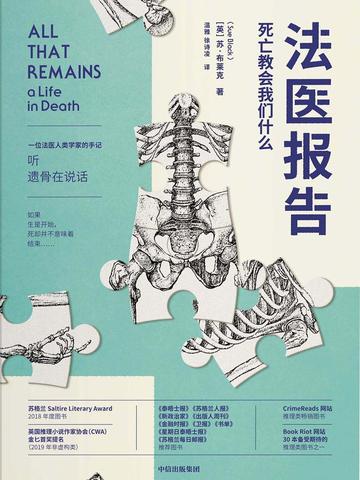
Sue Black faces death every day. As a forensic anthropologist, she sets her sights on the skeletons of ordinary people in laboratories, cemeteries, scenes of violence, murder, dismemberment, and mass deaths caused by war, accidents, or natural disasters. In this book, she reveals to us the different faces of death she has witnessed, explores the development and progress of the forensic science discipline through real cases she participated in, and also reveals the impact and insights of the discipline of forensic anthropology on her work and life. People always think that books about death will make people sad or scary, but this book is different. The book contains tragic stories, humorous stories, and real cases like suspense novels. Although she cannot teach us all about death, as an expert witness on the front lines of death, Sue Black is a wiser, more reliable, and more convincing guide.
Reader comments
The truth of life tells us that death can fall at any point in life. So since we cannot change the creation of our own lives, and we cannot predict or avoid death, then we should turn our attention to a point worthy of attention, which is the distance from life to death. The saddest thing for a person is not death and loss, but that something is lost in our hearts while we are still alive. We need to keep our hearts alive.
One thing we need to learn throughout our lives is how to face death. How to make plans for today, the day after tomorrow, and the future when you already know the truth that death will come sooner or later? How to face the sudden death of someone around you calmly? As a forensic anthropologist who deals with death almost every day, the author shows her attitude towards death, especially how to find key information revealing the cause of death from the speechless corpse, and at the same time, she can read information about the deceased's life from death. All these make readers feel the importance of this profession.
Just like what the book says, "Death is a feminine noun, but it is often depicted as a man." This statement is very novel. It is not as heavy as other books about death. Instead, it contains many humorous stories and mentions some real cases, just like reading a suspense novel. I think it is a bit similar to the book "Coroner", both interpret death from a professional perspective. Sue Black is like Qin Ming in "Qin Ming Forensic Medicine", a very reliable guide who leads us to understand the different aspects of death.
I think the most important concept that Chinese people, especially the elderly, should change is that death should not be a taboo. It is precisely because there is too much uncertainty about death in Chinese culture that it has caused too many joys, sorrows, and joys, mostly tragedies. Death is not the end, it is the beginning of a new life! But this will make high-ranking people and magicians very frustrated!
I really like the author's attitude towards death. Its respect for the corpse is impressive. The translation is also very good and it is easy to understand.
The truth of life tells us that death can fall at any point in life. So since we cannot change the creation of our own lives, and we cannot predict or avoid death, then we should turn our attention to a point worthy of attention, which is the distance from life to death. The saddest thing for a person is not death and loss, but that something is lost in our hearts while we are still alive. We need to keep our hearts alive.
One thing we need to learn throughout our lives is how to face death. How to make plans for today, the day after tomorrow, and the future when you already know the truth that death will come sooner or later? How to face the sudden death of someone around you calmly? As a forensic anthropologist who deals with death almost every day, the author shows her attitude towards death, especially how to find key information revealing the cause of death from the speechless corpse, and at the same time, she can read information about the deceased's life from death. All these make readers feel the importance of this profession.
Just like what the book says, "Death is a feminine noun, but it is often depicted as a man." This statement is very novel. It is not as heavy as other books about death. Instead, it contains many humorous stories and mentions some real cases, just like reading a suspense novel. I think it is a bit similar to the book "Coroner", both interpret death from a professional perspective. Sue Black is like Qin Ming in "Qin Ming Forensic Medicine", a very reliable guide who leads us to understand the different aspects of death.
I think the most important concept that Chinese people, especially the elderly, should change is that death should not be a taboo. It is precisely because there is too much uncertainty about death in Chinese culture that it has caused too many joys, sorrows, and joys, mostly tragedies. Death is not the end, it is the beginning of a new life! But this will make high-ranking people and magicians very frustrated!
I really like the author's attitude towards death. Its respect for the corpse is impressive. The translation is also very good and it is easy to understand.