Many people may believe that most of the choices we make every day are the result of carefully considered decisions, but this is not the case. More than 40% of people's daily activities are the product of habits rather than their own active decisions. Over the past 20 years, neuroscientists, psychologists, sociologists, and marketers have used research to discover not only how habits work but, more importantly, how to change them.
A habit is a choice we make deliberately or after deep thought. It is a behavior that we do frequently or even every day even if we no longer think about it after a period of time. This is a natural response of our nervous system. After a habit is formed, our brains enter a low-effort mode and are no longer fully involved in the decision-making process, so unless you deliberately fight a habit or become aware of other new habits, the behavioral pattern will kick in naturally. Although the impact of each habit is relatively small, over time, these habits combined can have a huge impact on our health, productivity, personal financial security, and happiness.
Habits are powerful, but they can also be cultivated deliberately; habits cannot be eliminated, but they can be replaced.
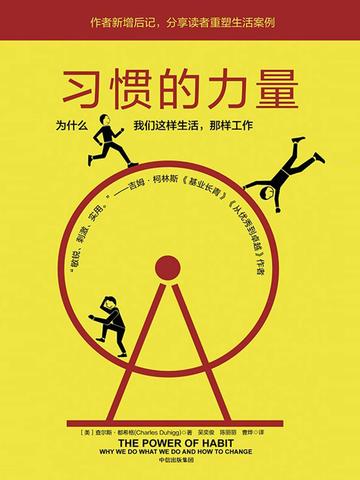
The author of this book synthesizes nearly 20 years of research on "habits" by scientists and businesses, including hundreds of academic studies, interviews with more than 300 scientists and business managers, and practical research results of dozens of companies. It is divided into three parts to explore the habits of individuals, the habits of successful organizations, and the habits of social groups. The author Dusig believes that as long as you master the "habit loop", learn to observe the cues and rewards in life, and find the correct routine behaviors that can gain a sense of accomplishment, no matter individuals, companies, or social groups, you can change deep-rooted habits. Learning to use the "power of habit" can transform your life and career.
Reader comments
"Life is just the sum of countless habits." In fact, every word, deed, and action of each of us is deeply affected by habits. From daily habits, we can see whether we will succeed in the future. This is the power of habits. Someone did a study specifically and wanted to know why the poor are poor and why the rich are rich. After five years of research, he found that rich people have some good habits that poor people rarely have. These habits are: read often, get up early, spend 30-40 minutes every day thinking about problems, and not be blind or follow the crowd. These habits are easy to do in the short term, but very difficult to persist in the long term. It is precisely because of these habits that they lead to a completely different destiny. As the saying goes: "A drop of water cuts through a stone, and a rope cuts through a wood." The most important thing in doing anything is persistence and perseverance.
From now on, develop good habits every day and stick to them day after day to benefit from them throughout your life.
The power brought by habits is small, but it is also long-term and profound. If we can treat the work of the day as ordinary as brushing our teeth and washing our face, then we will most likely achieve outstanding achievements. A habit is a repetitive pattern of behavior that can become an automated program for our thinking and behavior. Habit formation is a gradual process that requires constant repetition and persistence. The author provides some effective methods and strategies in the book to help everyone change bad habits or develop good habits. Through the analysis of actual cases, we can clearly understand the practical application and effectiveness of these methods.
"Life is just the sum of countless habits." In fact, every word, deed, and action of each of us is deeply affected by habits. From daily habits, we can see whether we will succeed in the future. This is the power of habits. Someone did a study specifically and wanted to know why the poor are poor and why the rich are rich. After five years of research, he found that rich people have some good habits that poor people rarely have. These habits are: read often, get up early, spend 30-40 minutes every day thinking about problems, and not be blind or follow the crowd. These habits are easy to do in the short term, but very difficult to persist in the long term. It is precisely because of these habits that they lead to a completely different destiny. As the saying goes: "A drop of water cuts through a stone, and a rope cuts through a wood." The most important thing in doing anything is persistence and perseverance. From now on, develop good habits every day and stick to them day after day to benefit from them throughout your life.
Freud and Jung discovered long ago that people's thinking and behavior patterns are largely influenced by the personal and collective unconscious. Different from the assumption of rational people set by neoclassical economics, social scientists increasingly agree that habits have an important impact on people's decision-making. The author of this book emphasizes that inertia exists not only in individuals, but also in organizations and society as a whole. In more academic terms, this may be a legal practice that can save transaction costs. Of course, we can benefit from identifying the underlying habits of other people and organizations.
This book tells me what habits are, the importance of habits, how to develop good habits, and how to identify bad habits. Habits are solidified through three steps: cue, habitual behavior and reward. Understanding how habits form helps us develop and identify them. In addition to personal habits, habits are also divided into corporate habits and social habits. The author has expanded the scope of habits, which is a very interesting point of view. Overall, this book is very meaningful. After all, it is difficult for most people to develop good habits and quit bad habits.
Habits are most malleable when using the Golden Rule of Habit Change: If we keep the cues and rewards the same, we can embed a new routine. But this is not enough. In order to maintain this habit, people must believe that change is possible. Most of the time, faith can only be formed with the help of a group. If you want to quit smoking, develop a new routine that provides satisfaction. If you use the same cues and provide the same rewards, you can change your routine and change your habits. Almost all habits can be changed if the cues and rewards remain unchanged.
Through a wealth of cases, the author lets us understand that habits can be changed. For me, who is about to get married, this book makes me more convinced that we can make our married life happier and more fulfilling by cultivating good habits. I highly recommend it to everyone!
I benefited a lot and provided me with a new way of thinking about quitting bad habits. It was also very comfortable to watch.
Habits are really important. I only paid attention to my own habits before and never thought about using them for commercial purposes. I can think about it in the future.
Very cool, very inspiring to me
After reading it, I benefited a lot, and it helped me know how to enhance her willpower and reduce the consumption of willpower when raising my child!








"Life is just the sum of countless habits." In fact, every word, deed, and action of each of us is deeply affected by habits. From daily habits, we can see whether we will succeed in the future. This is the power of habits. Someone did a study specifically and wanted to know why the poor are poor and why the rich are rich. After five years of research, he found that rich people have some good habits that poor people rarely have. These habits are: read often, get up early, spend 30-40 minutes every day thinking about problems, and not be blind or follow the crowd. These habits are easy to do in the short term, but very difficult to persist in the long term. It is precisely because of these habits that they lead to a completely different destiny. As the saying goes: "A drop of water cuts through a stone, and a rope cuts through a wood." The most important thing in doing anything is persistence and perseverance. From now on, develop good habits every day and stick to them day after day to benefit from them throughout your life.
The power brought by habits is small, but it is also long-term and profound. If we can treat the work of the day as ordinary as brushing our teeth and washing our face, then we will most likely achieve outstanding achievements. A habit is a repetitive pattern of behavior that can become an automated program for our thinking and behavior. Habit formation is a gradual process that requires constant repetition and persistence. The author provides some effective methods and strategies in the book to help everyone change bad habits or develop good habits. Through the analysis of actual cases, we can clearly understand the practical application and effectiveness of these methods.
"Life is just the sum of countless habits." In fact, every word, deed, and action of each of us is deeply affected by habits. From daily habits, we can see whether we will succeed in the future. This is the power of habits. Someone did a study specifically and wanted to know why the poor are poor and why the rich are rich. After five years of research, he found that rich people have some good habits that poor people rarely have. These habits are: read often, get up early, spend 30-40 minutes every day thinking about problems, and not be blind or follow the crowd. These habits are easy to do in the short term, but very difficult to persist in the long term. It is precisely because of these habits that they lead to a completely different destiny. As the saying goes: "A drop of water cuts through a stone, and a rope cuts through a wood." The most important thing in doing anything is persistence and perseverance. From now on, develop good habits every day and stick to them day after day to benefit from them throughout your life.
Freud and Jung discovered long ago that people's thinking and behavior patterns are largely influenced by the personal and collective unconscious. Different from the assumption of rational people set by neoclassical economics, social scientists increasingly agree that habits have an important impact on people's decision-making. The author of this book emphasizes that inertia exists not only in individuals, but also in organizations and society as a whole. In more academic terms, this may be a legal practice that can save transaction costs. Of course, we can benefit from identifying the underlying habits of other people and organizations.
This book tells me what habits are, the importance of habits, how to develop good habits, and how to identify bad habits. Habits are solidified through three steps: cue, habitual behavior and reward. Understanding how habits form helps us develop and identify them. In addition to personal habits, habits are also divided into corporate habits and social habits. The author has expanded the scope of habits, which is a very interesting point of view. Overall, this book is very meaningful. After all, it is difficult for most people to develop good habits and quit bad habits.
Habits are most malleable when using the Golden Rule of Habit Change: If we keep the cues and rewards the same, we can embed a new routine. But this is not enough. In order to maintain this habit, people must believe that change is possible. Most of the time, faith can only be formed with the help of a group. If you want to quit smoking, develop a new routine that provides satisfaction. If you use the same cues and provide the same rewards, you can change your routine and change your habits. Almost all habits can be changed if the cues and rewards remain unchanged.
Through a wealth of cases, the author lets us understand that habits can be changed. For me, who is about to get married, this book makes me more convinced that we can make our married life happier and more fulfilling by cultivating good habits. I highly recommend it to everyone!
I benefited a lot and provided me with a new way of thinking about quitting bad habits. It was also very comfortable to watch.
Habits are really important. I only paid attention to my own habits before and never thought about using them for commercial purposes. I can think about it in the future.
Very cool, very inspiring to me
After reading it, I benefited a lot, and it helped me know how to enhance her willpower and reduce the consumption of willpower when raising my child!
Very useful for reference. Recommended to watch.