Stats
5.8Score
Synopsis
No synopsis yet.
We haven’t got an English blurb for this one. It appears once the source description has been translated.
We haven’t got an English blurb for this one. It appears once the source description has been translated.




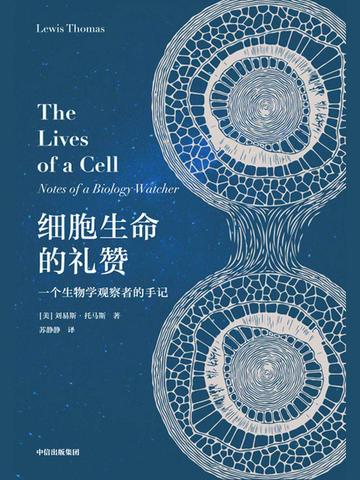
Have you ever wondered where you come from and why small cells are the basic structural and functional units of living organisms. The author of this book is the dean of Yale University School of Medicine and is known as the ideological source of modern Western medical history and medical philosophy. This book contains twenty-nine articles by the author, which are very rich in content and rich in philosophy. The author explores the commonalities of life forms through superficial phenomena, advocates the organic whole of the ecosystem, and opposes Darwinism and social Darwinism. The book contains the author's thoughts on life, life, society, etc., Which is thought-provoking.
Dr. Lewis Thomas, American medical scientist and biologist. Lewis Thomas has always been concerned about the phenomena of symbiosis, dependence and cooperation in nature and human society. Through humorous language, he tells us about magical events in nature, making us notice that not only humans are social animals, but also ants, bees, slime molds, fish, birds and other creatures show a high degree of organization in collective actions and seem to have the characteristics of holistic thinking and other interesting biological phenomena.
This is a very special science popularization reference book, because it is not only a popular science reading, but also a collection of essays, including the author's 29 popular science essays published in the New England Journal of Medicine over the years. It is both scientific and literary, neutralizing the boring nature of popular science readings, helping readers re-understand the subject of science and better understand the meaning of life and nature. In this book, we can clearly see the author's vision as a scientist and feel his romantic feelings as a poet.
"Each of us has a name as a personal mark, and we unreservedly believe that this classification system will protect our actual existence and ensure that we are clearly separated from each other or other living things. However, in the center of a crowded city, this classification system does not seem to have any effect. In essence, we do not have names, most of the time." This is a small book about biology, a bit of a popular science, it is his thinking about life, life, society and even the universe as a medical scientist and biologist.
This book gave me a deeper understanding and awe of life. As a father of two children, I know how precious and fragile life is. The sentence in the book "Humans are a part embedded in nature" resonated with me. We should respect and protect nature instead of trying to strip away the connection between humans and nature. This is not only respect for life on earth, but also a responsibility for the future of ourselves and our children.
When I was a child, I was fascinated by the world for a long time. How could there be so many strange creatures? The birds flying in the sky and the sharks swimming in the sea, where did they come from? With this question in mind, I read this book. As a biological observer, I was deeply attracted by cellular life. Cells are the basic units that make up our bodies and are the basis and key to all life processes. In my observation, I found that the different shapes, structures and functions of cells prove their excellence. Cells have different functions. For example, heart muscle cells are responsible for contracting to propel blood flow.
Biology is definitely great and magical in the narrow sense, so how can it be unpopular?