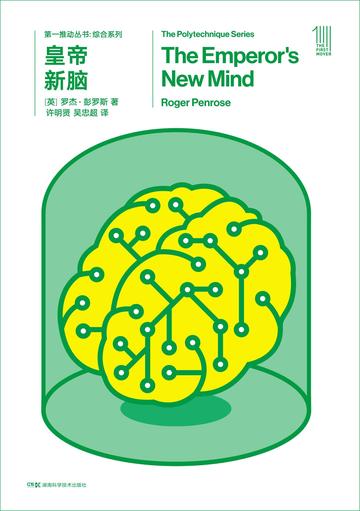
The Emperor's New Brain includes extensive discussions of computer science, mathematics, physics, cosmology, neurological and spiritual sciences, and philosophy, embodying the author's fearless spirit in challenging the biggest question in philosophy: the mind-body relationship. The book is filled with genius speculations, a re-evaluation of relativity and quantum theory, and new perspectives on modern physics and artificial intelligence.
Reader comments
Although Penrose spent a lot of thought and ink to construct the examples needed to demonstrate his arguments, I tend to believe that even if you want to understand 90% of this book, you need a very comprehensive knowledge reserve of physics and mathematics, as well as a patient and meticulous understanding of his logical deduction process. But after reading the whole book, I still agree with his point of view: the human brain is a much more advanced thing than computers. Our thinking and consciousness itself involve many non-computation processes. How to describe such non-computation processes and explain the generation and operation mechanism of consciousness is probably a challenge that the scientific community must face.
Roger Penrose, a British mathematician and physicist, has served as the Ross Boller Professor of Mathematics at the University of Oxford since 1973. He is recognized around the world as a very knowledgeable and original scientist, thinker, and philosopher. Professor Penrose and Professor Stephen Hawking collaborated on research on black holes and gravity, and both won the Wolf Prize in Physics in 1988. Featuring wide-ranging discussions of computer science, mathematics, physics, cosmology, neurological and spiritual sciences, and philosophy, this book is filled with genius speculation, a re-evaluation of relativity and quantum theory, and new perspectives on modern physics and artificial intelligence.
What a great book! Penrose explores many cutting-edge scientific topics in his book, and his perspectives are unique and illuminating. For example, his re-evaluation of relativity and quantum theory was an eye-opener for me. The book also mentioned that "Science is always unremittingly pursuing the truth." This sentence touched me deeply. All in all, this is a book full of wisdom and challenge, which made me think more deeply about science.
Although Penrose spent a lot of thought and ink to construct the examples needed to demonstrate his arguments, I tend to believe that even if you want to understand 90% of this book, you need a very comprehensive knowledge reserve of physics and mathematics, as well as a patient and meticulous understanding of his logical deduction process. But after reading the whole book, I still agree with his point of view: the human brain is a much more advanced thing than computers. Our thinking and consciousness itself involve many non-computation processes. How to describe such non-computation processes and explain the generation and operation mechanism of consciousness is probably a challenge that the scientific community must face.
Roger Penrose, a British mathematician and physicist, has served as the Ross Boller Professor of Mathematics at the University of Oxford since 1973. He is recognized around the world as a very knowledgeable and original scientist, thinker, and philosopher. Professor Penrose and Professor Stephen Hawking collaborated on research on black holes and gravity, and both won the Wolf Prize in Physics in 1988. Featuring wide-ranging discussions of computer science, mathematics, physics, cosmology, neurological and spiritual sciences, and philosophy, this book is filled with genius speculation, a re-evaluation of relativity and quantum theory, and new perspectives on modern physics and artificial intelligence.
What a great book! Penrose explores many cutting-edge scientific topics in his book, and his perspectives are unique and illuminating. For example, his re-evaluation of relativity and quantum theory was an eye-opener for me. The book also mentioned that "Science is always unremittingly pursuing the truth." This sentence touched me deeply. All in all, this is a book full of wisdom and challenge, which made me think more deeply about science.