Most of human life is spent in adversity. When we encounter various difficulties, failures and setbacks, the level of adversity quotient (AQ) will play a decisive role. Adversity quotient is an indicator of frustration tolerance and reflects people's psychological state and adaptability when facing adversity and setbacks. Cognitive psychology, psychoneuroimmunology and neurophysiology are the three pillars of the scientific theoretical system of adversity quotient.
The author explains the four dimensions of CORE—Control, Ownership, Reach, and Endurance—and how to use the LEAD tool (L= Listen, to listen to one's own reactions to adversity; E= Explore, to explore one's responsibility for results; A= Analyze, analyze evidence; D=Do, do something), while citing a large number of cases in real life, it comprehensively demonstrates to readers how to deal with adversity and how to reshape life, so as to climb up, surpass ourselves, and control our future direction.
A person's success must have three factors: high IQ, high EQ and high adversity quotient. When IQ and EQ are not much different from others, the most important factor in determining success or failure is adversity quotient. Only people with high adversity quotient can actively face various difficulties and obstacles, have firm perseverance and hard work, and can handle the relationship between people well. In this era full of variables, readers of all fields and levels should read this book.
Reader comments
This book talks about the importance of reverse quotient, which not only helps us solve incidents, but also relieves our anxiety and makes our lives easier.
The good thing about this book is that it not only tells you the importance, but also teaches you how to improve the reverse quotient of your team and individuals. I think the methods are very helpful. When you can think about how to reduce losses or even solve difficulties in times of adversity instead of complaining, then your life is at least a continuous climbing process, and you will always be a climber, not a camper. Reversing the victim mentality allows you to keep overcoming the slope.
This book is great! The author, Paul Stoltz, has done very in-depth research on adverse business. The cases in the book are rich and diverse, which benefited me a lot. Especially in today's highly competitive entrepreneurial environment, reverse business is really important. I especially like the LEAD tool mentioned in the book. It is very practical and can help us deal with various dilemmas. I think everyone who is working hard to start a business should read this book. I believe there will be great gains.
It talks about the real thing. Unlike many junk success-learning best-sellers in China, this book uses psychology as the authority to tell us the importance of reverse quotient in a plain and vivid way, what is reverse quotient, and how to improve your own reverse quotient (including, of course, others and organizations)
But for me, the case is a bit too complicated because many things are repeated, and some cases on the Internet have been exposed for a long time, so I suggest you read them as needed.
For example, those who care about psychological research can read the chapter "The Three Pillars of Adverse Quotient" specifically.
This book was recommended to me by a college student. I kept putting off reading it because of procrastination. Or he suddenly asked me about it and found out that I hadn't read it, so I started reading it out of guilt. I don't like reading very much. It was a bit boring at first, but I felt a little emotional after reading it. I used to feel that there was a reason why I didn't work hard, so I settled for the status quo. Now it seems like it's just escaping from reality [face covering] (Of course, I haven't finished reading it yet, but I've learned a lot after reading half of it)
The method given is quite informative, especially about asking yourself if there is any evidence that will produce the catastrophic consequences of your imagination, and using the mind-stopping method to stop yourself from catastrophizing adversity. The continuation part is very inspiring to me. I feel that I can control the spread of my negative psychology to a certain extent and prevent myself from expanding the scope of influence of adversity.
Because adversity exists in our lives and work for a long time, just like suffering is inevitable, we need to improve our adversity quotient to face and overcome the suffering in life, exercise our resilience, and live a good life.
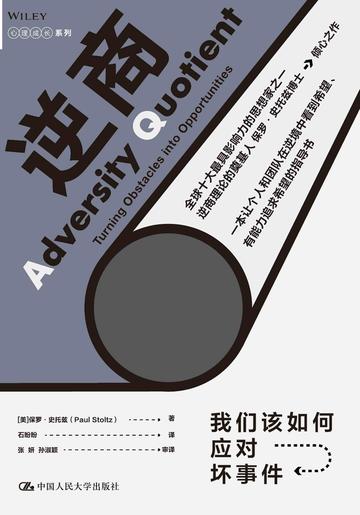





This book talks about the importance of reverse quotient, which not only helps us solve incidents, but also relieves our anxiety and makes our lives easier. The good thing about this book is that it not only tells you the importance, but also teaches you how to improve the reverse quotient of your team and individuals. I think the methods are very helpful. When you can think about how to reduce losses or even solve difficulties in times of adversity instead of complaining, then your life is at least a continuous climbing process, and you will always be a climber, not a camper. Reversing the victim mentality allows you to keep overcoming the slope.
This book is great! The author, Paul Stoltz, has done very in-depth research on adverse business. The cases in the book are rich and diverse, which benefited me a lot. Especially in today's highly competitive entrepreneurial environment, reverse business is really important. I especially like the LEAD tool mentioned in the book. It is very practical and can help us deal with various dilemmas. I think everyone who is working hard to start a business should read this book. I believe there will be great gains.
It talks about the real thing. Unlike many junk success-learning best-sellers in China, this book uses psychology as the authority to tell us the importance of reverse quotient in a plain and vivid way, what is reverse quotient, and how to improve your own reverse quotient (including, of course, others and organizations) But for me, the case is a bit too complicated because many things are repeated, and some cases on the Internet have been exposed for a long time, so I suggest you read them as needed. For example, those who care about psychological research can read the chapter "The Three Pillars of Adverse Quotient" specifically.
This book was recommended to me by a college student. I kept putting off reading it because of procrastination. Or he suddenly asked me about it and found out that I hadn't read it, so I started reading it out of guilt. I don't like reading very much. It was a bit boring at first, but I felt a little emotional after reading it. I used to feel that there was a reason why I didn't work hard, so I settled for the status quo. Now it seems like it's just escaping from reality [face covering] (Of course, I haven't finished reading it yet, but I've learned a lot after reading half of it)
The method given is quite informative, especially about asking yourself if there is any evidence that will produce the catastrophic consequences of your imagination, and using the mind-stopping method to stop yourself from catastrophizing adversity. The continuation part is very inspiring to me. I feel that I can control the spread of my negative psychology to a certain extent and prevent myself from expanding the scope of influence of adversity. Because adversity exists in our lives and work for a long time, just like suffering is inevitable, we need to improve our adversity quotient to face and overcome the suffering in life, exercise our resilience, and live a good life.