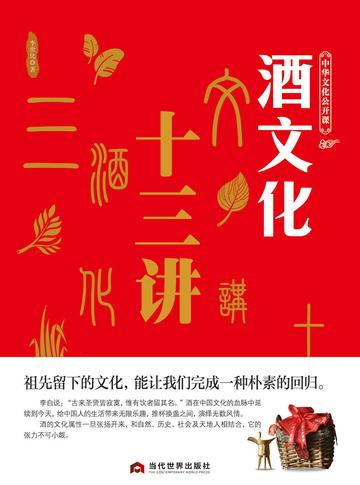
"Chinese Culture Open Class - Thirteen Lectures on Wine Culture" is a book published by Contemporary World Press in 2020. The author is Li Shihua.
Wine has a unique historical status in Chinese culture. Sometimes it is like Aladdin's magic lamp, sometimes like Pandora's box, catalyzing different stories, interpreting different legends, and giving Chinese culture a strong aroma of wine. Wine is an important communication medium. From national ceremonies and sacrifices to ancestral temples to gatherings of relatives and friends, and festive gatherings, wine is indispensable.
Regarding the likes and dislikes of wine, different people's evaluations can be described as vastly different. If you criticize it, it is a poison that penetrates the intestines, while if you praise it, it is a fine wine. Those who slander wine are called the source of the country's ruin; those who praise wine are called the hook for fishing poems; the former is like Zhou Gongdan, and the latter is like Bai Letian. In view of the fact that Xia Jie and Yin Zhou were addicted to wine and their country was destroyed, Duke Zhou instituted a ban on alcohol; Lotte declared himself a drunk Sima because his literary thoughts surged from drinking wine. Whether it is those who slander wine or those who praise wine, they are all obsessed with one end. Objectively speaking, wine has indeed made a great contribution to the culture of the motherland. Under the stimulation of wine, countless literati have made brilliant achievements in poetry, lyrics, songs, poems, literature, music, calligraphy, painting and other cultural arts. There are calligraphy masters Zhang Xu and Huai Su who wrote drunkenly, and Li Taibai, who wrote hundreds of poems about drinking.
In the development of thousands of years, wine has penetrated into almost every aspect of human social life. It can be said that the cultural history of wine is also a rich history of folk life.
Reader comments
I'm the one who searches for information about a work like crazy [face covering]
This book interprets Chinese wine culture in an easy-to-understand way, allowing me, a newly graduated college student, to have a deeper understanding of wine culture. The various legends about the origin of wine in the book are also very interesting, such as "Yi Di began to make wine" and "Dukang made wine". As mentioned in the book, wine is not only a material existence, but also a cultural symbol. After reading this book, I deeply felt the breadth and depth of Chinese culture.
Learned a lot of knowledge about wine and summarized it well
I'm the one who searches for information about a work like crazy [face covering]
This book interprets Chinese wine culture in an easy-to-understand way, allowing me, a newly graduated college student, to have a deeper understanding of wine culture. The various legends about the origin of wine in the book are also very interesting, such as "Yi Di began to make wine" and "Dukang made wine". As mentioned in the book, wine is not only a material existence, but also a cultural symbol. After reading this book, I deeply felt the breadth and depth of Chinese culture.
Learned a lot of knowledge about wine and summarized it well