Stats
5.8Score
Synopsis
No synopsis yet.
We haven’t got an English blurb for this one. It appears once the source description has been translated.
We haven’t got an English blurb for this one. It appears once the source description has been translated.
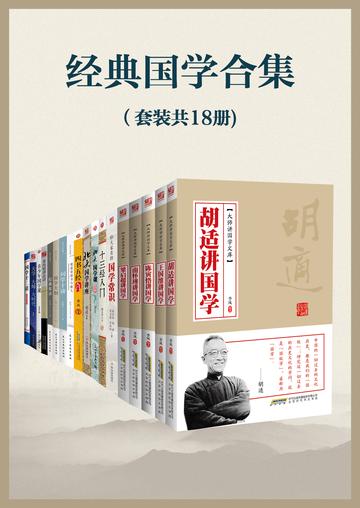
This collection covers various fields of ancient Chinese classics, including philosophy, literature, history, poetry, art of war, etc. The content is rich and diverse and has high academic and cultural value. "Mencius", "Book of Songs", "Chu Ci", "Historical Records", "Zuo Zhuan", etc. These works represent the essence of ancient Chinese wisdom and culture and are of great significance to understanding Chinese traditional culture, ways of thinking and values. These classic works not only have academic value, but also have a positive impact on personal cultivation and outlook on life.
Chinese culture has a long history, is extensive and profound, and is worth learning. Sinology is the rich tradition and cultural treasure of our Chinese nation. Inheriting it to the country is conducive to improving the quality of national culture, allowing people to share the essence of traditional Chinese culture and improve their realm. My favorite part of this book is the part where Liang Qichao talks about Chinese studies. I believe there is no one who doesn't know about Liang Qichao's Young China Theory. "Even though there is an eternity, there are eight wastelands. The future is like the sea, and the future is long. How beautiful my young China is, and I am not old with the sky! How strong my Chinese youth is, and my country has no borders!" As I get older, my eyes will get wet when I read this kind of words. The great thoughts and brilliance of our ancestors are recorded in the Chinese classics, and they should be studied carefully.
This book extracts the essence of Chinese studies. Mr. Zhu Ziqing advocated: "As a citizen with considerable education, he at least has the obligation to get in touch with the classics of his country." This is one of the motivations for me to read books. The book includes Chinese classics, Buddhism, Confucianism, art, etc. It has selected classic works by masters of Chinese studies such as Hu Shi, Nan Huaijin, and Wang Guowei. It is a relatively comprehensive history book, and it is all written by famous figures, helping readers easily appreciate the beauty of Chinese studies. Read classics to inherit the national book style, appreciate beautiful articles and appreciate the charm of wise men's books. It may be a bit obscure, but worth reading again and again.
Since Wang Guowei in the Qing Dynasty, our intellectuals have finally begun to consciously systematize knowledge and begin to sort out and summarize our philosophy and ethics. Among the vast Chinese classics, whether they are classics like the Four Books and Five Classics or reflections and compilations like the Ming and Qing Dynasties, they all need to be properly preserved, interpreted and publicized by future generations. The important thing is that we should internalize it as part of education. As Zhu Ziqing said, no matter how new the form of education is, the classics cannot be lost.
This book contains all knowledge about Chinese studies, classics, Buddhism and Confucian thought and art, etc. The masters of Chinese studies, Hu Shi, Wang Guowei and others, introduce us to some insights about Chinese studies. Starting from the thoughts of the masters of Chinese studies, we can better understand the charm of Chinese studies, grasp the essence of Chinese studies, and experience the true classic culture. There will be notes at the bottom of each page, so that we can better understand the true meaning behind Chinese studies, and it will benefit us even more.
The book says: "For the majority of young people, understanding and familiarizing themselves with Chinese studies has a very positive and practical significance for increasing their knowledge, broadening their thinking, clarifying things, improving their quality, inheriting culture, and enhancing their national self-confidence. For the education of young people, the book contains twelve chapters, including the chapter on moral integrity, respect, integrity, and humility. It writes about the educational significance of Chinese classics for young people. It is recommended that parents lead their children to read this set of books together, which is very helpful for children to cultivate their moral character and conduct themselves.