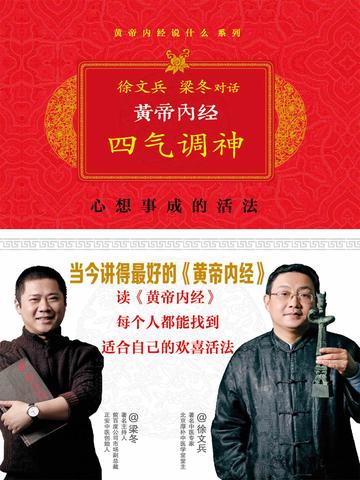
"Four Qi Adjusting the Spirit" is the second chapter in the "Huangdi Neijing·Su Wen". This is a classic life science book that teaches us how to adjust our diet, life, and work according to the climate changes throughout the year, so that our body can absorb the positive energy from various environments better and faster, and thus live a strong and self-sufficient life. Rather than saying it is a wonderful analysis of a great Chinese classic, it is better to say that it is a human revelation about happiness. In fact, it is an instruction manual for the best way to live in life. Everyone who reads it will be hooked and warm-hearted.
Reader comments
"The Yellow Emperor's Internal Classic" is a very important medical classic in ancient China. It has a total of 81 chapters, divided into two parts: Suwen and Lingshu, as well as appendixes such as Waizhuan and Taisu. The "Nei Jing" is based on the theory of traditional Chinese medicine and provides a comprehensive summary of the medical experience of ancient Chinese people based on the Yin-Yang theory and the Five Elements theory. Among them, "Four Qi Adjusting the Spirit" is a part of the "Nei Jing", which talks about how people adjust their diet, work and rest and social interactions according to the changes of the four seasons, which is of great help to contemporary people's health preservation.
Anyone who knows about ancient Chinese books must have heard of the name Huangdi Neijing. However, the obscurity and incomprehensibility of the content in this book is also one of the reasons why it is out of the circle. If we really want to fully understand the views expressed by the Huangdi Neijing and combine the medical knowledge in it with contemporary medical knowledge, we must not leave the annotations. This book solves this trouble for us very well. While including the original text, many annotations are also included in the book, making it easier and faster for us to understand. If you want to have a deep understanding of the Huangdi Neijing, this book is your best choice.
This book explains the contents of the Huangdi Neijing very thoroughly, and combines it with many life examples to make it easy to understand. The author's writing style is very humorous, just like chatting with friends, making people feel very friendly. I think this book is not only suitable for people who are interested in traditional Chinese medicine, but also for people who want to learn about health preservation. All in all, worth reading!
The Four Qi Regulating the Spirit is the second chapter of the Yellow Emperor's Internal Classic. The key idea is to nourish yang in spring and summer and nourish yin in autumn and winter. We can use the different seasonal characteristics of spring, summer, autumn and winter to help ourselves maintain better health and maintain better seasonal characteristics. In addition, the book also introduces the basic concepts and theoretical systems in traditional Chinese medicine theory, including yin and yang, the five elements, meridians, etc., Allowing readers to have an overall understanding of traditional Chinese medicine. The book also provides some practical health-preserving methods, including dietary conditioning, massage, exercise, etc., To help readers maintain physical and mental health in daily life. Studying this book can help us better understand the application of traditional Chinese medicine.
"The Yellow Emperor's Internal Classic" is a very important medical classic in ancient China. It has a total of 81 chapters, divided into two parts: Suwen and Lingshu, as well as appendixes such as Waizhuan and Taisu. The "Nei Jing" is based on the theory of traditional Chinese medicine and provides a comprehensive summary of the medical experience of ancient Chinese people based on the Yin-Yang theory and the Five Elements theory. Among them, "Four Qi Adjusting the Spirit" is a part of the "Nei Jing", which talks about how people adjust their diet, work and rest and social interactions according to the changes of the four seasons, which is of great help to contemporary people's health preservation.
Anyone who knows about ancient Chinese books must have heard of the name Huangdi Neijing. However, the obscurity and incomprehensibility of the content in this book is also one of the reasons why it is out of the circle. If we really want to fully understand the views expressed by the Huangdi Neijing and combine the medical knowledge in it with contemporary medical knowledge, we must not leave the annotations. This book solves this trouble for us very well. While including the original text, many annotations are also included in the book, making it easier and faster for us to understand. If you want to have a deep understanding of the Huangdi Neijing, this book is your best choice.
This book explains the contents of the Huangdi Neijing very thoroughly, and combines it with many life examples to make it easy to understand. The author's writing style is very humorous, just like chatting with friends, making people feel very friendly. I think this book is not only suitable for people who are interested in traditional Chinese medicine, but also for people who want to learn about health preservation. All in all, worth reading!
The Four Qi Regulating the Spirit is the second chapter of the Yellow Emperor's Internal Classic. The key idea is to nourish yang in spring and summer and nourish yin in autumn and winter. We can use the different seasonal characteristics of spring, summer, autumn and winter to help ourselves maintain better health and maintain better seasonal characteristics. In addition, the book also introduces the basic concepts and theoretical systems in traditional Chinese medicine theory, including yin and yang, the five elements, meridians, etc., Allowing readers to have an overall understanding of traditional Chinese medicine. The book also provides some practical health-preserving methods, including dietary conditioning, massage, exercise, etc., To help readers maintain physical and mental health in daily life. Studying this book can help us better understand the application of traditional Chinese medicine.
This is so wonderful
What is the first word of tomato scrambled eggs?