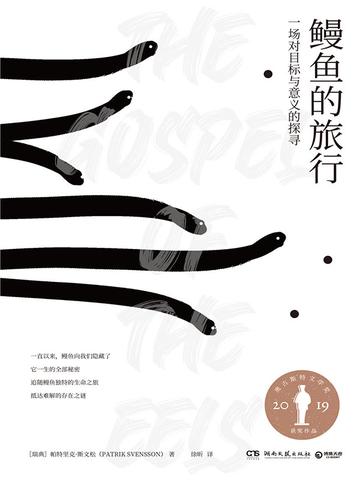
Eels are one of nature's strangest creatures. To this day, we still know very little about it.
European eels are born in the Sargasso Sea, an ocean with hard-to-define boundaries, and then travel to the coast of Europe, where they swim into rivers and streams to live. After living peacefully for decades, when the biological clock rings, it will complete its last transformation and embark on a long journey back to its birthplace, where it will reproduce and die. If it cannot start its journey, it seems to wait for eternity and never change.
For more than two thousand years, eels have remained a mystery. Aristotle was convinced that it had no gender, and Freud was repeatedly frustrated in his attempts to find its genitals. No one has ever seen eels mating.
The mysterious eel fascinates Patrick. Just as elusive as the eel is the complex and subtle relationship between him and his father. He explores the fields of literature, art, religion and the history of science, while reminiscing about his childhood days spent fishing for eels with his father. The eel's unknowability, its clumsy and romantic life journey, are like metaphors, triggering our thinking and understanding of survival and death, purpose and meaning.
Reader comments
The author's writing style is very unique and the writing style is very beautiful. It made me feel as if I was traveling with the eels. I like the story about eels and the author and his father in the book, they are very touching. Moreover, I also learned a lot about eels!
With 18 independent chapters, it weaves an exploration of life, memory and destination. The odd-numbered chapters reveal the scientific mystery of the eel—the long journey from the deep sea where it was born to the freshwater river. The sharp changes and waiting are metaphors for questioning the essence of life; the even-numbered chapters flow with the warm memories of the author Svensson and his father. Those silent companionships connect time like a migratory route. The mysterious biological characteristics of the eel have become a mirror image of the ultimate proposition of mankind: the pursuit of the origin of the self is always rising and falling in the fog of "who am I".
Memories are given a double metaphor here: both as neural pathways connecting the past and present, and as a labyrinth of reconstructed memories. When the author fishes out fragments of fishing with his father, the deceptiveness of memory quietly emerges—we tend to fish only those fragments that match our current emotional expectations, just like eel researchers who have filled the cognitive gap with different theories for thousands of years. The father figure and the eel legend finally merge in the text, and tradition and science, disappearance and eternity are reconciled. This narrative experiment spanning biology and literature ultimately transforms the migration of species into a poetic gaze on the return journey of life.
The mystery of the eel becomes an echo of the question in everyone's mind: Who am I? Where do I come from? Where am I going?
Because memory can be deceptive, it filters and chooses what to save. When we search our memory for a past scene, we are never sure whether we remember the most important or relevant content, but we remember what we expected.
When they decide they want to find the answer to something that piques their curiosity, they keep pushing forward and never give up until they finally find it. No matter how long it takes, no matter how alone they feel, no matter how hopeless the journey may be.
The world is an absurd place, full of contradictions and existential confusion. But only those with purpose may find meaning. We must imagine that the eels are lucky.
Faith is to get close to the mystery, to get close to things that cannot be described in words and cannot be understood. Faith requires you to give up part of your logic and reason.
We can see from this that time is an untrustworthy partner. No matter how long each second seems, life will end in the blink of an eye: we are born with our own origins and inheritance, and we try our best to escape this predetermined fate; maybe we succeed, but we will soon find that we must go all the way back to where we came from; if we cannot get there, we can never truly complete ourselves.
We know very little about life. We also know very little about death.
Life shows different forms in different bodies and different ideologies in different consciousnesses. However, no matter which form life takes, it will eventually lead to death.
How is the journey of an eel different from the journey of life? Go against the current, in order to go home, go against the current, go against the current in order to survive, go against the current in order to continue, and eventually die.
Life changes, this is the first law of evolution. Life is also perishable, this is the first law of life itself.
Is the final form of life death? What is death? Is the heart stopping in a cognitive sense? Does the brain stop thinking? Is life stopping breathing? Which state is called death?
Perhaps there are mental states in humans that are unknown to us, and as long as no one can tell us about them from the afterlife, we will never fully understand them. These mental states may be completely independent of the things we usually measure life by—heartbeats and breathing—and completely independent of time itself.
Until now, I have never had close contact with death. I have never seen a person die, nor have I seen with my own eyes what a person looks like when he stops breathing. But in the deepest part of my consciousness, I always feel that I experienced death when I was very young (I don't know whose death it was about). When I was young and still lived in a thatched house, I was always afraid of the small window on the back gable wall at night. It was so dark that it was like an abyss in the deepest part of the soul. A kind of cry would come from there in the dead of night. I vaguely felt that it was a cry about death, a desperate sob of separation, extinction and destruction. Although I was not old enough to store memories at that time, I seemed to be able to hear and feel the distant cry for death.
I think that is the memory of the past life that the young soul has not forgotten! As time goes by, slowly, we forget that the starting point of life may actually be death.
In fact, the main purpose of this book is to allow humans to understand our current situation and the sins we humans have committed through the behavior of eels and their past and present lives. Even if we are aloof, even if we claim to be the masters of all things, even if we look down on everything in the world arrogantly, in the end we and the eels may end up with the same outcome. We humans have pushed each species into the abyss of extinction, and it will be us humans who will eventually go to this abyss. Everything is but dust to dust, eels to eels, and humans to humans.
This book has a tender side and a cruel side. The relationship between father and son is warm and long-lasting. The eel journey is cruel and decisive.
The writing form of this book is very similar to "Zen and the Art of Motorcycle Maintenance". One section describes the relationship between father and son and the journey of life, while the other section is interspersed with the understanding of philosophy and the exploration of survival and death. This book is better understood and better described. Although the description seems simple, it is more thought-provoking and enlightening.
An interesting and meaningful masterpiece. The complexity and mystery of the eel problem are a concrete manifestation of various issues related to life.
The author's writing style is very unique and the writing style is very beautiful. It made me feel as if I was traveling with the eels. I like the story about eels and the author and his father in the book, they are very touching. Moreover, I also learned a lot about eels!
With 18 independent chapters, it weaves an exploration of life, memory and destination. The odd-numbered chapters reveal the scientific mystery of the eel—the long journey from the deep sea where it was born to the freshwater river. The sharp changes and waiting are metaphors for questioning the essence of life; the even-numbered chapters flow with the warm memories of the author Svensson and his father. Those silent companionships connect time like a migratory route. The mysterious biological characteristics of the eel have become a mirror image of the ultimate proposition of mankind: the pursuit of the origin of the self is always rising and falling in the fog of "who am I". Memories are given a double metaphor here: both as neural pathways connecting the past and present, and as a labyrinth of reconstructed memories. When the author fishes out fragments of fishing with his father, the deceptiveness of memory quietly emerges—we tend to fish only those fragments that match our current emotional expectations, just like eel researchers who have filled the cognitive gap with different theories for thousands of years. The father figure and the eel legend finally merge in the text, and tradition and science, disappearance and eternity are reconciled. This narrative experiment spanning biology and literature ultimately transforms the migration of species into a poetic gaze on the return journey of life. The mystery of the eel becomes an echo of the question in everyone's mind: Who am I? Where do I come from? Where am I going? Because memory can be deceptive, it filters and chooses what to save. When we search our memory for a past scene, we are never sure whether we remember the most important or relevant content, but we remember what we expected. When they decide they want to find the answer to something that piques their curiosity, they keep pushing forward and never give up until they finally find it. No matter how long it takes, no matter how alone they feel, no matter how hopeless the journey may be. The world is an absurd place, full of contradictions and existential confusion. But only those with purpose may find meaning. We must imagine that the eels are lucky. Faith is to get close to the mystery, to get close to things that cannot be described in words and cannot be understood. Faith requires you to give up part of your logic and reason. We can see from this that time is an untrustworthy partner. No matter how long each second seems, life will end in the blink of an eye: we are born with our own origins and inheritance, and we try our best to escape this predetermined fate; maybe we succeed, but we will soon find that we must go all the way back to where we came from; if we cannot get there, we can never truly complete ourselves.
We know very little about life. We also know very little about death. Life shows different forms in different bodies and different ideologies in different consciousnesses. However, no matter which form life takes, it will eventually lead to death. How is the journey of an eel different from the journey of life? Go against the current, in order to go home, go against the current, go against the current in order to survive, go against the current in order to continue, and eventually die. Life changes, this is the first law of evolution. Life is also perishable, this is the first law of life itself. Is the final form of life death? What is death? Is the heart stopping in a cognitive sense? Does the brain stop thinking? Is life stopping breathing? Which state is called death? Perhaps there are mental states in humans that are unknown to us, and as long as no one can tell us about them from the afterlife, we will never fully understand them. These mental states may be completely independent of the things we usually measure life by—heartbeats and breathing—and completely independent of time itself. Until now, I have never had close contact with death. I have never seen a person die, nor have I seen with my own eyes what a person looks like when he stops breathing. But in the deepest part of my consciousness, I always feel that I experienced death when I was very young (I don't know whose death it was about). When I was young and still lived in a thatched house, I was always afraid of the small window on the back gable wall at night. It was so dark that it was like an abyss in the deepest part of the soul. A kind of cry would come from there in the dead of night. I vaguely felt that it was a cry about death, a desperate sob of separation, extinction and destruction. Although I was not old enough to store memories at that time, I seemed to be able to hear and feel the distant cry for death. I think that is the memory of the past life that the young soul has not forgotten! As time goes by, slowly, we forget that the starting point of life may actually be death. In fact, the main purpose of this book is to allow humans to understand our current situation and the sins we humans have committed through the behavior of eels and their past and present lives. Even if we are aloof, even if we claim to be the masters of all things, even if we look down on everything in the world arrogantly, in the end we and the eels may end up with the same outcome. We humans have pushed each species into the abyss of extinction, and it will be us humans who will eventually go to this abyss. Everything is but dust to dust, eels to eels, and humans to humans. This book has a tender side and a cruel side. The relationship between father and son is warm and long-lasting. The eel journey is cruel and decisive. The writing form of this book is very similar to "Zen and the Art of Motorcycle Maintenance". One section describes the relationship between father and son and the journey of life, while the other section is interspersed with the understanding of philosophy and the exploration of survival and death. This book is better understood and better described. Although the description seems simple, it is more thought-provoking and enlightening.
An interesting and meaningful masterpiece. The complexity and mystery of the eel problem are a concrete manifestation of various issues related to life.
A poetic popular science book about eels