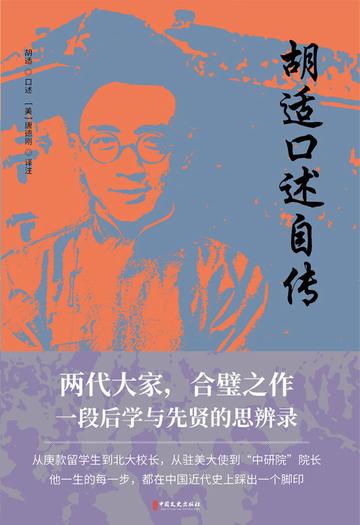
This book is compiled based on sixteen English oral recordings made by Hu Shi at the invitation of the Department of Chinese Oral History at Columbia University in the United States. Tang Degang was responsible for the interview and compiled the recording into text, covering Hu Shi's life experience and his summary and evaluation of his life's academic thoughts.
Tang Degang's annotations and comments further elaborated his own views on relevant characters and events, allowing readers to understand Hu Shi and his era more clearly. Therefore, this book received high praise from overseas historians in the 1970s - "Look at De Gang first, then Hu Shi."
Reader comments
Originally, I came here for the famous "Hu Shi" in modern times. I wanted to understand what kind of person Dr. Hu was from his autobiography, but I was attracted by teacher Tang Degang's annotations! The first few chapters of the self-report are acceptable, but the latter ones are a little boring and extreme. Fortunately, the annotations are still as wonderful as ever. Teacher Tang Degang's evaluation of Hu Shi's life and deeds is still correct, without exaggerating the praise or hiding the evil. (Except for the high praise from academic circles, readers do not understand and do not understand, so we will not make any evaluation for now.) Whether it is praise, disparagement or other opinions about Hu Shi, reading this book before drawing a conclusion may change his original opinion and gain new insights.
Mr. Hu Shi is one of the most famous scholars in modern China. In his later years, he was invited to give an oral history interview to recall his past. It just so happens that Hu Shi himself respects writing autobiographies, so in this interview, he is structured and very detailed about his hometown, his father, and his growth, study, and academic process since childhood. Indeed, as he himself expected, future generations have seen the life trajectory of a cultural celebrity, which is of great help to understand his life, the origins of his thoughts and changes.
Hu Shi is an important figure in the fields of modern Chinese literature, prose and translation. His autobiography vividly records his growth experience, academic exploration, ideological changes and personal insights in the first person. This autobiography demonstrates Hu Shi's unique insights and his understanding of China's social and cultural changes. Through his narrative, readers can have a deeper understanding of the life of this outstanding figure, Hu Shi, as well as his important position and influence in modern Chinese history.
For the interpretation of a celebrity, in addition to what he said, the evaluation of future generations is also very important; just like the relationship between Tang Degang and Hu Shi, through personal communication and oral communication, the two can be said to have a deeper understanding of Hu Shi's own thoughts. As the most remarkable scholar in modern China, this book can be described as a simple and clear faithful record of his thoughts, knowledge and life. It is suitable for Chinese young people to get started with "Hu Shi", and it is also suitable for experts in modern Chinese history to understand the past that seems to have happened yesterday from this scholar's perspective.
This book is very meaningful! Hu Shi's oral autobiography, coupled with Tang Degang's annotations and comments, give us a more comprehensive understanding of Hu Shi and his era. I think it's like chatting with a friend. It's interesting to listen to Hu Shi's story about his life experience and academic thoughts, and to see Tang Degang's insights. And I found that some of the characters and events mentioned in the book also reminded me of the experiences of my relatives and friends, which I found very resonant. I think this book is not only a historical work, but also a book that makes people think about life.
Hu Shi was the main leader of our New Culture Movement. He made significant contributions to Chinese culture and also made outstanding contributions to the ideological emancipation of the Chinese people. We are very interested in the lives of these people. We always want to understand the origin and development of their thoughts and their legendary lives, so that we can better understand the world. With their explanations of the world, we can better explain our own world and learn new ideas.
Originally, I came here for the famous "Hu Shi" in modern times. I wanted to understand what kind of person Dr. Hu was from his autobiography, but I was attracted by teacher Tang Degang's annotations! The first few chapters of the self-report are acceptable, but the latter ones are a little boring and extreme. Fortunately, the annotations are still as wonderful as ever. Teacher Tang Degang's evaluation of Hu Shi's life and deeds is still correct, without exaggerating the praise or hiding the evil. (Except for the high praise from academic circles, readers do not understand and do not understand, so we will not make any evaluation for now.) Whether it is praise, disparagement or other opinions about Hu Shi, reading this book before drawing a conclusion may change his original opinion and gain new insights.
Mr. Hu Shi is one of the most famous scholars in modern China. In his later years, he was invited to give an oral history interview to recall his past. It just so happens that Hu Shi himself respects writing autobiographies, so in this interview, he is structured and very detailed about his hometown, his father, and his growth, study, and academic process since childhood. Indeed, as he himself expected, future generations have seen the life trajectory of a cultural celebrity, which is of great help to understand his life, the origins of his thoughts and changes.
Hu Shi is an important figure in the fields of modern Chinese literature, prose and translation. His autobiography vividly records his growth experience, academic exploration, ideological changes and personal insights in the first person. This autobiography demonstrates Hu Shi's unique insights and his understanding of China's social and cultural changes. Through his narrative, readers can have a deeper understanding of the life of this outstanding figure, Hu Shi, as well as his important position and influence in modern Chinese history.
For the interpretation of a celebrity, in addition to what he said, the evaluation of future generations is also very important; just like the relationship between Tang Degang and Hu Shi, through personal communication and oral communication, the two can be said to have a deeper understanding of Hu Shi's own thoughts. As the most remarkable scholar in modern China, this book can be described as a simple and clear faithful record of his thoughts, knowledge and life. It is suitable for Chinese young people to get started with "Hu Shi", and it is also suitable for experts in modern Chinese history to understand the past that seems to have happened yesterday from this scholar's perspective.
This book is very meaningful! Hu Shi's oral autobiography, coupled with Tang Degang's annotations and comments, give us a more comprehensive understanding of Hu Shi and his era. I think it's like chatting with a friend. It's interesting to listen to Hu Shi's story about his life experience and academic thoughts, and to see Tang Degang's insights. And I found that some of the characters and events mentioned in the book also reminded me of the experiences of my relatives and friends, which I found very resonant. I think this book is not only a historical work, but also a book that makes people think about life.
Hu Shi was the main leader of our New Culture Movement. He made significant contributions to Chinese culture and also made outstanding contributions to the ideological emancipation of the Chinese people. We are very interested in the lives of these people. We always want to understand the origin and development of their thoughts and their legendary lives, so that we can better understand the world. With their explanations of the world, we can better explain our own world and learn new ideas.