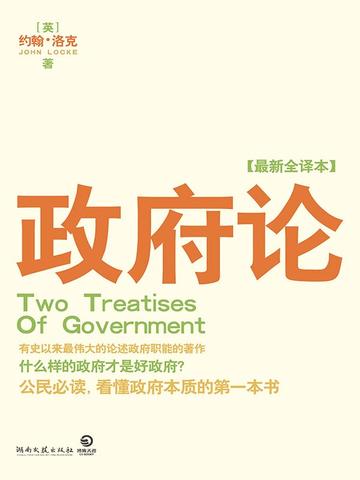
A must-read for citizens, the first book to understand the nature of government. Recognized as the greatest work on the functions of government in history, it asks what kind of government is a good government? It is very important for China to understand the logic of democratic government!
Reader comments
This is a book that attempts to set chains for all mankind. Locke's theory that people are not born free but are subject to greater rights can be said to be an innovative inheritance of Hobbes's war of all against all. It is also a speculative development of Rousseau's people who are born free; they are everywhere under the yoke of rulers; the author then discusses the origins of patriarchy and sovereignty, and quotes scriptures, first supplementing his theory with historical evidence, and then adding discussions on the origins of property, freedom, and government; it is a masterpiece of the Enlightenment era.
Do you still dare to write foreign books?
During the Opium War, Britain, which came from afar, defeated Manchu China, the great power in the east, and signed the unequal "Treaty of Nanjing" with the Manchu rulers. The once powerful China began its modern history of humiliation.
Perhaps we may ask why China was easily bullied by Britain, what caused China to lag behind the world, and why a small island country far away on the west coast of Europe quickly rose to become a world power. In the past, I thought it should be the "closed door" policy of the Qing Dynasty, or the British Industrial Revolution. However, after reading Locke's "Treatise of Government", I found the answer - thought. The rule of the Qing Dynasty was a huge setback in thought and in Chinese history, and China turned to decline. On the other hand, in Britain and Europe as a whole during the same period, the intellectual world was very prosperous, and "Treatise of Government" was a masterpiece.
The background of "Treatise of Government" is the British bourgeois revolution, but I think the book itself is a revolution. Revolution is about overthrowing an old and irrational world, and then building a new and better world. In the first part of "Treatise of Government", Locke's work was to overthrow the old and irrational world. He criticized the old world's "divine right of kings and hereditary throne" argument without mercy. In the second part, Locke put forward many constructive views. These views are still timeless to this day and are worthy of our study, thinking and research.
In the previous article, Locke pointed the finger directly at Robert Filmer and launched a sharp criticism of his "The Patriarchs". "The Patriarchs" is a book that debates the power of kings. It upholds the authority of the monarch and says that this power is given by God, so no one is born free. God gave Adam kingship, and this kingship was inherited from Adam on. In that era, Locke dared to directly express his dissatisfaction. The first sentence of the article was "Slavery is an abominable and miserable state of mankind." In the article, he relentlessly satirized "The Ancestors" and implicitly criticized a group of people represented by Filmay, who were full of a sense of justice. Locke's temperament is contained in the entire book, and you will be deeply affected every time you read it.
In the second part of "Treatise of Government", Locke proposed a solution to this kind of thinking, which gave great inspiration to later generations and promoted the progress of thought on a macro level.
In Locke's eyes, the state of nature is a state of equality, freedom, and property, and natural law governs the state of nature. It's like what we call "primitive society", where there is no class, no exploitation, and everyone is equal.
In the book, Locke also gave many of his own opinions. Many of the advantages and disadvantages of the system are just ideal societies. Ideals are always ideals. No system in the world will be perfect, but we can at least believe in progress. Society is made up of thinking humans. If everyone can make progress in his or her thoughts through learning and thinking, then the entire society will also progress.
These are my thoughts and feelings after reading "Treatise of Government".
The author's interpretation of the nature of government is very professional and philosophical. Governments in different countries and under different systems have different functions, but there are also some commonalities among them. The book starts with slavery, and deeply discusses the relationship between slavery and freedom, and then thinks about the relationship between fatherhood and royal power. I really like the author's relevant discussion of political society in the next chapter, from the origin to the purpose of government, as well as the form of the state. I have benefited a lot from reading it.
The author John Locke is really great and his point of view is very unique. Like my uncle, he always tells me something I don't know. This book also reminded me of the class cadres in our class. They should also serve everyone like a good government. I think this book is helpful to each of us and is worth reading!
The series of activities of "losing it as soon as you learn it" has ended
It's a very good book. When reading it, grasp three points: one is Locke's natural rights, one is government based on consent, and one is religious background. It is best to have some understanding of religious tolerance and the Bible.



This is a book that attempts to set chains for all mankind. Locke's theory that people are not born free but are subject to greater rights can be said to be an innovative inheritance of Hobbes's war of all against all. It is also a speculative development of Rousseau's people who are born free; they are everywhere under the yoke of rulers; the author then discusses the origins of patriarchy and sovereignty, and quotes scriptures, first supplementing his theory with historical evidence, and then adding discussions on the origins of property, freedom, and government; it is a masterpiece of the Enlightenment era.
Do you still dare to write foreign books?
During the Opium War, Britain, which came from afar, defeated Manchu China, the great power in the east, and signed the unequal "Treaty of Nanjing" with the Manchu rulers. The once powerful China began its modern history of humiliation. Perhaps we may ask why China was easily bullied by Britain, what caused China to lag behind the world, and why a small island country far away on the west coast of Europe quickly rose to become a world power. In the past, I thought it should be the "closed door" policy of the Qing Dynasty, or the British Industrial Revolution. However, after reading Locke's "Treatise of Government", I found the answer - thought. The rule of the Qing Dynasty was a huge setback in thought and in Chinese history, and China turned to decline. On the other hand, in Britain and Europe as a whole during the same period, the intellectual world was very prosperous, and "Treatise of Government" was a masterpiece. The background of "Treatise of Government" is the British bourgeois revolution, but I think the book itself is a revolution. Revolution is about overthrowing an old and irrational world, and then building a new and better world. In the first part of "Treatise of Government", Locke's work was to overthrow the old and irrational world. He criticized the old world's "divine right of kings and hereditary throne" argument without mercy. In the second part, Locke put forward many constructive views. These views are still timeless to this day and are worthy of our study, thinking and research. In the previous article, Locke pointed the finger directly at Robert Filmer and launched a sharp criticism of his "The Patriarchs". "The Patriarchs" is a book that debates the power of kings. It upholds the authority of the monarch and says that this power is given by God, so no one is born free. God gave Adam kingship, and this kingship was inherited from Adam on. In that era, Locke dared to directly express his dissatisfaction. The first sentence of the article was "Slavery is an abominable and miserable state of mankind." In the article, he relentlessly satirized "The Ancestors" and implicitly criticized a group of people represented by Filmay, who were full of a sense of justice. Locke's temperament is contained in the entire book, and you will be deeply affected every time you read it. In the second part of "Treatise of Government", Locke proposed a solution to this kind of thinking, which gave great inspiration to later generations and promoted the progress of thought on a macro level. In Locke's eyes, the state of nature is a state of equality, freedom, and property, and natural law governs the state of nature. It's like what we call "primitive society", where there is no class, no exploitation, and everyone is equal. In the book, Locke also gave many of his own opinions. Many of the advantages and disadvantages of the system are just ideal societies. Ideals are always ideals. No system in the world will be perfect, but we can at least believe in progress. Society is made up of thinking humans. If everyone can make progress in his or her thoughts through learning and thinking, then the entire society will also progress. These are my thoughts and feelings after reading "Treatise of Government".
The author's interpretation of the nature of government is very professional and philosophical. Governments in different countries and under different systems have different functions, but there are also some commonalities among them. The book starts with slavery, and deeply discusses the relationship between slavery and freedom, and then thinks about the relationship between fatherhood and royal power. I really like the author's relevant discussion of political society in the next chapter, from the origin to the purpose of government, as well as the form of the state. I have benefited a lot from reading it.
The author John Locke is really great and his point of view is very unique. Like my uncle, he always tells me something I don't know. This book also reminded me of the class cadres in our class. They should also serve everyone like a good government. I think this book is helpful to each of us and is worth reading!
The series of activities of "losing it as soon as you learn it" has ended
It's a very good book. When reading it, grasp three points: one is Locke's natural rights, one is government based on consent, and one is religious background. It is best to have some understanding of religious tolerance and the Bible.