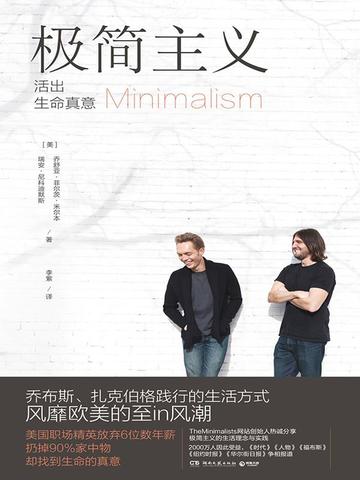
Minimalism does not mean that you have nothing, but that you travel through the ocean of matter to find what is truly important. In the book "Minimalism", Joshua and Ryan, who gave up their high-paying executive jobs and became pioneers of minimalist life in the United States, share their own life stories and minimalist life philosophy. By letting go of the excess in life, we can transcend material things and focus on the five most important values in life: health, relationships, passion, growth, and devotion. The book also contains a wealth of specific practical methods to help readers quickly live a minimalist life.
Minimalism starts with giving up, but ends with a more meaningful life.
Reader comments
I picked up this book today because books advocating a simple life have been popular in society in recent years. For example, "Breaking Away", "Subtraction", and a large number of such books all advocate the idea of minimalist living. Not long ago, even the People's Daily was advocating a minimalist lifestyle. I thought about believers of many religions who have another extremely simple lifestyle. Some media disclosed a group of people who escaped to the mountains and practiced Taoism on their own. I also explored and learned about their little-known living conditions - they are unkempt every day, and their food and clothing are far from enough. Plenty and balance, life is almost the most primitive way. He builds a few bricks and adds an earthen pot, collects firewood from everywhere to light a fire, cooks meals every day with very little oil and salt, grows his own grain and vegetables, is self-sufficient, and occasionally walks dozens of miles to the town market to exchange for daily necessities. There is no way to discuss the same phenomenon from a static perspective and a developmental perspective. Because their premises are different. Yes, this is a different issue underlying the phenomenon.
Minimalism isn't all bad;
but across the ocean of matter;
Find what really matters;
Make life more meaningful.
Minimalist Life
We often equate having more material things with happiness.
But in reality, happiness comes from our relationships with others, personal growth, and zest for life, not mountains of stuff.
The more stuff we have, the harder it is to focus on what's important.
The accumulation of material things only complicates our lives, and what we really need is often much less than what we have.
By getting rid of unnecessary material burdens, you can make space in your life.
The quality of life does not depend on how much stuff we have, but on how we spend our time;
Pursue the things that truly make us feel fulfilled and happy, like learning new skills, hobbies, and how we interact with the world around us.
[Three core questions]
1. Does minimalism mean giving up everything?
: Minimalism does not mean giving up completely. It only requires retaining items that have real value and meaning to life, and removing those excessive and non-essential materials. For example, when sorting clothes, donate or discard clothes that have not been worn for many years and have no commemorative significance, so as to reduce the number of clothes and the trouble of sorting.
2. How to be minimalist in interpersonal relationships?
: Focus on the people who really matter, rather than broad social interactions. For example, reduce participation in some gatherings that are just for entertainment, and maintain communication with a few close friends to make interpersonal relationships simpler.
3. How to practice minimalism in a consumer society?
: You need to exercise restraint and buy what you really need: before shopping, think about whether you need it yourself or whether the outside world makes you need it. However, this is not an easy task. The consumer culture is prevalent in modern society. Advertising and other advertisements constantly stimulate consumer desires. Promotional activities during various shopping festivals make people prone to impulsive consumption.
Summary
Minimalism brings not a sense of deprivation, but a sense of control.
We begin to actively decide "what is and is not in life" instead of being pushed by material, time, and information.
Minimalist life does not become barren, but becomes clearer.
We know what we want, we are not consumed by trivial matters, and we can enjoy simple but high-quality daily life more calmly.
From time to time, you need to read some minimalism-related books to remind yourself. I was particularly impressed by the view on work: "Success = happiness + growth + contribution. I hope this job will make me feel happy, encourage me to grow, and help me surpass my own work. Create more and consume less. Work is not the problem, but how to work is. When work becomes the mission of life, you don't have to balance work and life. Evaluate everything in your life, relationships, family, salary, career, your concept of success, your vision of life, everything."
This book is called "Minimalism", but it doesn't tell you how to be frugal, how to be simple, how to make your life simpler and simpler. On the contrary, it teaches you how to add, not for life, but for yourself. To be precise, it is for your own spirit, teaching you how to enrich your spiritual world without being swayed by external factors such as temptation and money, etc., And truly achieve minimalism from the inside out. Reading it gives people a feeling of reconciliation with themselves and healing of the soul.
This book explores the minimalist lifestyle, sharing many tips for reducing stuff, stress, and anxiety. I've found that applying some of these tips has really changed my life.
1. Clear space. The author advocates classifying items into necessities, useful items, and unused items, and donating or throwing away unused items. I tried to tidy up my home over the weekend and got rid of a lot of unnecessary items. The freshness in the air and the spaciousness of my home made me feel relaxed and happy.
2. Reduce shopping. Try to avoid buying unnecessary items, which not only saves you money but also reduces the items to manage. I try to buy less clothes and shoes, I'm no longer addicted to shopping, and I no longer suffer from the headache of the junk in my house.
3. Minimalist thinking at work. Apply minimalist thinking to your work to focus more on what matters. I tried to reduce the number of tasks I had to perform per day to less than three, and gained more stress-free free time.
Overall, this book provides us with an important need: to slow down and enjoy life, and reduce the overwhelming burden of objects and information.
It helps us focus on what matters most.
Recommendation: If you have time, read this book to learn more about minimalism.
A good book, worth reading more, reflecting on and learning from. To be sure, it will be beneficial to every reader. I very much agree with the views in the book:
①Happiness comes from within, from the heart, and from a life full of meaning.
②Health, relationships, passion, growth and dedication. These five values are the basis for living a meaningful life... The five values are equally important. Rather, the importance of each value changes over time for each of us.
③We are not our property itself. Our value is not limited to the possessions we own.
④Minimalism helps us in the following points: 1. Get our time back. 2. Let's get rid of the excess. 3. Enjoy our life. 4. Explore the meaning of our lives. 5. Live in the moment. 6. Focus on what's important. 7. Pursue our passions. 8. Find happiness. 9. Do whatever we want. 10. Find your calling. 11. Experience freedom. 12. Create more and consume less.
⑤ "Simple Success Equation": Success = happiness + continuous progress.
Haha, it's just that if it is used in materials, it will definitely affect the development of social economy. Therefore, in order to contribute to the social economy, moderate consumption is still necessary.
I resonated with the stories of authors who gave up material pursuits and found a more meaningful life. I am also thinking about how to give my children more quality companionship as they grow up, instead of being burdened by material things. The practical methods in the book are very practical and I have already started trying them! I have benefited a lot from the author's experience and wisdom, and recommend it to everyone!
Combining the author's own experience and thinking, it explores the origin of our true happiness.
To be honest, I feel that money is not directly proportional to happiness. The older I get, the more I lose the ability to be happy.
With an annual salary of 300,000 yuan, I am no happier than I was during my poor days in elementary school and junior high school.
It's really worth reading carefully.
Great life coaching
There are some small ideas that can indeed guide practical life. Useful.
It's worth learning from and makes people start to think, at least, we shouldn't get value by constantly buying, right?
I picked up this book today because books advocating a simple life have been popular in society in recent years. For example, "Breaking Away", "Subtraction", and a large number of such books all advocate the idea of minimalist living. Not long ago, even the People's Daily was advocating a minimalist lifestyle. I thought about believers of many religions who have another extremely simple lifestyle. Some media disclosed a group of people who escaped to the mountains and practiced Taoism on their own. I also explored and learned about their little-known living conditions - they are unkempt every day, and their food and clothing are far from enough. Plenty and balance, life is almost the most primitive way. He builds a few bricks and adds an earthen pot, collects firewood from everywhere to light a fire, cooks meals every day with very little oil and salt, grows his own grain and vegetables, is self-sufficient, and occasionally walks dozens of miles to the town market to exchange for daily necessities. There is no way to discuss the same phenomenon from a static perspective and a developmental perspective. Because their premises are different. Yes, this is a different issue underlying the phenomenon.
Minimalism isn't all bad; but across the ocean of matter; Find what really matters; Make life more meaningful. Minimalist Life We often equate having more material things with happiness. But in reality, happiness comes from our relationships with others, personal growth, and zest for life, not mountains of stuff. The more stuff we have, the harder it is to focus on what's important. The accumulation of material things only complicates our lives, and what we really need is often much less than what we have. By getting rid of unnecessary material burdens, you can make space in your life. The quality of life does not depend on how much stuff we have, but on how we spend our time; Pursue the things that truly make us feel fulfilled and happy, like learning new skills, hobbies, and how we interact with the world around us. [Three core questions] 1. Does minimalism mean giving up everything? : Minimalism does not mean giving up completely. It only requires retaining items that have real value and meaning to life, and removing those excessive and non-essential materials. For example, when sorting clothes, donate or discard clothes that have not been worn for many years and have no commemorative significance, so as to reduce the number of clothes and the trouble of sorting. 2. How to be minimalist in interpersonal relationships? : Focus on the people who really matter, rather than broad social interactions. For example, reduce participation in some gatherings that are just for entertainment, and maintain communication with a few close friends to make interpersonal relationships simpler. 3. How to practice minimalism in a consumer society? : You need to exercise restraint and buy what you really need: before shopping, think about whether you need it yourself or whether the outside world makes you need it. However, this is not an easy task. The consumer culture is prevalent in modern society. Advertising and other advertisements constantly stimulate consumer desires. Promotional activities during various shopping festivals make people prone to impulsive consumption. Summary Minimalism brings not a sense of deprivation, but a sense of control. We begin to actively decide "what is and is not in life" instead of being pushed by material, time, and information. Minimalist life does not become barren, but becomes clearer. We know what we want, we are not consumed by trivial matters, and we can enjoy simple but high-quality daily life more calmly.
From time to time, you need to read some minimalism-related books to remind yourself. I was particularly impressed by the view on work: "Success = happiness + growth + contribution. I hope this job will make me feel happy, encourage me to grow, and help me surpass my own work. Create more and consume less. Work is not the problem, but how to work is. When work becomes the mission of life, you don't have to balance work and life. Evaluate everything in your life, relationships, family, salary, career, your concept of success, your vision of life, everything."
This book is called "Minimalism", but it doesn't tell you how to be frugal, how to be simple, how to make your life simpler and simpler. On the contrary, it teaches you how to add, not for life, but for yourself. To be precise, it is for your own spirit, teaching you how to enrich your spiritual world without being swayed by external factors such as temptation and money, etc., And truly achieve minimalism from the inside out. Reading it gives people a feeling of reconciliation with themselves and healing of the soul.
This book explores the minimalist lifestyle, sharing many tips for reducing stuff, stress, and anxiety. I've found that applying some of these tips has really changed my life. 1. Clear space. The author advocates classifying items into necessities, useful items, and unused items, and donating or throwing away unused items. I tried to tidy up my home over the weekend and got rid of a lot of unnecessary items. The freshness in the air and the spaciousness of my home made me feel relaxed and happy. 2. Reduce shopping. Try to avoid buying unnecessary items, which not only saves you money but also reduces the items to manage. I try to buy less clothes and shoes, I'm no longer addicted to shopping, and I no longer suffer from the headache of the junk in my house. 3. Minimalist thinking at work. Apply minimalist thinking to your work to focus more on what matters. I tried to reduce the number of tasks I had to perform per day to less than three, and gained more stress-free free time. Overall, this book provides us with an important need: to slow down and enjoy life, and reduce the overwhelming burden of objects and information. It helps us focus on what matters most. Recommendation: If you have time, read this book to learn more about minimalism.
A good book, worth reading more, reflecting on and learning from. To be sure, it will be beneficial to every reader. I very much agree with the views in the book: ①Happiness comes from within, from the heart, and from a life full of meaning. ②Health, relationships, passion, growth and dedication. These five values are the basis for living a meaningful life... The five values are equally important. Rather, the importance of each value changes over time for each of us. ③We are not our property itself. Our value is not limited to the possessions we own. ④Minimalism helps us in the following points: 1. Get our time back. 2. Let's get rid of the excess. 3. Enjoy our life. 4. Explore the meaning of our lives. 5. Live in the moment. 6. Focus on what's important. 7. Pursue our passions. 8. Find happiness. 9. Do whatever we want. 10. Find your calling. 11. Experience freedom. 12. Create more and consume less. ⑤ "Simple Success Equation": Success = happiness + continuous progress. Haha, it's just that if it is used in materials, it will definitely affect the development of social economy. Therefore, in order to contribute to the social economy, moderate consumption is still necessary.
I resonated with the stories of authors who gave up material pursuits and found a more meaningful life. I am also thinking about how to give my children more quality companionship as they grow up, instead of being burdened by material things. The practical methods in the book are very practical and I have already started trying them! I have benefited a lot from the author's experience and wisdom, and recommend it to everyone!
Combining the author's own experience and thinking, it explores the origin of our true happiness. To be honest, I feel that money is not directly proportional to happiness. The older I get, the more I lose the ability to be happy. With an annual salary of 300,000 yuan, I am no happier than I was during my poor days in elementary school and junior high school.
It's really worth reading carefully.
Great life coaching
There are some small ideas that can indeed guide practical life. Useful.
It's worth learning from and makes people start to think, at least, we shouldn't get value by constantly buying, right?
Very practical and fits my current situation.